
Possession Without Incision
Uruguay governed the ball but not the match. Two-thirds of possession, 611 passes completed at 88 percent accuracy, and a midfield trio — Manuel Ugarte, Rodrigo Bentancur, Federico Valverde — who operated through the center and kept the game's tempo firmly in Uruguayan hands. On that evidence alone, it reads like a controlled performance. It was not.
The problem was the final third. Uruguay took 27 shots and produced 1.5 expected goals from them — just over 0.05 per attempt. The ball moved freely in the middle of the pitch and stalled whenever it approached the box. Recycling possession is not the same as creating danger. A midfield must govern, not merely commute — and governing means deciding when to accelerate, when to commit, when to force the issue. What Uruguay's midfield produced was volume without incision.
Possession without consequence is only politeness. Saudi Arabia allowed Uruguay to be polite all afternoon, retreated behind the ball, and waited. The structural imbalance was not in who held the ball. It was in who made anything from holding it.
The Block That Made the Ball Expensive
Saudi Arabia's answer to Uruguay's possession was structural: retreat, compress, and make every yard of the final third cost something. Their defensive line sat deep in their own half. Hassan Altambakti and Nawaf Boushal anchored the defensive base barely past the edge of their own penalty area; Abdulelah Al-Amri and Moteb Al-Harbi were only marginally higher. Saud Abdulhamid held the widest position in that defensive band, still deep enough that Saudi Arabia rarely risked giving Uruguay space in behind.
The results of that posture were visible in the numbers. Saudi Arabia made 42 clearances — a figure that reflects not panic but sustained, organized repulsion. Mohammed Al-Owais made nine saves. Those are not the statistics of a team that held on by luck. They are the statistics of a team that accepted the terms of the match: you may have the ball, but you will not have the space to use it properly.
Mohamed Kanno and Saud Abdulhamid between them made seven tackles, and both spent the game positioned to intercept or clear rather than advance. That kind of commitment is easy to praise in the abstract and hard to maintain under sustained pressure. Saudi Arabia maintained it. The structural cost to Uruguay — forced into 27 low-quality attempts — was significant. The responsibility for those 27 shots producing so little belongs not only to Saudi Arabia's shape, but to whoever in Uruguay's attack was supposed to break it.
Four Corners and a Clean Strike
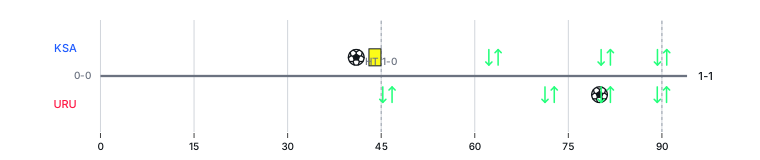
Everything Saudi Arabia had denied Uruguay in open play, they manufactured themselves in a four-minute corner sequence late in the first half. Between the 38th and 41st minutes, four shots came from corner situations in or around Uruguay's six-yard box. Al-Amri's right-foot attempt at 38 minutes was saved. His header moments later missed. Mohamed Kanno's header in the 40th minute was kept out. And then Al-Amri arrived again at the near post and converted from barely three meters out — a chance of sufficient quality that it needed very little help.
The sequence did not require Uruguay to collapse defensively or abandon their shape. It required Saudi Arabia to sustain corner pressure long enough that the box became crowded and Uruguay's defensive alignment was briefly overloaded. That is a structural condition, not a breakdown of nerve. The goal itself was the product of concentration in a small area over a short period — repeated deliveries into the same zone until one of them found a body in the right place.
What the sequence exposes is a different kind of responsibility: the obligation to clear the box under sustained set-piece pressure, not merely to attempt it once. Uruguay did not clear it cleanly. Saudi Arabia made them pay. The match had been about what Uruguay couldn't do in Saudi Arabia's half. For four minutes, Saudi Arabia showed exactly what they could do in Uruguay's.
Halftime Widened Uruguay's Lanes
Uruguay came out for the second half with a different flank structure. Matías Viña made way for Juan Sanabria, and Darwin Núñez came off for Agustín Canobbio simultaneously — both changes at the interval, both on the flanks. The effect was visible in where those replacements operated: Canobbio pushed high and wide on one side, Sanabria stretched the opposite flank. The horizontal width of Uruguay's attacking shape increased, which applied a different kind of pressure to Saudi Arabia's compact block.
This mattered. A block this deep is most comfortable when the ball arrives centrally — the defenders know where the danger is coming from and can step across to meet it. Wider occupation forces decisions, creates angles, and stretches the horizontal compactness that had kept Uruguay's central approaches blocked throughout the first half. The personnel change was a structural shift, not merely a rotation.
What it could not do, on its own, was guarantee that the quality of the chances produced would rise proportionally. The substitutions changed the lanes Uruguay occupied. Whether the ball was being played into those lanes with the right timing, weight, and decision-making is a question about technical execution that the shape alone cannot answer. Uruguay altered their approach. The underlying imbalance — the deep block, the organized Saudi clearances — remained the match's central constraint.
Synthesis
The match asked a simple question and answered it plainly. Can a team that governs possession without penetrating the final third take responsibility for the result? Uruguay could not.
Saudi Arabia accepted the terms on offer and organized accordingly. Their defensive line sat deep, their clearances were constant, and their goalkeeper was tested nine times. The structure held not through individual heroics but through collective positioning and the discipline to hold it for ninety minutes. Al-Amri's goal arrived not from sustained attacking play but from a corner cluster that Uruguay failed to survive. That is a small window of concentration, and Saudi Arabia used it with precision.
Uruguay's halftime changes widened the pitch and applied a different kind of pressure on Saudi Arabia's block. The substitutions were the right structural response to what the first half had shown. But widening lanes and improving chance quality are not the same thing — and the underlying problem, that 27 shots produced so little genuine danger, predated the personnel decisions and outlasted them.
The match rewarded the team that understood what it was being asked to do. Saudi Arabia was asked to defend compactly, limit space, survive set pieces they conceded, and take whatever chance appeared. They did all of that. Uruguay was asked to break a deep block, convert possession into danger, and prevent the kind of concentrated corner pressure that gave Saudi Arabia its lead. That responsibility was not met. The ball was there. The authority to do something with it was not.