
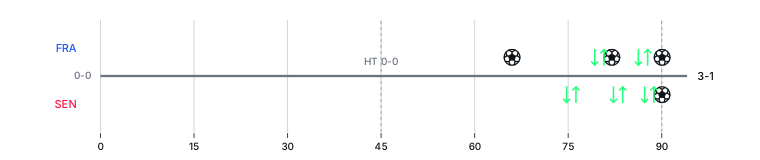
France Found the Central Lane — Eventually
The 2-1 scoreline will be read as French superiority, and that reading is lazy. France did not control this match. They controlled thirty minutes of it — roughly the 46th to the 75th — and in that window they were genuinely impressive: seven shots, 1.2 combined xG, and Senegal not registering a single attempt in response. That is a clean phase reversal, and it matters. But calling it dominance across ninety minutes is the kind of historical revision that coaches perform at press conferences.
What France built during that middle phase was central access. Michael Olise operated through the center of the attacking half and created the most dangerous chances of the first hour: a high-quality strike at 53 minutes that required a save, then the assist for Kylian Mbappé's opening goal at 66. Mbappé himself worked centrally, drawing another strong save at 57 before finishing. The two saves before the goal were not near misses — they were high-probability chances, the kind that reveal a team that has found where the space is and keeps returning to it.
Senegal offered nothing in attack from the restart through the 75th minute. Zero shots, zero xG. That is not coincidence. France had found something in their buildup shape that closed the transition routes Senegal had used so effectively in the first half. The constraint changed, and Senegal had no immediate answer to the change.
The mistake is to start the story here, in the phase France won. The first half was a different match entirely.
Senegal's First Half Was Real
Anyone who watched the first half without knowing the final score might reasonably have expected Senegal to win. They outshopped France five to one. Their combined xG for the period was more than ten times France's single blocked attempt at 19 minutes — a low-quality Dembélé effort that barely registers.
The better chances were Senegal's, and they were genuinely dangerous. Nicolas Jackson hit the post from a fast-break at 25 minutes — a left-foot strike that carried reasonable goal probability and the kind of geometry that goes in as often as not. Ismaïla Sarr missed a high-quality opportunity in stoppage time at the end of the half. Both Jackson and Sarr operated at positions that suggested they were consistently finding space behind France's first line: Jackson deeper through the center, Sarr wider and advanced. These were not accidental. The transition routes were open, and Senegal found them repeatedly.
France's attacking shape in the first half was essentially irrelevant. One blocked shot in 45 minutes is not a tactical plan — it is a team that has been effectively contained. Senegal kept their defensive structure compact enough to deny France any meaningful central access and committed forward when they recovered the ball. The fast-break at 25 minutes is the clearest example: Jackson into space, shot on goal, post.
Senegal left the first half without a goal, which feels unjust on the numbers. The match, at halftime, was still theirs to win.
Barcola Changed the Cost of Chasing
Bradley Barcola entered at 80 minutes. He scored at 82. Two minutes is not a sample size — it is a sentence, and the sentence reads: Senegal were exposed the moment they had to chase.
With France already 1-0 up and Senegal needing to push forward, the space behind Senegal's defensive line became a real commodity. Adrien Rabiot threaded Barcola through on a fast-break, and Barcola finished. The shot carried a half-chance probability — high enough that, given the positioning, most clinical forwards convert it. Barcola, operating from a high right-channel position, needed almost no time to affect the scoreline.
This is what a well-timed substitution actually does. Not magic, not a master plan — it changes the arithmetic of risk. Senegal were already carrying the structural cost of chasing a goal. Barcola's entry added pace to the exact lane where that cost would be paid. The fast-break was the consequence, not the design. France did not need a genius to see it coming; they needed a fast runner with the confidence to run in behind, and Barcola provided both inside 120 seconds.
At 2-0, the match looked decided. That reading was also too simple.
Senegal's Bench Had an Answer Too
Ibrahim Mbaye came on at 75 minutes. Iliman Ndiaye followed at 83. At 90+5, Ndiaye assisted Mbaye for a fast-break goal to make it 2-1. If the Barcola sequence demonstrated how fresh legs punish a chasing team, the Mbaye sequence demonstrated the same principle in reverse — and both teams were now chasing.
The goal itself was low probability: Mbaye's finish came from a position and angle that does not convert reliably. That it went in is not evidence of Senegal's sustained late control; it is evidence that a fast-break goal, by definition, requires only one good sequence. Ndiaye, centrally positioned when he came on, found Mbaye in behind France's defensive line. The buildup to that moment is not fully traceable in what is visible, but the outcome is unambiguous.
What the late phase shows is not a Senegal comeback narrative. They had one shot in the second half and it went in — which is an extraordinary conversion rate, but it is not sustained pressure. France took three shots in the final phase worth more than 0.6 combined xG and scored twice. Senegal took one worth less than 0.1 xG and scored once. The late game was not balanced. It was chaotic, and chaos occasionally produces scorelines that look more competitive than the underlying structure warrants.
Senegal's bench earned genuine credit. The result — 2-1 — is honest about that. The match was not.
Synthesis
Three distinct matches happened here, and the people who watched only the scoreboard missed all of them. Senegal were the more threatening side in the first half — not accidentally, not by luck, but because they denied France's progression routes and converted that defensive structure into fast-break opportunities that should have produced a goal. Jackson's post, Sarr's miss: that was a side that knew where the danger was coming from and aimed at it.
France's reply was not tactical genius. It was a specific 30-minute window in which their central access clicked — Olise and Mbappé finding high-quality positions, Senegal offering nothing in attack — and the goal at 66 minutes was the payoff. Barcola's entry then exposed the structural cost Senegal were already paying for chasing the game. Two minutes, one goal, 2-0. That is the kind of sequence that gets described as a masterclass in squad depth. It was two minutes. Keep some proportion.
The late Senegal goal is the most interesting moment in the match precisely because it refuses the clean France-controlled-it narrative. Mbaye converting from a low-probability fast-break in stoppage time does not rewrite the story, but it does complicate it honestly. Both benches mattered. Both teams had phases. The result is fair without being the whole truth.
France won because they owned the middle phase, had the right substitute at the right moment, and left Senegal with just enough room at the end to score a goal that makes the whole thing look closer than it was. Which is, of course, exactly how good teams prefer to win: comfortably enough to manage, narrowly enough to seem human.