
Wood Did Not Hide
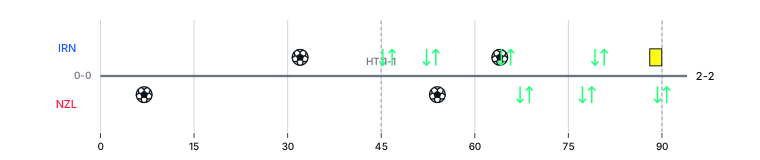
Both of New Zealand's goals came from the same source: Chris Wood receiving the ball, holding his position under pressure, and delivering it to Elijah Just at the moment it mattered. The first arrived in the seventh minute, the second at 54, and in each case the structure of the chance was identical — Wood as the anchor, Just as the finisher. Two goals, two assists, one linking player who accepted full responsibility for New Zealand's attacking output.
What makes this worth naming is not that a striker helped a goal; it is that Wood operated from a withdrawn central position and still managed to be the decisive connector. He did not drift to the flanks for easier touches, did not wait for others to create space. He stayed in the channel where the game was hardest and made both sequences possible. Just's two finishes — a right-foot goal at seven minutes and another on a fast break shortly after the hour — would not have existed without that willingness.
Just converted cleanly on both occasions. Two shots, two goals, two shots on target — his line was modest in volume and conclusive in output. But the responsibility was Wood's. He is the reason New Zealand had anything to build around. A midfield that cannot find its striker, or a striker who cannot be found, produces nothing. Wood was findable. That is not a small thing.
Rezaeian Refused the Role He Was Positioned In
Iran's answer to New Zealand's linkage came from a player whose average position throughout the match sat deep in the defensive left lane. Nothing in that spatial profile suggests a man who would finish with a goal, an assist, and the highest attacking contribution on his side. Ramin Rezaeian managed all three regardless.
His 32nd-minute goal — a right-foot finish from close range that carried genuine weight — leveled the score after New Zealand's early lead. His assist at 64 minutes delivered Mohammad Mohebi's equalizing header. Between those two contributions sits 0.37 expected goals, a figure that reflects the quality of his finishing positions, not incidental involvement. Rezaeian did not stumble into these moments. He moved into spaces that produced real chances.
The contradiction is worth sitting with. A player who averaged his position in defensive territory was, by every measure of output, Iran's most productive attacking figure. That does not make him a conventional attacking player — the positional average over 90 minutes flattens too much movement to draw that conclusion. What it shows is that when the opportunity existed, Rezaeian took it. Iran's other outfield players had more nominal offensive responsibility than he did. On this occasion, he was the one who delivered it.
The First Half Did Not Stay Balanced
New Zealand's opening quarter was authoritative in chance output — five shots and nearly 0.4 expected goals against Iran's one attempt worth almost nothing. That edge was not small, and it produced the seventh-minute goal. A team that takes five shots to Iran's one in the opening quarter is doing something right structurally, even if the specific mechanisms behind it cannot be traced from phase totals alone.
But the match shifted. Between the 16th and 30th minutes, Iran produced three shots worth roughly 0.25 expected goals while New Zealand managed two worth barely anything. The early New Zealand dominance had dissolved into something more contested. By the time the third phase arrived — the final stretch before half-time — Iran had accumulated three shots worth over half an expected goal and converted Rezaeian's finish at 32 to level the score. The match entered the break at 1-1.
What the phase-by-phase output shows is a first half that moved in one direction: from New Zealand control to Iranian recovery. Whether that shift had a single tactical cause or was the product of accumulated small adjustments is not something the shot and goal totals can answer. What they confirm is that Iran used the middle portion of the first half to close the gap in output, and then used the final portion to score. Possession without consequence is only politeness — but Iran eventually made theirs count.
Iran's Substitutions Opened the Second-Half Attacking Window
Iran made two changes in quick succession as the second half began: Mehdi Ghayedi came on at kick-off, Ali Alipour followed at 53 minutes. Within eleven minutes of that second change, Mohammad Mohebi had headed Iran's equalizer past the New Zealand goalkeeper, with Rezaeian providing the assist. The timing of those three events — two personnel changes and a goal — is not proof of a verified plan, but it is not nothing either.
Ghayedi's spatial profile placed him high and wide on the right side of the attack. Alipour occupied a similar advanced position. Both players extended Iran's options in the final third, adding bodies in areas where New Zealand's defense now had to account for more movement. Whether that directly enabled the Mohebi header or merely created the climate in which the chance appeared is a distinction the available records cannot resolve with certainty.
What can be said plainly is this: Iran looked like a different attacking unit after 53 minutes. The equalizing goal arrived from a central headed chance — a different mode of creation than what Rezaeian had provided in the first half. The substitutions appear to have broadened the threat. The causal chain between personnel and goal is real enough to name without overstating it.
Surman and Boxall Understood Where the Danger Would Arrive
Iran produced six shots in the final 15 minutes — more attempts in that closing window than in either of the first two first-half phases combined. New Zealand held the draw despite it. That resistance was not organizational in any shape that can be confirmed from the available records, but two players did the tangible work: Finn Surman made nine clearances across the match, Michael Boxall added seven. Together they cleared the ball 16 times in a game New Zealand's team total shows at 24.
In a phase built on volume rather than quality — Iran's six late shots were worth only around 0.30 expected goals — the measure of the defense is not tactical sophistication. It is whether the central defenders read where the ball would arrive and removed it before it became a chance of consequence. Surman and Boxall did that repeatedly. Nine clearances from one defender in a 90-minute match is a number that speaks to sustained defensive involvement, not a single decisive intervention.
The shape behind those clearances — whether New Zealand sat in a deliberate low block, how high or deep their line held — is not something the records can establish. What they show is two defenders who did not avoid the work of late-game absorption. That is the least romantic form of responsibility. It is also the form that most often goes unrewarded when a draw is all there is to show for it.
Synthesis
Four goals, four players who understood the demands placed on them, and a result that honored neither side with a winner. The 2-2 was not chaos — it had a structure, and the structure ran through individuals more than systems.
Chris Wood carried New Zealand's attacking responsibility for the full 90 minutes and delivered it twice to Elijah Just. Ramin Rezaeian carried Iran's most consequential attacking thread from a position that suggested he might not, then scored and assisted and left the pitch with more impact than anyone who nominally held a more advanced role. Both men accepted the game as it was given to them. Their respective teams followed the leads those contributions made possible.
The first-half swing and the second-half substitution window showed how quickly a match's distribution of advantage can move. New Zealand were sharp early and then managed just enough — in the late phase, Surman and Boxall made the clearances that kept Iran's pressure from becoming something worse than 0.30 expected goals across six shots. Those are the numbers of a defense under moderate duress, not siege, but the clearances still had to be made.
A draw at 2-2 leaves nothing settled. But it leaves something clear: both sides had a player who refused to merely participate. That is, in the end, the most a match can ask of anyone.