
Wolfe Stayed High on the Right — and That Is Where the Goal Came From
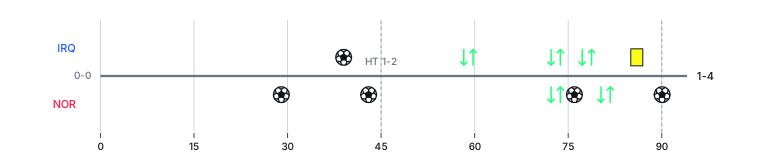
The opening goal was not built on improvisation. David Møller Wolfe spent the match in Norway's attacking right lane — advanced, wide, available — while Antonio Nusa held a deeper slot on the same flank. That layered right-side occupation meant Norway had width high enough to threaten the box and depth underneath to recycle if the first option closed. When the move broke forward at 29 minutes, Wolfe was already in position. He delivered the assist. Haaland finished with his left foot from close range — a chance with almost no right answer for a goalkeeper.
The shot quality tells the story plainly. Haaland's finish carried an xG above 0.8, which is the kind of number you expect from a yard out with the goal open. The route to it ran through the right corridor: Wolfe high, the angle created, the ball delivered before Iraq's defense could recover the line. One clean sequence, one goal. Nothing more needs to be claimed about Norway's flanks across 90 minutes. The right side gave them a clear route to the opener, and they took it.
The responsibility here was accepted without hesitation. Wolfe held his position, the structure offered a delivery option, and Haaland recognized exactly what the moment required. That is football working as it should — not bravery, not luck, but players understanding their role in a shape and executing it.
Berge and Aursnes Governed the Center — Ødegaard Had Room to Think
Norway completed 536 passes at nearly 89% accuracy and held 61% of the ball. Those figures are only meaningful if you understand why possession was sustainable — and the answer sits in where Sander Berge and Fredrik Aursnes stood. Both midfielders occupied central positions in Norway's attacking half, providing the compact occupancy that keeps a team's ball moving rather than stalling under pressure. There was always somewhere to play.
That central density gave Martin Ødegaard a different set of conditions. He operated deeper and to the left — further from the final third than Berge or Aursnes — which placed him in a zone where he could receive from the buildup and distribute forward before Iraq's pressure arrived. A playmaker in that deeper left slot can govern tempo when the distances are right and the central midfielders have already shortened the pitch. Norway's 536 passes suggest those conditions held for most of the match.
Iraq completed 333 passes at 81% and finished with 39% possession. The gap is not merely size — it is rhythm. Norway's midfield pair took responsibility for the game's central ground. Ødegaard took responsibility for connecting buildup to attack. The result was a match played almost entirely on Norway's terms. Possession without that kind of structural accountability is only keeping the ball. This was something more deliberate.
Hussein Was Iraq's Only Real Answer
Iraq carried 39% possession and one big chance across the full match. Their attacking output concentrated almost entirely in a single player: Aymen Hussein, who stationed himself centrally in the attacking half and served as the primary target for Iraq's direct progression. Three headed attempts, one goal — that is the shape of Iraq's attacking phase in miniature.
The goal itself was genuine. At 39 minutes, Hussein met a cross centrally and headed it in to make it 1-1. The shot's xG was under 0.09 — a low-probability attempt that went in. That kind of finish demands credit. Earlier, in the fifth minute, he had attacked a set-piece delivery from nearly the same zone and missed the target entirely. At 53 minutes, another headed attempt, again centrally, again off target. The pattern is consistent: Hussein in the box, the ball played toward him, the outcome variable.
The limitation of building an attack around one aerial focal point is not that the idea is wrong — it is that it requires the target to convert chances that the numbers say he will mostly miss. Hussein converted once. The supply was limited, and when Norway's midfield controlled the ball and the game's tempo, Iraq had fewer and fewer opportunities to reach him at all. He was real; the structure around him was not enough.
Four Changes at 73 Minutes — Østigård on the Scoresheet Three Minutes Later
At the 73rd minute, Norway made four substitutions simultaneously. Antonio Nusa off, Andreas Schjelderup on. Fredrik Aursnes off, Kristian Thorstvedt on. David Møller Wolfe off, Leo Østigård on. Oscar Bobb off, Alexander Sørloth on. Four new players on the pitch at once — new runners, new physical freshness, new spatial relationships for Iraq's defenders to account for.
Three minutes later, Østigård scored. A defender, just introduced, assisted by Ødegaard, finishing to make it 1-3. The sequence is tight enough to note without overclaiming causality. What the record shows is four personnel changes followed almost immediately by a goal from one of the new arrivals. Whether those changes created the goal directly or simply coincided with Norway moving through their final gear is a distinction the scoreline alone cannot settle. What is not in doubt is that from the 76th minute forward, the contest was over.
Østigård played 17 minutes, scored once, put one shot on target. For a central defender arriving late into a match, that is an unusual and decisive contribution. The responsibility accepted by a player entering at 1-2, in the final quarter, and converting his moment — that is the kind of specific act that shapes a final scoreline.
After the Third Goal, Iraq Had Nothing Left to Offer
Once Norway made it 1-3 in the 76th minute, Iraq's attacking phase stopped entirely. Zero shots in the final 15 minutes. Norway had seven in that same window, scored twice more, and collected a yellow card against an Iraqi defender for a foul in the 86th minute. The final goal — in the sixth minute of stoppage time — was recorded as an Aymen Hussein touch, a fitting, bleak endpoint for the player who had carried Iraq's entire attacking load through the evening.
The late-phase output split — seven shots to zero — is not a coincidence. It is the consequence of Iraq needing to chase two goals against a team that had just introduced four fresh players, held structural control of the ball, and had no reason to take risks. Iraq's defensive phase did not produce a single shot on the other end. The 86th-minute foul and yellow card suggest a team still attempting to compete physically when the tactical contest had already ended.
Iraq finished the match with one shot on target across 90 minutes. Hussein scored it. That figure alone describes the gap in output responsibility: Norway's midfield pair and wide players accepted the game's central demands; Iraq's response was to find Hussein and hope. He answered once. The match ended 4-1.
Synthesis
Three mechanisms governed this match. Norway's right-lane occupation — Wolfe advanced, Nusa deeper — produced the first clean delivery route and Haaland's opener. The central midfield structure, with Berge and Aursnes anchoring through the middle and Ødegaard pulling back to the left to govern tempo, gave Norway a possession base Iraq could not disrupt. And the 73rd-minute quadruple substitution cracked the game irreversibly open, with Østigård on the scoresheet three minutes after arriving.
Iraq's argument rested entirely on Aymen Hussein. He was their direct route past Norway's midfield block, their aerial threat, and ultimately their only shot on target. He scored a genuine goal from low probability. He also missed two other headed attempts and received no help from a team that held 39% possession and generated one big chance across ninety minutes. A single focal point, badly supplied, can produce a moment — as Hussein proved at 39 minutes. It cannot win a match.
What the evening really exposed was the difference between having a plan and having players prepared to govern it. Norway's midfielders accepted the responsibility of controlling central ground. Wolfe accepted the responsibility of holding the right lane until it mattered. Østigård, arriving cold in the 73rd minute, accepted the responsibility of finishing when Ødegaard found him. Iraq ran and fought and produced one real moment of quality. The rest was Norway deciding how the match would end.