
The Midfield Took Responsibility — Algeria Could Only Pass Around It
A midfield must govern, not merely commute. Argentina's central pair understood the assignment. Enzo Fernández sat through the center of the defensive half; Rodrigo De Paul angled toward the left channel. Between them they recorded six tackles and five interceptions. Argentina as a team finished with 25 tackles and 12 interceptions across ninety minutes. That is not a passive number. It is what a midfield looks like when it accepts responsibility for the spaces it occupies.
The consequence of that volume is the cleanest possible result: Algeria did not put a single shot on target. Seven shots in total, none requiring the goalkeeper to move. Zero big chances created. A total of 0.3 xG for the match — the shape of a side kept at arm's length rather than genuinely threatening. You do not finish ninety minutes with those numbers against a team that merely holds shape at the back.
What the record does not give us is the exact line at which Argentina chose to engage, or the precise trigger behind each intervention. What it shows plainly is that two central midfielders who spent the match in the defensive half were the most consistent defensive presence on the pitch, and the outcome around them was a goalkeeper who never had to work.
Possession Without Consequence Is Only Politeness
Algeria had more of the ball. Fifty-two percent possession. Six hundred and eight passes completed at over ninety-one percent accuracy. By any superficial reading, a team comfortable in their work. The problem was that none of it was consequential.
The first fifteen minutes produced zero shots from either side. The next window brought Argentina a goal; Algeria remained scoreless and shotless. In the final stretch of the first half, Algeria generated four attempts — their most active period before the interval — worth roughly 0.10 xG in total. It was their best attacking phase of the match and it still asked the goalkeeper nothing. In the second half, they managed one shot between the 46th and 60th minutes worth 0.06 xG, then one more in each of the final two windows. Seven shots. Zero on target. A match-total of 0.31 xG.
The gap between Algeria's passing volume and their shot output is the whole story of why the scoreline finished the way it did. Over six hundred passes, completed with discipline and care, and the goalkeeper was untouched. The evidence does not tell us exactly where those passes were played or precisely why each attempt to progress stalled — but the output speaks clearly enough. Possession without a route into dangerous positions is not pressure. It is the away side of a midfield battle.
Messi Occupied the Space That Demanded Finishing
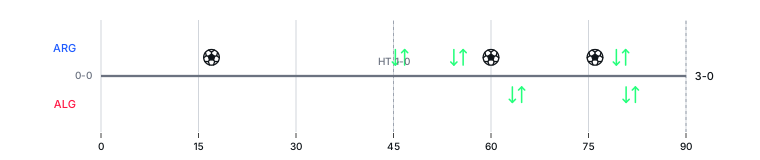
Three goals from four shots on target in eighty minutes. That is the number, and it does not flatter. Messi spent the match in the central attacking zone and the shots he produced from there covered the full difficulty range. The first, at seventeen minutes, was a left-foot finish carrying low probability — taken and buried. The second, at sixty minutes, was a right-foot strike from close range, the kind of chance that feels simpler than it is until someone misses it. The third, at seventy-six minutes, again left-footed, again converted without hesitation. His individual expected goals across the match sat near 1.0. He outperformed it.
That is not decoration. That is what it looks like when a player accepts that the finish is his responsibility and does not pass it to someone else. He did not hide from the ball, which already placed him above several others on the night. He stayed centrally, where the chances were going to arrive, and he finished three of them.
The evidence supports describing Messi as the central finishing reference point for Argentina in this match. It does not tell us whether Argentina's attack was designed solely to supply him, or whether other routes were deliberately closed off. What it shows is that the central finishing role was occupied with authority, and that authority was exercised three times before he left the pitch.
The Substitutions Accelerated the Same Pattern
Three changes in the opening nine minutes of the second half — Gonzalo Montiel at forty-six, then Thiago Almada and Lautaro Martínez both at fifty-five — coincided with the most concentrated attacking output Argentina produced across the entire match. In the window between the forty-sixth and sixtieth minutes, Argentina generated five shots worth 0.84 xG. That is nearly seventy percent of their total match chance quality compressed into a quarter-hour.
Nicolás González, who had been on the pitch in the first half before being replaced at fifty-five minutes, registered an assist during his time on the field. The record does not permit a clean causal chain from the personnel changes to the surge — other game-state factors were in play, and the evidence supports correlation rather than isolated cause. What it does show is that chance creation jumped sharply in the same window as those changes, and that the pattern Argentina had built from the opening whistle became sharper, not different.
These were not changes that reversed a bad situation or introduced a different tactical idea. Argentina were already ahead, already holding the midfield, already arriving centrally through Messi. The substitutions did not shift the logic of the match — they coincided with the moment its intensity peaked. A team that understands its own pattern can do that. A team that is only running does not know when to run faster.
Synthesis
The match had a clear shape from early on, and that shape did not change. Argentina's midfield held the center, made Algeria's possession consequenceless, and left the finishing to a man who could be trusted with it. Messi scored three goals. Algeria produced nothing on target. The scoreline reflects the structure faithfully.
What this match exposes is the difference between a team that participates and a team that governs. Algeria circulated the ball with accuracy and discipline — and arrived nowhere. Over six hundred passes, the goalkeeper was never asked a question. Possession without a route through the midfield is patience without purpose, and patience without purpose is its own kind of surrender.
The second-half substitutions sharpened the same logic rather than abandoning it for something new, which is its own kind of judgment. The central pattern did not require reinvention at half-time. It required application — and a sharper application of it when the moment allowed. Fernández and De Paul accepted responsibility for the defensive center. Messi accepted responsibility for the finish. Three times over, without flinching. The result followed, as it tends to when those two things happen simultaneously.