
The Right Side Was Not an Accident
Austria did not win this game because they controlled it. They won because their shape tilted in the right direction — and that is a different, less flattering story.
The structural asymmetry was legible throughout. Stefan Posch stayed anchored deep on the left, providing the ballast that allowed the right side to function offensively. While Posch held, Phillipp Mwene pushed high into the attacking right flank, and Marcel Sabitzer advanced into the same corridor alongside him. The consequence was a persistent overload on Austria's right that Jordan's left side had to constantly account for. With 63% possession and 580 passes to circulate, Austria had the time to make this tilt accumulate — not beautifully, but functionally, which is its own kind of honesty.
What the asymmetry actually changed was the map of progression. Austria's right side offered cleaner exits from buildup and drew Jordan's defensive attention toward one flank, creating the conditions — corners, set-pieces, second balls — that would eventually matter. Mwene and Sabitzer sharing the same advanced corridor forced decisions Jordan could not fully resolve.
It is tempting to call this possession football and leave it there. That phrase flatters the method without describing it. What Austria had was a building structure with a deliberate imbalance — not brave, but honest about what it was attempting. The right side was the mechanism. Everything else was what that mechanism eventually permitted.
Jordan's Answer Was Direct and Occasionally Right
The possession numbers invited a story about Austrian dominance. Jordan rejected that story with the only tool a 37%-possession side actually possesses: the vertical ball before the defense resets.
Jordan completed 330 passes to Austria's 580. Fewer corners, no big chances, a fraction of the territory. And yet they finished level in shots — 11 each, four on target each. That is not noise. That is a team that understood its own purpose.
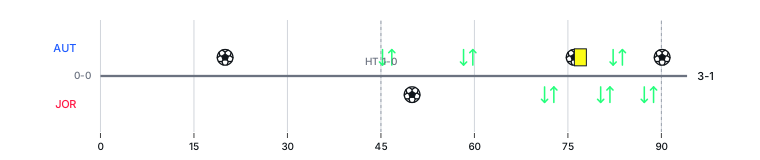
Ali Olwan's equalizer at 50 minutes was the precise illustration. Assisted by Noor Al-Rawabdeh, Olwan ran onto a fast-break and scored with a low-quality right-foot chance — under 0.09 xG — that went in anyway. Olwan spent most of the match sitting deep and central in his own half; the fast-break was the one moment where that positioning inverted into an attacking threat. Jordan had earned exactly the kind of chance their structure was designed to create.
One documented transition goal does not make Jordan a pure counter-attacking side. What it does establish is that their shot volume came from vertical efficiency rather than territorial accumulation. The scoreline, when it eventually went against them, was not the story of a team without ideas. It was the story of a team whose ideas had a limited ceiling against sustained positional load — and who found their best answer precisely once.
Arnautović and the Weight That Changes a Room
Sašа Kalajdžić played the first half as a high central striker and registered one off-target header. That is not a criticism of Kalajdžić — it is a description of what Arnautović changed.
Marko Arnautović came on at halftime and the central threat Austria had been sketching without conviction suddenly acquired mass. Four shots in 45 minutes. A right-foot finish from a corner at 67 minutes, subsequently ruled out. A left-foot effort saved in stoppage time. A penalty converted at 90+12. His expected goals total across those 45 minutes was 1.1 — more than two-thirds of Austria's entire match figure from a player who started on the bench. He operated centrally in the attacking half, the same general territory as his predecessor, but the output was categorically different.
This is not a case for calling it a masterstroke. It is a case for recognising that a particular striker was right for that particular phase of that particular match. The 67th-minute effort was disallowed, which is why Austria needed the stoppage-time penalty to make the scoreline read what it does — a detail the comfortable result conveniently obscures. Football does not require more than situational fit, and it rarely gets it. Arnautović provided it.
Thirteen Clearances Is a Description of Pressure, Not Composure
Yazan Al-Arab made 13 clearances, four interceptions, and three tackles. The natural reading is resilience. The better reading is repetition under load — a wall that held until it didn't.
The phase between 61 and 75 minutes showed Austria producing two shots worth 0.6 xG while Jordan offered nothing in return. Then from 76 minutes onward: Austria four shots, over 1.1 xG, two goals; Jordan one shot worth almost nothing. Al-Arab's own goal at 76 minutes — a corner-kick header that found the wrong net — was the first fault in that wall. Thirteen clearances does not describe calm; it describes volume, and volume eventually finds the gap.
The stoppage-time penalty completed the picture. Austria's late phase generated more shot quality in fifteen minutes than Jordan managed across the entire match. The structure that had kept the match competitive for long stretches could not absorb the sustained late surge without cost — and the cost, when it arrived, arrived twice in quick succession. Austria scored three goals in the final quarter of a match they had spent most of the first half merely navigating. That gap between process and result is where the real match lived.
Synthesis
Austria won 3-1. The scoreline says comfortable. The match says eventually.
The right-side buildup asymmetry was the structural engine — Posch deep, Mwene and Sabitzer advanced, the right flank tilted into Jordan's defensive attention. That shape made Austria functional in possession without being particularly bold. Jordan's answer — 11 shots from 37% possession, Olwan's fast-break equalizer at 50 minutes — was the honest cost of that design. A stretched buildup structure invites exactly the kind of direct vertical threat Jordan used, and they used it well enough to stay level for most of the second half.
Arnautović was the variable that separated Austria's structure from their result. Four shots, a disallowed finish, a penalty in stoppage time — he gave the right-side shape something to attack toward. Without him, the buildup asymmetry produces corners and half-chances that never quite add up. With him, it produces 1.1 xG in 45 minutes from a player who wasn't even on the pitch at kick-off.
Al-Arab's 13 clearances are the honest epitaph for Jordan's effort — not a collapse, but accumulated weight that eventually broke through the wall. The 3-1 result is not wrong. It is just not the whole argument. The football was messier, more contingent, and more interesting than any comfortable scoreline has reason to admit — and the teams that win by structure rather than conviction almost never get credit for the distinction.