
Anderson Governed; Others Ran
The question worth asking first is not how many goals England scored, but who made them structurally possible. Elliot Anderson answered it plainly. Stationed deep in central midfield, he accepted the responsibility that midfielders most often avoid — staying available under pressure, intercepting before the problem reached the backline, recycling possession without glamour. Four interceptions across ninety minutes is not a decoration; it is evidence of someone reading danger before chasing it.
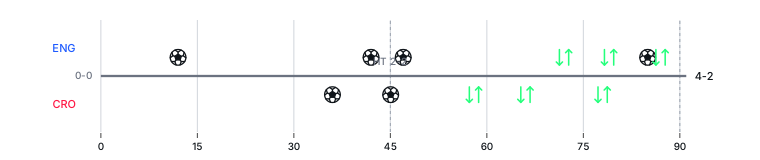
Anderson completed the full match without substitution, which in itself is a form of statement in a game that ended 4-2 and required late changes elsewhere. More telling was his role in the go-ahead moment: it was his pass that sent Jude Bellingham through for England's third goal at 47 minutes, restoring the lead after Croatia had twice pulled level. That combination — defensive floor plus line-breaking contribution — is what distinguishes a midfield organizer from a midfield passenger.
England's midfield has not always had this. Runners, yes. Players willing to receive between the lines, sometimes. A player who understood where the next danger would appear and positioned himself accordingly before it arrived — that is rarer, and Anderson provided it here. The game had a governor. That matters more than the scoreline suggests.
Croatia Handed England the Field
There is a kind of attacking ambition that punishes itself. Croatia's central defenders, Vušković and Šutalo, averaged positions inside England's half over the course of the match — not in a support role on set pieces, but as a structural tendency across the ninety minutes. A center-back who spends his afternoon in the opponent's territory is making a choice about the game's geometry, and Croatia made that choice at considerable cost.
The consequence was visible in England's numbers: 22 shots, 11 on target, seven big chances. That volume does not emerge from English creativity alone; it requires the opposition to leave space behind. When a back line sits that high, every England transition becomes an opportunity to run at defenders who have ground to cover and insufficient time to organize. The structure invited exactly the bursts that England then produced.
It would be too strong to call it reckless without knowing the instruction behind it. But the outcome speaks: England were given the field, and they used it. Whether that was a managerial calculation that misfired or a gradual drift upward under pressure cannot be determined from what happened on the pitch alone. What can be said is that Croatia's defenders spent too much of the match in the wrong half of it, and England's chance count reflects the gift that created.
The Openings Were Windows, Not Waves
England did not press Croatia constantly. What they did was apply pressure in short, high-output windows — and those windows happened to contain the match's defining moments. In the first fifteen minutes, England produced four shots worth nearly 1.6 in expected goals, including Harry Kane's penalty goal at 12 minutes. The match began with England treating the opening exchanges as an opportunity rather than a settling-in period.
The second half repeated the pattern. In the fifteen minutes immediately following the restart, England produced nine shots and none for Croatia — a lopsided phase that included Anderson's assist for Bellingham's goal at 47 minutes, the moment England moved from 2-2 to 3-2. Bellingham's finish was a low-probability chance from a difficult angle, but the volume surrounding it — nine attempts to Croatia's zero — confirms that England's dominance in that window was structural, not accidental.
These bursts should not be confused with sustained match control. Croatia scored twice, and there were periods where the game was less certain than the final margin suggests. The relevant point is that England concentrated their threat at the moments when it mattered most: immediately after kick-offs, when shape is transitional and defensive lines are still finding their positions. Whoever understood that rhythm better in those windows owned the scoreline. England did.
The 72nd Minute Was Not a Coincidence
At 72 minutes, with England leading 3-2 and the match still fragile enough to turn, three substitutions arrived simultaneously: Declan Rice on for Morgan Rogers, Marcus Rashford on for Anthony Gordon, Bukayo Saka on for Noni Madueke. Three changes at once in the final quarter of a match with a one-goal margin is not passive management.
The sequence that followed is on the record. Saka, thirteen minutes into his appearance, provided the assist. Rashford, also thirteen minutes into his, finished. The fourth goal arrived at 85 minutes and converted a tense 3-2 into a closed 4-2. Both substitutes contributed directly: Saka with the pass, Rashford with the finish, and neither required much time to do it.
The evidence cannot prove these changes were pre-planned or that they alone produced the goal. What it can show is that fresh players, introduced at the moment the match was still live, directly executed the sequence that settled it. Rashford's finish was not a high-probability chance — the position and shot angle were difficult — but he was there, and he converted it. Saka found him. That is what substitutes are asked to do: accept responsibility for the match at the moment when the match is still asking questions. Both answered.
Synthesis
A 4-2 win is easy to read as chaotic — goals traded, nerves involved, a margin that flatters no one for much of the night. The football underneath it was more structured than that reading allows.
Anderson governed the middle, which meant England always had someone accepting the ball in tight spaces and someone positioned to recover it when possession broke down. That kind of midfield stability is the precondition for everything else: phase bursts require a platform, and Anderson was the platform. Croatia's center-backs, averaging inside England's half, turned that stability into opportunity — they compressed the space behind them, handed England the transition lanes, and then watched England use them across 22 shots and seven big chances.
The attacking windows themselves were short but productive precisely because the structural conditions Croatia created were never corrected. England ran at space that should not have existed. The first burst produced Kane's penalty; the second produced Bellingham's goal; the late substitutions produced Rashford's finish. Each of those three moments had a different actor, but the same underlying logic: England met the responsibilities the match created, and Croatia did not.
The scoreline ends at 4-2. The match argument ends somewhere simpler: one team had players who understood where the next danger would appear. The other had players who were still looking for it.