
Ghana Set the Terms with a Defensive Shape That Meant Business
Ghana defended with a shape that gave Panama the ball and removed the spaces that would have made it dangerous. Jonas Adjei Adjetey and Jerome Opoku registered eight and seven clearances respectively — fifteen between the two central defenders alone, out of twenty-six for the team. That is not a statistic about effort; it is evidence of a back line that stayed compact, read where danger would appear, and dealt with it before it became a crisis.
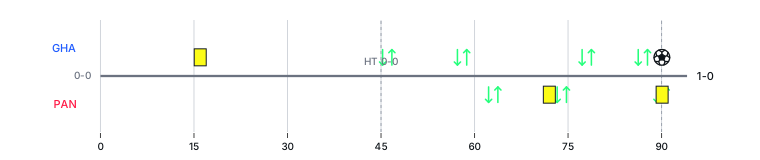
Panama finished with 62% possession and 582 passes completed at 86% accuracy. Those numbers sound like control. Against Ghana's defensive block, they mostly described occupation of safe ground. The phase record for the opening fifteen minutes shows Panama generating 0.07 xG from two shots; the following fifteen minutes produced nothing at all. The block did not merely limit chances — it removed the sense that chances were imminent.
The responsibility Ghana's defenders accepted was severe: absorb sustained pressure, contest every ball in the box, and trust that a clean sheet was earnable across ninety minutes. Adjetey and Opoku did not hide from that responsibility. Which already separated them from a considerable portion of what followed at the other end. Panama had the ball. Ghana had the players who understood what it meant to defend it properly.
Panama's Buildup Leaned Left and Left the Right Largely Decorative
Panama's buildup carried a visible structural imbalance. Amir Murillo pushed consistently high on the left, operating in attacking-third territory for most of the match. César Blackman on the right stayed considerably deeper, rarely threatening the space his teammate was occupying on the opposite flank. One side advanced, one side held back.
Whether that asymmetry was permanent or situational matters less than what it produced. A concentrated attacking presence on the left meant Panama's most advanced buildup movement came through that channel. The right, with Blackman staying deep, provided width in possession but not the same penetrating intent.
For Ghana, the consequence was manageable. A compact defensive shape with two organized central defenders does not fear one advanced flank when it can locate where the pressure is coming from. You set your lines against a threat you can find. It is the threat that arrives from multiple directions simultaneously — two advanced fullbacks, overloads on both sides — that deforms a block. Panama's asymmetry, however consistent in positional terms, never became that kind of problem. Murillo was high. Blackman was deep. Ghana's defenders knew which side to watch. That knowledge, over ninety minutes, is worth more than people tend to admit.
Possession Without Consequence Is Only Politeness
Panama's total chance value for the match was 0.75 xG. They had 62% possession and put more passes together in ninety minutes than Ghana managed in total. Possession without consequence is only politeness.
The first half laid out the problem with some clarity. Three separate fifteen-minute windows produced, in order: two shots worth 0.07 xG, no shots and no xG at all, and one shot worth 0.06 xG. That is not a team manufacturing sustained pressure on a compact block. That is a team keeping the ball in front of the block and calling it pressure. Ghana's shape never broke because Panama's passes, for all their accuracy, rarely asked it to break.
Two big chances across the full match, and a game total of 0.75 xG, reflects not a team defeated by misfortune but a team that did not find the zones that matter often enough. Governing the ball is its own responsibility. If ninety minutes of possession produces three early shots in the first half and limited genuine threat thereafter, the question is not whether the defending side was fortunate. The question is what the possessing side was doing with the authority it had. Panama circulated the ball well. They rarely used it to make Ghana govern something they could not handle.
Díaz Arrived and Immediately Asked Harder Questions
Ismael Díaz came on at 74 minutes in place of José Luis Rodríguez, and in sixteen minutes he produced more direct threat than Panama had managed in the seventy-four before him. Two shots on target. A combined shot quality just over 0.3 xG from those two actions alone. At 85 minutes, his right-foot effort drew a save. At 90+9, already trailing, he rose to meet a set-piece delivery — a headed chance of real quality, and saved again.
The comparison with what preceded him is not flattering to those who were on the pitch first. Panama had circulated the ball diligently for over an hour and produced almost nothing centrally, almost nothing in range of goal. Díaz arrived and immediately looked for positions that asked harder questions of Ghana's shape — in front of goal, direct, in zones that demanded a response.
He did not change the scoreline. But he changed the character of what Panama were threatening, and he raised the pressure around Ghana's goal precisely when Panama most needed that elevation. A substitute who arrives and within minutes forces two saves is a substitute who accepted the responsibility the moment required. The only remaining question was whether Panama could find a goal before Ghana found the space that Panama's late push was inevitably creating.
Yirenkyi Took the Final Responsibility and Did Not Drop It
Caleb Yirenkyi answered that question himself. He had spent the match doing work that does not attract cameras — three interceptions, cutting off Panama's attempts to find an opening through the middle, understanding where danger would arrive before it arrived. That kind of spatial discipline tends to go unremarked. It did not go unrewarded.
At 90+5, with Panama pressing numbers forward, Ghana converted a defensive action into a fast break and Yirenkyi ran onto a chance that the position made nearly certain. His right-foot finish carried a shot quality that left almost nothing to fortune, and he converted it. Score 1-0. Match over.
The connection between his defensive work and his decisive goal is not a coincidence of minutes. A player who understands danger, who intercepts rather than chases, tends also to understand how space opens when the opponent overcommits. Yirenkyi was where the opportunity required someone to be, and he was composed enough to finish it under the weight of the moment. Panama had introduced their sharpest attacker to push for a goal. Ghana's most complete player on the night punished the gap that the pushing created. That is how the match resolved: not through superior possession, not through tactical ingenuity at the high end of the pitch, but through a player who accepted every responsibility the game placed in front of him.
Synthesis
The easy reading of this result is that Ghana scored late and took something they perhaps did not deserve. That reading mistakes the final event for the full accounting.
Ghana's defensive shape earned the result before Yirenkyi collected it. Without twenty-six clearances — fifteen of them from two central defenders who accepted the primary physical and spatial responsibility — Panama's possession advantage becomes a scoring advantage. Adjetey and Opoku understood the demands of the match and met them. Panama's midfield, for all its passing volume and accuracy, never generated equivalent attacking purpose. Murillo pushed high and left; Blackman stayed deep and right; the asymmetry was consistent but never destabilizing for a Ghana back line that knew exactly where to look.
Díaz, introduced late, gave Panama a sharper cutting edge in the final stretch and twice forced saves of genuine quality. But by the time he arrived, Ghana had already defended the majority of the match without serious damage. His own sharpest chance came in injury time with the scoreline already against him.
Yirenkyi's winner was not fortune. It was the precise embodiment of the match's reward structure: discipline earns position, position earns the chance, finishing the chance earns the win. Panama had the ball most of the evening. What they did not have was a player willing to accept the game's full set of responsibilities — both the unglamorous interceptions and the high-pressure finish. Yirenkyi had both. That difference, in the end, was the only one that mattered.