
The Ball Was Theirs. The Match Was Not.
Portugal finished with 75 percent of the ball, 783 passes completed at better than 92 percent accuracy, and one shot on target. That is not a paradox requiring clever explanation. It is a straightforward accounting of what possession without consequence looks like.
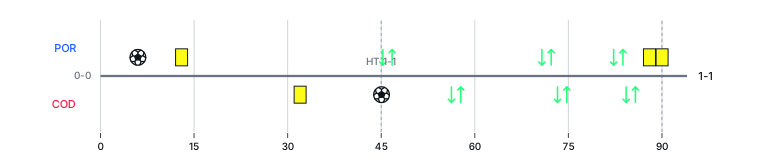
The problem was not that Portugal moved the ball poorly. They moved it often and cleanly. The problem was that movement never accumulated into pressure. In the middle phase of the first half — the sixteen-to-thirty window when a team in control should be pressing its numerical advantage — Portugal produced a single shot worth almost nothing. The second half opened with a fifteen-minute stretch in which they did not manage a shot at all. By the final whistle they had seven shots in total, three of which arrived in the closing quarter when the scoreline demanded something. That is not a team governing a match. That is a team in possession of it.
Possession without consequence is only politeness. Portugal were extremely polite. DR Congo, with 250 passes and 25 percent of the ball, were rather more rude — and rather more dangerous.
Six Minutes In, and Already Running Out of Ideas
The opening goal told you what Portugal were capable of, and how rarely they returned to it. Pedro Neto worked the right channel high and wide, found the space to deliver, and João Neves arrived centrally to head in at the near post. Six minutes played, 1-0, and a wide-right lane had been opened and used with precision.
The difficulty is that this sequence described one moment, not a method. Neto's role kept him advanced and wide throughout — he occupied that right corridor persistently — and Neves drifted into central territory where the header was available. The geometry was correct. The execution was sound. But Portugal did not keep returning to that combination with any regularity. The lane existed; the willingness or ability to exploit it consistently did not follow.
A team that scores early and controls the ball should be asking itself how to manufacture the second goal from the same structural logic. Portugal asked themselves that question for eighty-four minutes and answered it with six more shots, one of which troubled the goalkeeper.
DR Congo Accepted the Discomfort and Made Portugal Pay for Theirs
There is a certain kind of defensive performance that gets misread as passivity. DR Congo made 27 clearances and 17 tackles. They gave up territorial control entirely, sat deep, and invited Portugal to come at them. None of that is passive. That is a team accepting a specific burden because it comes with a specific reward.
The reward arrived through transition. Samuel Moutoussamy found a left-footed shot blocked in first-half stoppage time; Cédric Bakambu missed from a counter in the 77th minute — a right-footed fast-break attempt that carried genuine threat on the break. Over the full match, DR Congo ended with eight shots to Portugal's seven, and 0.8 in total chance value against Portugal's 0.6. A team that touched the ball for roughly one quarter of the match generated the better chance profile.
The responsible question is not why DR Congo defended deeply. The responsible question is why Portugal, with three times the ball, allowed that arrangement to work.
A Corner in Stoppage Time, and Portugal's First-Half Verdict
Yoane Wissa's header arrived in the fifth minute of first-half stoppage time, delivered by Arthur Masuaku from a corner. The chance carried an expected-goals value of around 0.35 — a close-range header from a dead-ball delivery, the kind that a compact defensive shape is supposed to prevent. Portugal had spent the previous thirty-nine minutes in comfortable possession. They walked into halftime level.
The sequence itself was not complicated. A corner, a delivery to the near-post area, a header from close range. What made it significant was its position in the match's economy. Portugal had the ball, had led since the sixth minute, and had manufactured almost nothing in the intervening time. DR Congo needed one set piece to make that irrelevant.
This was not evidence of a chronic set-piece vulnerability — one corner does not prove that. But it was evidence of what happens when a team governs the ball without governing the match. When your possession yields nothing in open play, you leave a door open for the moments you cannot fully control. DR Congo walked through it.
Conceição Came On, and the Left Flank Moved Forward
The first thing Portugal did at halftime was replace Bernardo Silva with Francisco Conceição. Silva had operated on the left side at a moderate depth — useful in circulation, less threatening in the final third. Conceição pushed considerably higher and wider on the same flank, altering the left side's entire occupation profile.
The positional shift was clear. Where Silva's presence sat closer to the halfway line, Conceição's was markedly deeper into the attacking half and further toward the touchline. In the fifteen-minute window following the tactical change — roughly minutes 61 to 75 — Portugal produced two shots worth a combined 0.4, their most productive spell of the match. The adjustment created a different shape on that side.
What the substitution did not do was win the game. Portugal's left side was higher and wider after the break; their chance volume in the final fifteen minutes returned to the same modest level as the rest of the match. A different player, a different position, the same problem. The pass was available more often. The authority to turn it into something was not.
Synthesis
The match produced a 1-1 draw, which is the correct result in the sense that neither team demonstrated a convincing claim to more. Portugal's possession was genuine and their passing almost immaculate. None of that translated into authority over what actually mattered — the quality and frequency of chances.
DR Congo defended with discipline and punished the space Portugal vacated. Twenty-seven clearances, seventeen tackles, a compact shape that Portugal could pass around but rarely through. When the moments arrived — on the counter, and then from a corner in stoppage time — they were taken. Wissa's header, arriving from a set piece after Portugal had run the ball for eighty-four minutes, was not an accident. It is what becomes possible when possession is mistaken for control. A chance worth 0.35 from close range is not created by fortune; it is created by the gap that sustained sterile possession leaves open.
The halftime adjustment on the left changed Portugal's shape without changing their problem. More width, more depth, a different player — and still one shot on target across ninety minutes. Portugal did not run bravely in the wrong directions. They passed carefully in the wrong ones. The responsibility for that belongs to the team, not the system. A midfield must govern, not merely commute.