
The Possession Numbers Describe a Contest That Was Already Settled
The scoreline invites the easy version: two red cards, six goals, case closed. The red-card explanation isn't wrong — it's just incomplete in a way that obscures what Canada actually did for ninety minutes.
The full-match numbers are stark. Canada completed 566 passes at over 90%, held 79% of possession, and generated 19 corners and five big chances. Qatar managed two shots across the entire contest, neither on target. They completed passes at 63% with 164 total — less than a third of Canada's volume — and recorded 57 clearances, the measure of a side spending the match trying to get the ball out rather than build with it. One corner. Zero big chances. An expected-goals total of 0.18 for the game.
Maxime Crépeau's average position sat deep and central — consistent with a side that kept the ball and didn't need its goalkeeper operating far from goal to sustain pressure. These are full-match figures, covering every minute of the contest, not a selective window. They describe a team that controlled territory comprehensively: a possession structure that kept Qatar pinned, starved of the ball, and unable to generate any meaningful threat. The red cards didn't manufacture that picture. They intensified it.
Two Red Cards Didn't Break Qatar — They Confirmed What Was Already Breaking
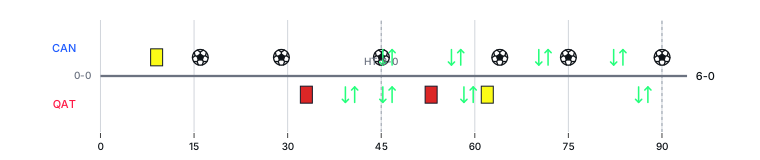
Homam Al-Amin went off in the 33rd minute — a professional foul as the last man. Assim Madibo followed twenty minutes later in the 53rd. Qatar went from eleven to ten to nine inside the same half, and the phase data around those dismissals shows exactly what coincided with each departure.
From the 31st minute to the end of the first half, Canada generated eight shots worth just over 2.0 in combined shot quality. Qatar produced zero shots, zero expected goals in that window. The period covering the 46th to 60th minute — after Madibo's red card reduced Qatar to nine — told the same story: Canada with two more attempts, Qatar with none going forward. What the phase numbers record is a complete absence of Qatar's attacking output running alongside a growing Canadian threat, with the timeline of each dismissal sitting squarely in the middle.
The 57 clearances Qatar logged across the full match are the plainest indicator of how they spent the evening: not building, not progressing, but surviving — and eventually failing to survive at any level once nine men were asked to absorb a full Canadian side in open play. The red cards accelerated the collapse. The clearance volume tells you the contest's shape was already one of containment and pressure long before the match was numerically settled.
Jonathan David Occupied the Same Address Three Times and Canada Kept Finding Him
Jonathan David's role was not complicated. He stayed central, stayed high, and converted. Three goals from five shots on target, with a total shot quality of 2.1 — meaning he finished well above expectation on chances that were already good. His average position sat in the attacking third, centrally, and that's precisely where each goal came from.
The first arrived at 29 minutes: a right-foot finish carrying modest shot quality — around 0.14 — converted cleanly from a tight angle. The second came in first-half stoppage time, a near-post finish from close range with a shot quality approaching 1.0, the kind of chance a model treats as near-certain. The third, in the second minute of stoppage time at the end, was a left-foot finish from inside the box assisted by Saliba — a high-quality position, shot quality just under 0.7, converted with the match already decided.
Three different moments, three different foot and angle combinations, one consistent address on the pitch. What the concentration reveals isn't isolated brilliance — it's a central finisher returning to the same profitable zone because Canada's sustained possession kept manufacturing the conditions. The possession engine delivered volume; David's central positioning converted the best of it. Qatar had no reliable answer at eleven men, and progressively fewer resources to commit as numbers dwindled.
Saliba Arrived and Kept the Invoice Coming
Nathan-Dylan Saliba entered in the 57th minute, replacing Ismaël Koné, and within seven minutes he had scored. In the 64th, a right-foot free-kick from distance — a low-probability chance carrying a shot quality around 0.06 — went in regardless, making it 4-0. In stoppage time at the end of the match, Saliba picked out David centrally to complete the 6-0 scoreline: one goal, one assist, 33 minutes on the pitch.
The obvious qualifier applies: this was a nine-man opposition deep in a match Canada already controlled. The ask on Saliba wasn't to change the structure — it was to sustain the pressure and add direct end-product, which he did both times he touched the ball productively. A free-kick goal from that distance conversion probability is not a repeatable outcome; the assist for the sixth goal, finding David in a high-quality central position, was composed and precise.
What the cameo confirms is narrower than a talent verdict, but still useful: a substitute entering in that game state, against that opposition, and immediately producing direct output suggests Canada had a functional enough system that a fresh player could slot in and operate without needing to reorient. The match's result was settled before Saliba arrived. What his 33 minutes add to the picture is a bench that could extend pressure rather than simply manage the clock — a different thing, even if the context made it look routine.
Synthesis
The match has a clean surface narrative: red cards happened, a 6-0 happened, and one explains the other. That version isn't false — it's just the last layer of a sequence that started well before Al-Amin's dismissal in the 33rd minute.
Canada's possession structure produced 79% of the ball, 566 passes at over 90% accuracy, and confined Qatar to two shots across ninety minutes. Those are full-match numbers. They describe a team that controlled territory for the entirety of the contest, not one that needed Qatar's discipline problems to create an advantage. The red cards widened a gap that the possession structure had already opened. Qatar's 57 clearances are the record of a side that had been reduced to emergency containment for most of the evening — not a team that fell apart only once numerically outnumbered.
Within that frame, David was the execution point: three goals from a central position that Canada's system kept returning the ball to, with a shot quality total of 2.1 that he exceeded. Saliba extended the pressure from the bench with 33 productive minutes — a goal from a low-probability free-kick and a composed assist that closed the scoring.
What the match exposes isn't a Qatar collapse that happened to coincide with good Canadian finishing. It's a Canadian side where structural control, individual finishing, and substitution impact all worked in the same direction on the same evening. The red cards made the result larger. The possession structure made the result logical.