
Six Minutes, One Goal, and a Match That Rearranged Itself Around Both
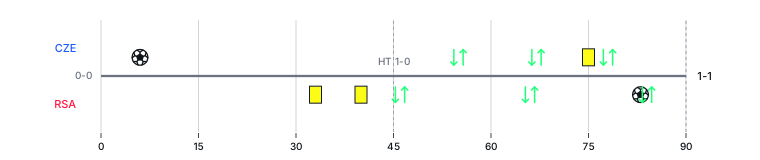
Michal Sadílek scored with his left foot in the sixth minute, from a throw-in set-piece, and the match became a different negotiation. Not because Czechia had earned anything particularly coherent — the shot carried modest quality, around 0.18 in chance weight — but because it arrived before South Africa had any answer to the question, and early leads in tournament football are not just scorelines. They are permission slips. Permission to sit, to compress, to make the other side carry the weight of invention.
And Czechia used that permission immediately. They took four shots in the opening fifteen minutes, then essentially stopped. The next fifteen minutes produced nothing from them — zero attempts, zero threat. Alexandr Sojka, who provided the assist, contributed two clearances across his 55 minutes and left the pitch without further attacking trace. Sadílek himself completed 67 minutes, one goal, one shot on target, and a defensive contribution. The picture is not of a team that scored and pushed; it is of a team that scored and withdrew.
The lazy reading of a 1-0 lead held for most of a match is that the team in front was controlling it. That reading is comfortable and usually wrong. Czechia were not controlling this match. They were occupying a position gifted to them in the sixth minute and spending the next hour making it expensive to retrieve. That is a coherent choice. It is not the same thing as dominance, and calling it such is what passes for analysis in press boxes that mistake survival for authority.
All That Passing Had Somewhere Else to Be
South Africa had 62% of the ball. They completed 563 passes at 90% accuracy — Czechia managed 340, at nearly ten percentage points less. By every circulation metric, South Africa ran this match. They moved the ball cleanly, they kept it, and they kept Czechia honest enough that the home side never felt free to press forward again in any sustained way.
None of it translated into a convincing chance edge. South Africa finished the game with 1.35 in accumulated shot quality against Czechia's 1.02. That gap is real — South Africa were the better side in expected terms — but it is not a gap that reflects an 84-minute siege. When you own 62% of the ball and complete passes with that consistency and your reward is a third of an expected goal more than the team protecting a lead from deep, the ball was going somewhere it was not being used.
This is the possession trap that no one likes to name because naming it is uncomfortable: high-volume, high-accuracy circulation against a low block often produces exactly this. Beautiful numbers. Modest consequence. The pass completion was real. The danger was managed. South Africa moved the ball the way a clever team moves furniture around a room that is already locked. Industrious, purposeful, and not quite the point.
Czechia Brought on a Defender and Called It a Plan
At 78 minutes, with South Africa pressing and Ladislav Krejčí already booked three minutes earlier for a foul, Czechia substituted a midfielder out and brought David Zima in. A defender, introduced with twelve minutes left to play, to play deep on the left side. Two clearances in twelve minutes — that was the contribution, and it was exactly the contribution asked for.
This was not creative management. It was a team using its substitution to reduce a problem rather than solve it. Zima operated deep in his own defensive third, and the spatial evidence places him anchored well back. The move fits the picture of a team pulling the drawbridge up with twelve minutes remaining — adding a body to the block, shrinking the available space, accepting that South Africa would keep the ball and betting that the shape would hold long enough.
The bet did not hold, though the substitution itself cannot take the blame. Czechia had been absorbing pressure, and the structural cost of protecting a narrow lead without ever extending it is simply this: the odds compound with every minute. You can make the block denser, but if the team against you is generating shot after shot from the final quarter-hour onward, a defensive change at 78 is reinforcement of a position that was already under real stress. It is rational. It is also not an argument that you had solved anything.
Eight Shots in Fifteen Minutes Is Not Luck. It Is a Sentence Finally Completed.
From the 76th minute to the final whistle, South Africa produced eight shots. Against Czechia's three. The accumulated shot quality in that window for South Africa was over 1.0 — essentially, the mathematical expectation of a goal, compressed into fifteen minutes after spending an hour circulating the ball without that kind of volume or urgency.
The question is not why South Africa found this gear late. The question is why it took so long. Evidence Makgopa's headed attempt at 74 minutes — saved, low quality — and then another effort in stoppage time showed the forward presence was there. Krejčí's booking at 75 gave South Africa the kind of card pressure that makes defending marginally more fraught. The pieces converged. The late phase was not a reversal of fortune or some inexplicable surge; it was the logical conclusion of a match South Africa had always been likely to force into discomfort if they stayed patient long enough.
Those eight shots, carrying that much weight in such a short window, are the match's most honest statement. Not the first 75 minutes of admirable circulation, and not the sixth-minute goal that invited a siege — but this late, concentrated pressure that finally made the scoreline feel insufficient as a description of what had happened on the pitch.
Mokoena Played Ninety Minutes, Collected a Yellow Card, and Then Made It Count
Teboho Mokoena was booked in the 33rd minute for a foul. He played the rest of the match under that restriction — two tackles, two interceptions, a clearance, the full ninety minutes — and then stepped up to take a penalty in the 83rd minute and converted it. The penalty carried shot quality around 0.79, which is what penalties carry. It went in. South Africa were level.
What is worth examining in Mokoena's match is not the penalty itself, which is a structure of football that does not require much discussion — good players take them and score them. It is that he played the entire match on a yellow card and remained functional enough in both phases to be the player standing at the spot when the equalizer arrived. That requires a kind of composure that shows up in the stat line only as minutes played, but it is legible in the sequence: booked early, remained involved, delivered the most important action of the match for his team.
His expected goals for the game sat at 0.8, almost entirely from that single penalty attempt. One shot on target, one goal. It is not a volume performance — it is a precision one. Mokoena did not make this match exciting for 83 minutes. He made it matter at the end, and in a 1-1 draw that hinged entirely on whether South Africa could turn a long possession advantage into an actual result, that is the only distinction that keeps the scoreline from reading as Czechia's.
Synthesis
The result is 1-1 and the temptation is to call it fair. Possession to South Africa, early goal to Czechia, late penalty to South Africa — clean symmetry that suggests both sides got what they deserved. That reading is too tidy by half.
Czechia scored from a set-piece in six minutes and then made a considered decision to defend their fortune rather than add to it. The block held for over an hour. When it finally cracked — late, under eight shots and the accumulated weight of a team that had been patient all evening — it cracked on a penalty. Not from open play. The manner matters: South Africa's equalizer came from a structure that rewarded pressure and card accumulation, not from the flowing buildup that defined their possession dominance.
What the match actually reveals is the gap between how a team moves the ball and how dangerously it uses it. South Africa were the superior passing side. They were also a team that spent most of the game circulating the ball against a compact block without finding real cutting angles — until, in the final quarter, something about the urgency changed and the shots came in volume. That late version of South Africa was a genuinely threatening team. Whether the first seventy minutes were patient build-up to that moment or simply possession without sufficient edge is the question this draw leaves unresolved.
Czechia scored, protected, reinforced, and eventually conceded. South Africa passed, circulated, and eventually pressed until the lead broke. Both sides got a point. Whether either side earned the result they would have chosen is a different, less comfortable question.