
Bosnia Built a Wall Switzerland Couldn't Find the Door To
Bosnia came with 38% possession and left the first half with the scoreline untouched — which is exactly the point. The compact block they set limited Switzerland's 62% of the ball to almost no real danger before the break. That is not a team surviving on luck. That is organized resistance working.
The pattern across the first three fifteen-minute windows is clean. Two Swiss attempts worth almost nothing in the opening quarter-hour, two more worth even less in the next, then zero Swiss shots at all in the final stretch before the break. Bosnia, by contrast, generated more chance value in that last phase than Switzerland had produced in the previous thirty minutes combined. No big chances conceded. No central breakthroughs. Every time Switzerland circulated possession, Bosnia's shape compressed the lanes through the middle and pushed play wide, where it could be absorbed.
The mechanism was not simply sitting deep. It was controlling the vertical space so that Swiss buildup never found the penetrating pass to generate a real opening. 35 clearances across the full match tells you how much defensive work accumulated. The scoreline at half-time was accurate — Bosnia had not been fortunate, they had been organized — and that distinction is what makes the second-half unraveling worth understanding on its own terms, not as an inevitable consequence of the first.
Widmer Holds, Rodríguez Pushes — Switzerland's Lopsided Spine
Switzerland's buildup carried a visible asymmetry between the two fullbacks throughout the match. Silvan Widmer stayed deep on the left, anchoring the rest defense and maintaining cover when possession changed hands. Ricardo Rodríguez, on the right, pushed high into the attacking half — operating almost as an extra body in the midfield-to-forward transition. The gap between where each of them spent the match is stark: one sat in defensive territory, the other spent his time well into the opponent's half.
With 587 passes completed at 88% accuracy, Switzerland had the ball constantly. The shape was there — Rodríguez providing width and a high progressive option on one side, Widmer providing structural security on the other, central occupation through the middle. In possession, this created a recognizable right-side overload threat and kept the left secure against transition. But against Bosnia's compact defensive block, all that circulation kept finding the same wall. The asymmetry gave Switzerland a clear buildup structure; it did not create the central penetration needed to break a well-set defense.
Switzerland generated 13 shots and three big chances across the full match, but almost none of that quality arrived before the 71st minute. The idea was sound. The distances, against Bosnia's shape, were not yet enough — and the answer to that problem did not come from adjusting the fullback split. It came from the bench.
Three Substitutes at 71, One Goal Three Minutes Later
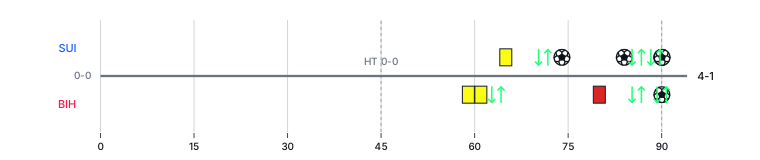
At 71 minutes, scoreless and stuck, Switzerland made three changes simultaneously: Michel Aebischer for Djibril Sow, Johan Manzambi for Dan Ndoye, Rubén Vargas for Fabian Rieder. Three minutes later, Manzambi scored — a right-foot finish that carried modest expected-goal value, under 0.1, but the ball went in, the block cracked, and the game state flipped in a way it had not threatened to do all half.
That first goal matters beyond its own chance quality. A scoreless game at 74 minutes becomes a match Bosnia must now chase while already defending. What followed: Vargas scored at 84, Breel Embolo with the assist, to make it 2-0. At 90, the same two combined in reverse — Vargas the provider, Manzambi the finisher — for 3-0. Between them, the two substitutes were directly involved in three of Switzerland's four goals after coming on at the same minute.
The evidence shows the timing and the output, not the intent behind the changes. What the sequence does establish is that the three introductions at 71 coincided with a complete break in a match that had been locked for over an hour. The scoreline moved from 0-0 to 3-0 within the time it takes a half to start and reach its midpoint — and the players who drove that shift entered the pitch together.
One Red Card, Three Goals, No Recovery
Bosnia's compact block was built on coordination. Every player in a shape like that holds a piece of the structure — take one away and the arithmetic of defense changes immediately. Tarik Muharemović's professional foul as last man at 80 minutes brought the red card, and with it came a ten-man defense against Switzerland's freshly introduced attackers and a game already tilted 1-0 against them.
What followed is stark in the numbers: four Swiss shots worth 1.6 combined expected goals between the 76th minute and full time, three converted. Vargas at 84 made it 2-0, Embolo the provider. Manzambi at 90 made it 3-0, Vargas turning assister. Granit Xhaka finished in stoppage time for 4-1. Bosnia managed one shot in reply, worth essentially nothing. The scoreline shifted from 1-0 to 4-1 in approximately twelve minutes of football.
The dismissal does not need a mentality story to explain what came next. A block that requires eleven players to hold shape and close space in coordination does not hold shape and close space the same way with ten. Switzerland's attack — already lifted by the substitution window, already ahead — now faced a defense that could not maintain the coverage that had worked for 79 minutes. Three goals is what that arithmetic looks like on the scoresheet.
Synthesis
The match ran in two distinct phases — not of time, but of structure. Bosnia came with a compact block that genuinely held Switzerland's possession-based approach to almost nothing across the first half. Switzerland had the ball, the buildup shape, and the right-side threat from Rodríguez pushing high — but all that circulation kept meeting organized compactness. The idea was sound. The result at half-time was fair.
The break came from two directions at once. The triple substitution at 71 minutes introduced Manzambi and Vargas into attacking positions when Bosnia's block had spent over an hour absorbing Swiss ball and running out of answers to new movement. Manzambi scored three minutes in. That goal changed the game state; the subsequent pressure changed Bosnia's available choices. When Muharemović was dismissed at 80, the structural cornerstone of the block was replaced by open space that ten men could not cover the way eleven had.
The 4-1 final looks like a comfortable win. The 0-0 at half-time tells you it was not. Both scorelines are accurate. Bosnia built something that worked for 74 minutes and fell apart in ten — not because the idea was wrong, but because the structure that made it work ran out of the numbers it needed to survive.