
61% Possession Wasn't a Statistic — It Was a Starting Condition
The gap in the passing numbers tells you something real before you add any interpretation. Colombia completed 520 passes at 85.6% accuracy. Uzbekistan managed 318 at 76.1%. That's not a stylistic preference — that's one team moving the ball with the kind of consistency that keeps the other side's attacking players away from situations where they can cause damage.
Possession at that volume and accuracy creates a territorial reality: Colombia spent more of the match in positions where they could threaten, and Uzbekistan spent more time without the ball than with it. The 61-to-39 split is the floor the rest of the match was built on. Colombia generated four big chances across the full game; Uzbekistan created one. Nothing that followed in terms of width, goal creation, or late-phase production would have looked the same without that baseline.
What the numbers cannot tell you is exactly how Colombia structured their buildup or what instructions shaped it. But you don't need that detail to see what it produced: a match played almost entirely on Colombia's terms, with Uzbekistan's eight total shots coming inside a frame Colombia controlled. The ball stayed with Colombia. That's where the next mechanism started.
Fullbacks Forward, Width Held — and Muñoz Found the Opening
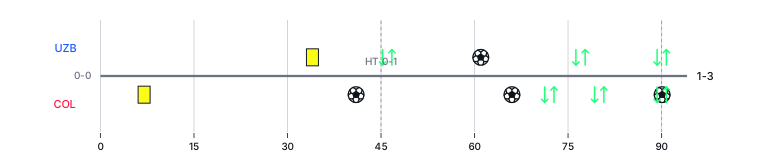
The goal at 41 minutes didn't begin with the finish. It began with where Daniel Muñoz and Johan Mojica chose to stand.
Both fullbacks registered average positions in the attacking half — Muñoz wide on the left, Mojica mirroring him on the right. Two fullbacks pushed that high means two wide reference points that Uzbekistan had to account for simultaneously. When Luis Díaz found Muñoz centrally, the shot came from close range and carried nearly a 0.5 chance of going in. That's not accidental positioning. That's the product of a structure that had established enough width to open a central lane, even if we can't isolate the exact defensive response that gave Muñoz the space.
The evidence here is the position and the result: Muñoz averaged in the attacking half on the left, Mojica in the attacking half on the right, and the first goal came through a central avenue assisted by Díaz. The width coincided with the opening. Whether Uzbekistan's back line tracked the fullbacks and conceded the center, or whether the space existed for another reason, the record doesn't specify. What it shows is two advanced wide players and a high-value central finish — a sequence where the structure gave Muñoz the position, and his recognition and execution did the rest.
The Closing Stretch Changed the Leverage
James Rodríguez came off at 72 minutes — Jaminton Campaz came on. Eight minutes later, Cucho Hernández replaced Luis Javier Suárez. What followed in the final window was measurably different from what Uzbekistan wanted out of that stretch.
Colombia produced four shots worth around 0.35 xG between the 76th minute and full time. Uzbekistan generated five shots in the same window but only 0.15 xG — more volume, less danger. The gap in shot quality tells you where those efforts were coming from: Colombia's opportunities were better positioned, Uzbekistan's were not. That's the window in which the match was decided.
The third goal made the sequence concrete. In the ninth minute of stoppage time, Campaz headed home from close range, with the assist coming from Hernández — the two players introduced in the second half combining for the goal that closed it at 3-1. Did the substitutions cause that outcome directly? The sequence supports correlation, not causation. But Campaz on the pitch, Hernández providing the final delivery, the ball in the net — the chain from substitution to goal is short. Colombia had built a platform through possession and width; the players who entered in the closing stretch were the ones who converted it.
Synthesis
Three layers, one result — and each one made the next possible.
The possession baseline wasn't decoration. Colombia's 61% and 520 passes at high accuracy meant Uzbekistan spent the match reacting rather than building. That environment is what allowed Muñoz and Mojica to stay high and wide without paying a heavy cost on the other end — if the ball mostly belongs to you, advanced fullbacks carry less risk. And those advanced positions were present when Díaz found Muñoz centrally in the 41st minute for a high-value finish.
The late phase was where the accumulated structure paid off. Campaz and Hernández entered a match Colombia already controlled, and the final window produced sharper shot quality for Colombia than for Uzbekistan despite Uzbekistan generating more attempts. The stoppage-time header — Campaz converting from Hernández's delivery — was the last beat of a sequence that had been running since kick-off.
What makes this worth examining is the order underneath the scoreline. Possession created the territory. The territory allowed the width. The width coincided with the central lane that Muñoz converted. And the two late substitutes found the same platform waiting for them when they needed it. The idea survived contact. The players read it at the right moments.