
Thirty Minutes of Possession, Zero Shots
South Korea finished the match with 58% possession — a number that, taken alone, tells you almost nothing useful. What the opening 30 minutes told you was specific: through two full phase windows, with the ball cycling reliably through their lines, South Korea did not produce a single shot. Mexico, working with less of the ball, had three in that same period.
The contradiction is not that possession is overrated as a general principle. It is that South Korea's possession in these phases was structurally disconnected from shot creation. The ball moved, but it did not arrive anywhere that forced a genuine decision. This is the gap the match exposed from the first whistle — control of the ball and control of the conditions under which that ball could be used are not the same thing, and here they pointed in different directions.
The easy reading of the final scoreline is a tight, competitive game between two evenly matched sides. The opening half hour complicated that reading before it had fully formed. A side with the majority of possession that cannot register a shot is not threatening — it is cycling. Mexico did not need to manufacture pressure in those phases; South Korea's buildup was not yet supplying any.
One Wingback High, One Wingback Home
South Korea's buildup was not just slow to threaten — it was structurally lopsided in a way that narrows the question of why. Kim Moon-hwan operated consistently in the attacking half on the left, pushed high and wide as the primary outlet on that flank. Young-woo Seol, his counterpart on the right, spent the match anchored deep in the defensive half — a fundamentally different role, a fundamentally different position on the pitch.
The result was a buildup that leaned left. When South Korea advanced, the threat concentrated down one channel. That kind of asymmetry can be functional — a single-side overload can draw defenders and open space elsewhere — but it also places a ceiling on unpredictability. A team that crowds one side and leaves the other locked deep gives the defending side one fewer problem to solve. The right flank was not a progressive option; it was effectively absent from the buildup structure.
What the positional gap between the two wingbacks cannot tell us is whether it caused the shot drought directly, or how Mexico's midfield responded in real time. The asymmetry describes a structural constraint on South Korea's ability to threaten from multiple angles. It does not, by itself, prove why South Korea never found a way through — but a buildup shaped this unevenly reduces the number of entry points available, and that reduction compounded across 30 scoreless minutes.
Two Minutes, Three Shots, One Goal
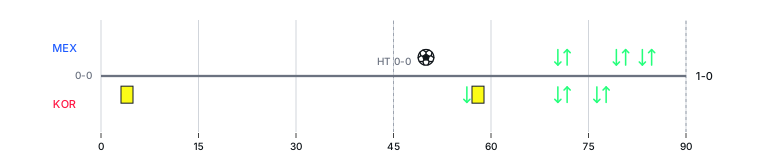
The goal did not come from sustained territorial dominance or a lengthy Mexico buildup sequence. It came from a burst. In the 49th minute, Jesús Gallardo missed with a left-footed effort. Moments into the 50th, Raúl Jiménez's header was blocked. Then Luis Romo finished right-footed — a low-quality chance converted, 1-0.
Three shots in roughly 90 seconds. None were high-percentage opportunities: Gallardo's around 0.04, Jiménez's around 0.04, Romo's around 0.06. What they represented was a cluster — a moment of compactness and sequential output in the match's opening second-half minutes that South Korea could not absorb cleanly. Romo's finish was the third attempt in that window, not the first.
The match turned on this sequence not because Mexico was rolling through its opponent, but because the window was enough. South Korea had moved the ball for 30 minutes without testing the goalkeeper; Mexico needed one compact exchange at the top of the second half to take the lead. That asymmetry — volume of possession against concentration of output — is what the scoreline was recording. A 0.06 chance converted from a three-shot cluster is not a sign of overwhelming pressure. It is a sign that one brief moment of sequential output, calibrated to the actual demands of this match, was sufficient.
The Surge That Came Too Late
Trailing 1-0, South Korea's response came through the bench. Yang Hyun-Jun entered at 71 minutes for the right-sided Seol, directly addressing the buildup asymmetry that had defined the first half. Gue-sung Cho came on at 77 for Seung Ho Paik, adding a direct aerial threat in the final third. The effect on the shot profile was significant and immediate.
In the final 15 minutes, South Korea produced six shots worth roughly 0.6 xG as a group — by far their most threatening phase of the match. The two highest-quality chances were both saves: Cho's header at 87 minutes was worth around 0.26, Yang Hyun-Jun's left-foot effort moments later around 0.16. Both were the kind of chances South Korea had been unable to create for the previous 80 minutes. Further headed attempts from Cho and Hyeon-gyu Oh in stoppage time kept pressure on but did not convert.
The timing link between the substitutions and the attacking spike is clear. What it cannot resolve is the harder structural question: what changed between the first half's scoreless cycling and this late intensity? Score-state pressure, fresh legs in advanced roles, and the tactical shift those substitutions represented all likely intersected. The surge was real, and it tested Mexico — but it arrived after the decisive moment had already passed. A 0.6 xG burst from the 76th minute onward does not rewrite what the first half diagnosed.
Synthesis
The match did not produce a complicated result. It produced a logical one, given the structures that shaped it.
South Korea held the ball, leaned left through an asymmetric buildup, and spent 30 minutes without threatening the goalkeeper. Mexico scored through three shots clustered at the top of the second half — the only sequence in the match that broke through with any sequential compactness. After the goal, South Korea found attacking intensity through substitutions that their starting shape had not generated, but found it too late and against a side that only needed to protect what it had.
The surface reading is a narrow Mexico win over a team that had more of the ball. The more accurate reading is that South Korea's possession was structurally disconnected from shot creation for most of the game, and Mexico's single productive burst was better calibrated to what the match actually required. More ball, built toward one flank, recycled without a right-side outlet — that is not a structure that punishes a compact defense. It is one that leaves the door closed from the inside.
What the late surge adds to that picture is bounded: it shows that when score-state pressure and the right personnel combined in the final phase, South Korea could threaten in ways the first half did not reflect. Whether that late capacity was always available, suppressed by the starting structure, or unlocked only by desperation is a question the 90 minutes raises without fully answering. The result is not ambiguous. The system that produced it still has something unresolved in it.