
Morocco's Possession Structure Decided What Kind of Match This Would Be
Morocco's 670 passes at nearly 90% accuracy, 59% of the ball — these numbers describe a structure that actively compressed Scotland's options from the first whistle. The clearest evidence isn't Morocco's attack; it's Scotland's absence from it. Between the 16th and 30th minutes, Scotland produced zero shots. When the second half opened, another zero-shot window extended through the hour mark. Morocco didn't need to do anything extreme to achieve this. They simply kept the ball long enough to make Scotland's buildup irrelevant.
The problem that kind of possession creates isn't just territorial. When one side controls roughly 60% of the ball for extended stretches, the other faces a compounding constraint: limited recovery time between defensive phases, fewer opportunities to build patterns in their own attacking third, and growing dependence on set pieces or long transitions for any chance creation at all. Scotland finished with six shots, none on target. That's not primarily a story of individual failure — it's a structural consequence of how little time and space Scotland had to operate in dangerous areas.
Morocco's control wasn't total. The final quarter fractured it, and Scotland found something late. But from the first whistle through the 75th minute, the match unfolded almost entirely on Morocco's terms. The possession structure didn't guarantee a goal. It did guarantee that Scotland spent most of the night solving a defensive problem rather than creating an attacking one.
Hakimi Was the Point Where Morocco's Structure Sharpened Into Threat
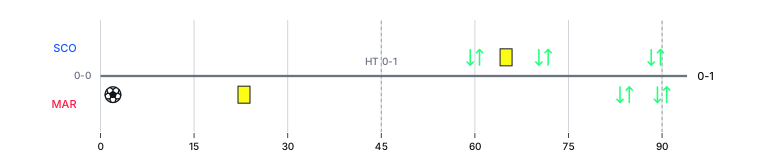
The question with Achraf Hakimi isn't whether he was Morocco's clearest individual attacking outlet — he was — but why his contribution stood apart from the rest of Morocco's attack. He accumulated 0.3 xG across 90 minutes, a total that exceeded any other individual threat Morocco generated. His most dangerous moment arrived in the 38th minute: an assisted right-foot attempt worth 0.30 on its own. That kind of shot quality doesn't arrive by accident — it requires the right player reaching a dangerous situation with the ball at his feet.
Hakimi operated in advanced areas wide on Morocco's left, his positioning stretching between the defensive and attacking thirds. That placement — high enough to be a genuine threat, wide enough to draw attention — gave Morocco an outlet that didn't require sustained central combination play to produce danger. His xG total effectively means he was carrying a significant portion of Morocco's individual threat in a single player's movement pattern over 90 minutes.
The evidence here is specific rather than sweeping. His spatial pattern and shot record confirm outlet status and shot production; they don't establish that every Morocco attack ran through him or that his wide role was a fixed tactical instruction. What they do show is that when Morocco's sustained possession created space and the ball reached Hakimi in a useful situation, the chance quality was there. That's the mechanism worth naming: possession control created the conditions; Hakimi converted one of those conditions into the match's clearest individual opening.
Ferguson Gave Scotland Defensive Ballast — and Nothing More Than That
Lewis Ferguson's 7 tackles — a match-high — and 2 interceptions need context to mean anything useful. He operated centrally in Scotland's defensive half, which placed him directly in the path of Morocco's central progression attempts for most of the evening. That positioning, combined with the volume of defensive actions, created Scotland's most consistent source of disruption through the middle of the pitch.
What this protected is relatively clear. Morocco finished with 12 shots and around 1.0 xG across 90 minutes — openings were being created, but not freely, and not through the center with the kind of ease their possession share might have permitted. Ferguson's presence, repeatedly making the tackle or cutting the passing lane, contributed to keeping Morocco's most direct central route restricted. He absorbed pressure. That's a real and necessary thing.
But defensive ballast doesn't generate attacking momentum, and this is where the performance exposes its own internal tension. Ferguson's role was specifically about resisting Morocco's structure — it wasn't designed to create Scotland's response to it. Scotland had zero shots on target for the entire match. His value was containment: absorbing what Morocco brought centrally, not manufacturing what Scotland needed going forward. The structure he helped provide was disciplined. It just solved only one side of an asymmetric problem — and the other side, the attacking side, remained largely unresolved until the final quarter.
The Late Substitutions Changed the Closing Phase — Not the Match
At the 60th minute, Scotland introduced Kieran Tierney. Eleven minutes later, Lyndon Dykes replaced Che Adams. What followed is documented even if causation can't be pinned entirely to the changes themselves. In the final 15 minutes, Scotland produced 3 shots worth 0.27 xG — their most concentrated attacking spell of the evening. Dykes, on the pitch for 19 minutes total, was central to it. His 86th-minute header from a corner carried 0.14 xG and represented Scotland's single clearest chance of the closing phase. A miss, but a real chance.
Dykes's positioning tells the structural story. He stayed in the center of the attacking third, which shifted Scotland's threat toward box occupation and aerial delivery rather than the cautious shape they'd maintained for the first hour. Morocco's grip loosened slightly in this period — they also generated 3 late shots, but worth only 0.14 xG combined, less threatening than Scotland's final wave.
The contradiction is real but it's also bounded. Scotland's most dangerous football came when the game state justified — or required — committing resources forward. That decision, backed by the substitutions, produced their best attacking phase. But it arrived after Morocco had already spent 75 minutes dictating how the match was played. The late push changed the shape of the closing phase. It didn't change who had set the terms from the start.
Synthesis
What makes this match coherent as a system rather than just a result is how each mechanism reinforced the others without requiring any single element to carry the whole weight. Morocco's possession structure — sustained, high-accuracy, operating across both halves — set the rhythm. Scotland couldn't build from the back with continuity; their attack was episodic rather than sustained. Within that framework, Hakimi became the sharpest individual expression of what Morocco's possession could produce: not through constant involvement, but through positioning when the ball arrived in the right situation and the shot quality was genuinely high.
Ferguson kept Scotland organized and competitive in the middle. His defensive workload was real and the protection it offered was visible — Morocco's central progression wasn't free, and the chance count reflected that. But individual ballast in midfield doesn't generate an attacking platform, and that gap in Scotland's structure was never solved in the first 75 minutes. It required a game-state decision — substitutions, risk, forward commitment — to unlock anything approaching genuine threat.
The late push is where the match's internal tension becomes clearest. Scotland's best attacking shape depended on conditions that Morocco's structure had made too costly to adopt earlier. They committed forward, Dykes arrived centrally, they created their best chance of the night — and it wasn't enough. That asymmetry is the match in miniature: one side set a structural problem from the opening whistle; the other found a partial answer only when the time to use it had nearly run out.