
The Team That Accepted the Ball Also Accepted the Game
USA set the terms of this match through the ball, not through industry or fortune. Sixty-two percent possession and 524 passes completed at better than 85% accuracy are not merely pleasing numbers — they describe a team that understood where the match needed to be played and was willing to accept the burden of running it. Australia managed 308 passes at 71%, which tells you something about the kind of football each side was prepared to offer and the kind each was content to receive.
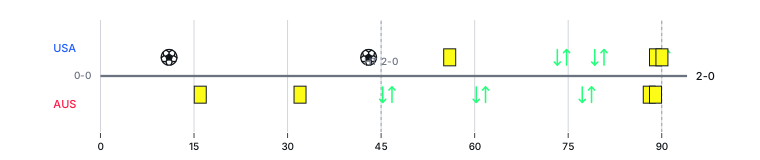
The opening quarter-hour made the hierarchy plain. USA produced four shots to Australia's two, and an own goal by Australian defender Cameron Burgess put the home side ahead in the 11th minute. The goal arrived early, but it did not feel accidental. USA had already established that they would circulate without anxiety — that they would move Australia rather than wait for a mistake. That is a particular kind of authority. Not spectacular, but real.
What possession at this level buys is not goals directly. It removes other people's options. Australia spent most of the first half defending, clearing (23 clearances for the match), and fouling (16 fouls total). That is the shape of a team that has handed the game's governance elsewhere. USA accepted that responsibility without making a speech about it. The structural cost of Australia's chosen response would reveal itself clearly enough.
Australia's Line Looked Like Courage. It Functioned Like a Gamble.
The interesting question is not why Australia conceded twice in the first half. The interesting question is what they were attempting instead, and what it cost them.
Both of Australia's center-backs — Harry Souttar and Alessandro Circati — averaged positions in the attacking half across the match. That is an aggressive structural choice. It compresses the space between the lines, challenges USA's progression higher, and attempts to shift the contest into a territory where Australia might compete. The intention was plausibly to deny USA the comfortable circulation they clearly preferred. The problem is that a line positioned that high has considerably further to travel when possession turns.
USA's opener came at 11 minutes, through that Cameron Burgess own goal. Alexander Freeman added the second at 43. Two goals before halftime, both against a side whose center-backs had moved persistently into territory that left space in behind. Average positions across a full match cannot locate Souttar or Circati in the exact second before either chance arrived — the link between the structural tendency and the specific outcomes is plausible, not proven to the centimeter. But the pattern is not subtle. Australia accepted a tradeoff — a high block, a compressed midfield, space conceded behind the line — and USA found that space twice before the break. A gamble that does not pay is still a gamble. The match remembered which side had chosen it.
Three Substitutes, One Decent Chance, and a Game That Stopped Being Contested
Three substitutions at halftime is not adjustment. It is admission that the first half had gone badly enough to require structural surgery.
Australia brought on Jason Geria, Nishan Velupillay, and Mohamed Touré at the break, replacing three starters simultaneously. The immediate window — 46 to 60 minutes — produced nothing from Australia in attack: zero shots, zero threat. USA managed two modest attempts of their own in that period, around 0.1 xG combined, which is the shooting output of a team protecting a lead rather than extending it. Both sides were, in different ways, declining to take responsibility for what happened next.
Then the picture shifted. After the 61st minute, USA registered no shots for the remainder of the tracked window. Australia produced two, carrying roughly 0.3 xG between them — the most meaningful attacking return they managed all evening. The clearest moment was a Cristian Volpato fast-break at 62 minutes: a right-foot chance from a position that offered genuine probability, around one-in-four by the shot-quality measure. He missed. But the fact that Australia had reached that territory at all, through a counter from a team two goals down and comprehensively outpossessed, suggested the structural changes had genuinely opened options that did not exist in the first half.
Whether USA chose to manage the game conservatively or simply ran out of attacking intent is a distinction the record cannot make cleanly. What it shows is that the side which had governed the match stopped attempting to govern it — and Australia, briefly, had something to say.
Synthesis
USA governed this match with possession and early goals. Australia accepted a structural tradeoff that punished them twice before halftime. Three halftime substitutes changed the available options without changing the scoreline. That is the structure — and it is not particularly flattering to either side in full.
USA's case is the stronger one, but it carries a qualification. Sixty-two percent possession, two first-half goals, and a lead that was never seriously threatened: that is the result of a team that understood its responsibility and met it through the first 43 minutes. The passing was controlled, the early territorial pressure was genuine, and Cameron Burgess's own goal in the 11th minute came from a situation USA had earned. But after the break, with the match effectively settled, the home side's attacking output dropped to nothing. That is not a tactical crime. It is, however, a team that handed back the game's forward momentum and spent the final half-hour hoping Australia's new-look attack would not make them pay for it.
Australia's story is more complicated. The high defensive line that gave USA space for two goals was their own structural decision, and it failed them plainly. The triple substitution was bold — perhaps the only bold thing available to them at that point. Volpato's fast-break chance at 62 minutes was the best thing they produced all night. But 0.44 xG across a full match and a 2-0 defeat is not a near thing. It is a team that was outgoverned for the hour that mattered, then found a foothold in the quarter-hour that didn't.
The match's judgment is precise: USA accepted the game's demands when it was hardest to do so, and that was enough. Whether they set those demands aside in the second half by design or drift is, in the end, a question only they can answer.