
Fast Breaks, Not Patience
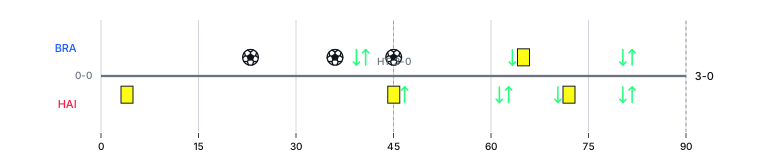
The match was settled not by possession or positional patience but by two vertical moments Haiti had no structural answer for in real time. Matheus Cunha scored at 23 minutes and again at 36 — both left-footed, both from fast-break situations, both from close range near the center of goal. Brazil produced five shots worth roughly 0.6 expected goals in the 16-to-30-minute window and scored once; the following phase delivered two shots worth another 0.6 expected goals and produced two more goals. That is a conversion rate that explains a scoreline without explaining a style.
What makes this interesting is what Haiti did during those same windows: nothing. Zero shots in both phases. A deep block absorbs progressive buildup reasonably well. It does not absorb a team that can immediately punish turnovers with vertical attacks before the shape can reset. Haiti's structural problem in those moments was not that Brazil were relentless — it was that Brazil did not need to be relentless to score twice.
Cunha played 64 minutes, scored from his only two shots on target, and finished with a combined expected goals figure around 0.7. The efficiency is real and worth stating precisely. It is also limited to two specific transition sequences — this tells us what happened in those moments, not whether Brazil can manufacture the same damage against sides that defend the vertical lanes more carefully. The first half was decided. The second half would be a different conversation.
The Right Side Did the Expensive Work
Vinícius Júnior's average position on the night sat well into the right attacking third — consistently high, consistently wide. The mechanism behind that positioning was asymmetric: one fullback held deeper while the other pushed into the overlap, creating the spatial condition for Vinícius to stay advanced rather than dropping into midfield shape. This is not a claim about instructions or role assignments; it is a claim about where the space existed and where he occupied it.
The output from that position was clean. He assisted Cunha's second goal at 36 minutes, and then scored the third himself in stoppage time — a right-foot finish assisted by Paquetá, converting a chance worth roughly 0.3 expected goals. One goal, one assist, two shots on target across 81 minutes. Against a side defending deep, that kind of return from an advanced wide position reflects a structure that kept him in attacking areas long enough to contribute twice in the same half.
The spatial record shows where he averaged, not every movement he made. What it confirms is that both contributions came from an advanced right-side position — goal and assist converging in the same area the structural setup had made available. In a match already settled by fast breaks, Vinícius was the factor that made the margin three instead of two. That sounds like praise. It is also simply the most accurate description of what happened.
Casemiro Did the Math No One Films
Six tackles in 90 minutes. That is the simplest and most honest version of what Casemiro contributed here. Add one interception and two clearances, and you have a player who was consistently active in winning the ball rather than simply positioning around it — which is a different kind of presence, and a less glamorous one.
The limitation is genuine and should be stated plainly: six tackles does not tell you where those interventions happened, when they interrupted Haiti's rhythm, or what Brazil's broader shape looked like around them. A single player's tackle count cannot reconstruct a team defensive structure, and it should not be asked to. What the number establishes is a consistent individual defensive footprint, applied across the full ninety minutes.
In the context of a match Brazil spent protecting a three-goal lead, that footprint had a specific function. When the game state tilts this far before halftime, a central midfielder's job becomes simpler and less visible: stay between the ball and the goal, make the intervention when it is available, and make the lead boring to chase. Six tackles across ninety minutes suggests Casemiro took that job seriously. Whether Brazil needed him to, given the scoreline, is a separate question. That he was present and active throughout is not in doubt.
Haiti Shot. It Did Not Matter.
Haiti's second half looked like a team given room to try with no clear idea what to do with it. Brazil registered zero shots in the first two fifteen-minute windows after the break. Haiti registered several. The quality was negligible in each phase: the 46-to-60-minute window produced two Haiti shots worth about 0.11 expected goals combined; the next fifteen minutes added three shots for another 0.11; the final stretch brought four more attempts worth roughly 0.09. No phase cracked 0.12. Haiti's total expected goals across the entire match was 0.23, with zero big chances recorded.
The individual attempts tell the same story from different angles. Wilson Isidor had a shot blocked at 49 minutes. Jean-Ricner Bellegarde missed from a fast break at 56. A corner header at 63 was saved. Two set-piece attempts in the 66th minute both went wide. Isidor found the keeper again at 87. The pattern — blocked shots, missed set pieces, saved long-range efforts — is a portrait of a team with access to the final third and nothing sharp to do once it arrived there.
The easy version of this is that Haiti came on after the break, and technically that is not wrong: they did produce shots, which they had not managed at all in the first half. The less flattering version is more accurate. Haiti found space in a match Brazil had largely stopped attacking, and the resulting volume reflected effort rather than genuine danger. That gap between quantity and quality is the honest summary of forty-five minutes — not momentum, not competitive pressure, just a ceiling on what Haiti could manufacture even when given room to try.
Synthesis
Three goals before halftime, built on two fast-break sequences Haiti had no structural answer for, and one right-side combination that pushed the margin to three in stoppage time. A midfielder completing six tackles over ninety minutes while Brazil managed a comfortable lead. And a second half in which Haiti generated enough shots to look busy without generating anything that threatened to change the score.
The comfortable interpretation is that Brazil were professional and decisive. That is accurate. The more interesting version is that the match had exactly one half of football worth analyzing, and it was decided not by sustained creative pressure but by transition efficiency against a side that could not defend the vertical lane in real time. What Brazil did well, they did quickly. What followed was administrative.
Vinícius was the most consequential figure — goal and assist from an advanced right position in the same half. Cunha was the most efficient — two finishes from two shots, both in transition, both before the hour. Casemiro was the steadiest — six tackles, ninety minutes, nothing dramatic to resolve. Haiti produced 0.23 expected goals across the entire match and zero big chances. The scoreline is clean. The football, for one half, had genuine sharpness. The other half was the kind of thing that wins matches and loses interest simultaneously — effective the way filing paperwork is effective. It gets done. Nobody admires it.