
Two Substitutions, One Sequence, Two Goals
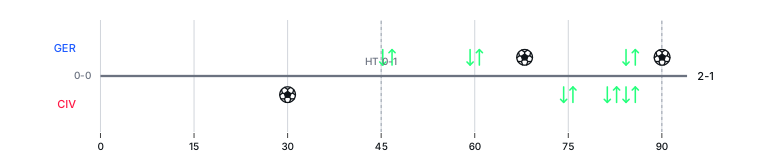
Germany were a goal down and barely threatening when the double change arrived at the hour mark. Jamal Musiala made way for Deniz Undav; Aleksandar Pavlović came off for Nadiem Amiri. Eight minutes later, Amiri picked up the ball, found Undav in the box, and Undav finished with his left foot. That was 1-1. Then, deep into stoppage time, Felix Nmecha assisted Undav's second — same outcome, different helper. Final score: 2-1 to Germany.
The numbers around that shift are hard to ignore. Between the 61st and 75th minutes, Germany produced three shots worth around 0.7 in chance quality, scored once, and allowed nothing. Before the changes — the entire opening sixty minutes of the second half — Germany had managed one shot worth almost nothing. Côte d'Ivoire had four shots in that same window. The direction of the game had been clear.
What the substitutions did structurally is harder to pin down with certainty — this is not a case where you can point to a single coached adjustment and trace every subsequent pass back to it. What you can say is that Undav gave Germany a finishing reference in the box that the first hour did not have, and Amiri's assist on the equalizer came quickly enough to suggest he plugged directly into a live attacking sequence rather than spending time finding his feet. That combination — a recognizable target, a creative passer, enough space to connect — is what the 68th minute made visible.
The Right Side Stayed High and Usable
Before asking why Undav found space, it helps to look at where Germany kept their weight. Florian Wirtz operated high on the right throughout the game — attacking-half territory, wide enough to stretch Côte d'Ivoire's left side. Nathaniel Brown held a similarly advanced position on the same flank, also firmly in the attacking half. That combination meant Germany had two bodies consistently available in the channels on that side.
The asymmetry is sharp when you compare it to the left. Nico Schlotterbeck sat noticeably deeper — a defensive-half average position — which gave Germany a different shape on each side. One side offered forward presence and width; the other anchored the structure. That kind of split either keeps a progression lane available or leaves the back side exposed on turnovers. The occupation on the right was consistent across the match.
Brown's numbers reflect this dual role: six tackles and an interception alongside a shot on target. He was high enough to contribute offensively, but the defensive numbers suggest he was also absorbing pressure when things broke down. Average positions tell you where players operated, not what passes they exchanged — but the right-side occupation was the persistent shape Germany brought to the game, and when Undav arrived, that lane was still there.
Côte d'Ivoire Had Already Made Germany Pay Once
The reason the 60th-minute changes mattered so much is what was already on the scoreboard. Franck Kessié scored at the 30-minute mark — a right-foot finish from close range, a shot worth around 0.3 in chance quality — and that goal came from transition. In the 16-to-30-minute window, Côte d'Ivoire generated two shots worth a combined 0.6, scored from one, and Germany had almost nothing in return.
The second half started with more of the same. At 50 minutes, Kessié was on the end of a fast-break chance — blocked. At 51 minutes, Christ Oulaï had another transition opportunity — missed. Both chances came before Germany had made their changes. In the 46-to-60-minute window, Côte d'Ivoire generated four shots worth 0.4; Germany produced one worth almost nothing. The flow of the match was pointing in one direction.
These were not speculative long shots. Kessié's goal came from close range on a transition move; the two blocked and missed chances after half-time were tagged fast-break and reached positions worth 0.16 and 0.20. Côte d'Ivoire kept finding the same route: move quickly once possession turned over, arrive in threatening positions before Germany reorganized. That threat did not disappear after the substitutions — it just ran out of time to punish Germany again.
Synthesis
Three things shaped this result, and none of them works as a standalone explanation. Germany had a consistent right-side presence — Wirtz and Brown high, Schlotterbeck deeper — that gave the attack a lane to work through. That lane existed in the first half too, and Germany were still a goal down at half-time. The shape creates the opportunity. The players still have to recognize it and execute under pressure, and for sixty minutes, the combination simply wasn't clicking.
Côte d'Ivoire's transition threat was the load Germany had to manage throughout. Kessié's goal came from a quality chance, and the two fast-break opportunities at 50 and 51 minutes were earned looks at goal — not speculative efforts, but shots from positions that hurt. Côte d'Ivoire kept arriving in threatening positions off transitions, and that pattern held until the substitutions changed the tempo on the other end.
The 60th-minute changes are where the match turned because Undav gave Germany something specific: a finisher in the box who could convert the chances the right-side shape was building toward. Amiri's assist for the equalizer came just eight minutes after entering the pitch. Undav's second, in the fourth minute of stoppage time, sealed it. The right side provided the occupation. The transition threat had nearly made it irrelevant. What settled it was two substitutes finding each other, in the right space, when it still mattered.