
The Flanks Were the First Problem Sweden Could Not Solve
Netherlands did not build this match around one flash of individual quality or one lucky sequence. The structure was the argument. Denzel Dumfries stayed high on one flank and Cody Gakpo occupied the opposite wide lane, and between them they created a simple, repeating problem: Sweden's defensive block could not hold its shape against both simultaneously.
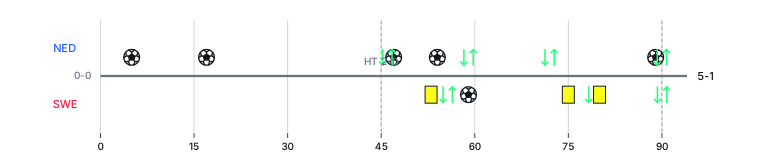
The connection between that width and the actual goals was direct. Gakpo assisted the opening goal at five minutes, Dumfries assisted the second at seventeen, then Dumfries provided the third just after the interval. Three goals, two wide players, both flanks used in the same tactical logic. The Netherlands did not need to disguise the mechanism — they needed Sweden to fail to answer it, which Sweden did.
What this cannot prove is whether that width was part of a preplanned wing-first scheme or an emergent pattern that kept working. The distinction probably matters less than the result: the same two wide players were directly implicated in the match's three most structurally significant goals. When your wide players are your most productive assisters and they are operating from opposite touchlines, the width is doing something real. For Sweden, that something was making every defensive decision a trade-off they kept losing.
Brobbey Was the Central Reward the Width Kept Generating
Width stretching a defensive block is only useful if someone is positioned to receive what it opens up. Brian Brobbey was that someone. His average position sat deep inside the attacking half through the center — the natural target for delivery once Sweden's defensive coverage was being pulled to both sides.
Both of his goals came from the same logic compressed into the opening twenty minutes. At five minutes, Gakpo delivered from wide and Brobbey converted from close range — a shot with an xG value above 0.55, the kind of chance that should go in. At seventeen, Dumfries came from the other flank and Brobbey converted again, this time from an even higher-value position, a shot carrying an xG above 0.63. The opening fifteen minutes produced three Dutch shots worth 0.61 xG in total, with Brobbey's first chance accounting for nearly all of it — not chaos, but controlled access to a central striker in the spaces the width created.
The fair caveat: this describes the opening sequence, not a complete picture of how Netherlands created chances across ninety minutes. But the opening sequence is what set the terms of the match. Two goals in seventeen minutes, both finished centrally, both generated from wide delivery — the structure worked before Sweden had any realistic chance to adjust to it.
The Second Half Turned Into Transition Leverage
Three-nil at half-time is the kind of scoreline that changes how both teams move. Netherlands could afford to transition quickly rather than patiently recycle possession. Sweden had to push forward to make the scoreline meaningful. The result, in the fourteen minutes between the forty-seventh and fifty-ninth minute, was a match that briefly belonged to neither side's structure.
Gakpo's goal at fifty-four minutes and Anthony Elanga's reply at fifty-nine were both fast-break events — not set-piece situations, not patient buildup. Gakpo converted from a longer distance than the early central chances, finishing a break on the counter. Elanga, assisted by Alexander Isak, scored Sweden's only goal in identical circumstances five minutes later. The same window produced four Dutch shots worth over a combined expected goal and three Swedish shots worth roughly 0.4 xG — the match was briefly permeable in both directions.
What the record does not show is exactly where possession was lost before each transition began. What it does show is that both teams found themselves exposed behind their lines in the same window, and both converted once. For Netherlands, a fourth goal extended an already decisive lead. For Sweden, the moment proved that transition space existed — but only briefly, and not enough to change anything structural about the match.
Summerville Arrived at Half-Time and Compounded Everything
Substitutions at half-time are rarely dramatic on their own. The drama comes from what the substitution does to the game's existing tensions. Crysencio Summerville came on for Donyell Malen at the interval, and within eight minutes he had assisted Gakpo's fourth goal. He then scored the fifth himself at eighty-nine minutes, set up by Memphis Depay. One goal, one assist, forty-five minutes played — a stat line that requires no interpretive generosity.
The structural point is not just that Summerville was effective. It is that his arrival added another attacking presence into a second half where Sweden was already trying to push higher and cover more ground. A team defending a three-goal deficit cannot afford more attacking pressure — and that is precisely what Summerville delivered. His assist for the fourth came from a fast-break situation where the transition space had already opened, and he was in position to exploit it.
This does not mean the substitution was designed to produce those specific moments, and the evidence does not establish exactly what role or zone he occupied within the attacking shape. The output is what is documentable: a substitute who contributed directly to two of the final three goals across a second half in which Netherlands never looked like conceding their lead.
Sweden's Back Three Spent the Match in the Wrong Half
The clearest structural fact about Sweden's performance is where their defenders were. All three members of their back line — Gustaf Lagerbielke, Isak Hien, and Victor Lindelöf — averaged positions in the attacking half across the match. Not slightly advanced. Consistently on the wrong side of the halfway line in aggregate.
That kind of positioning carries a predictable cost: space behind. When Netherlands broke in the second half, they were not discovering space that hadn't existed — they were running into territory the Swedish back line had ceded by spending its time so far forward. The transition goals in the forty-seventh to fifty-ninth minute window were the visible consequence of a shape that left the area behind the defenders accessible. The high positioning coincided with repeated exposure throughout the match.
The important limit here is that average positions describe where players spent their time, not the exact defensive line at every moment of exposure. Whether Sweden's high positioning was an instructed tactic, a byproduct of sustained Dutch possession pressing them back, or something else entirely is not something the record can confirm. What the record does confirm is that all three central defenders habitually operated ahead of halfway, and that exposure behind them was a recurring feature of the match. The match did not create that contradiction. It revealed it.
Synthesis
The 5-1 result looks like a comfortable win. It was — but comfortable is not quite the right diagnosis. It was a connected one.
Netherlands built the match in layers that each depended on the one before it. Dumfries and Gakpo stretching the width created the conditions for Brobbey to collect high-value central chances in the opening twenty minutes. Those early goals set a game state that Netherlands could exploit in transition, and Summerville's arrival compounded the damage rather than simply extending a lead. The mechanisms were linked: wide access opened central space, central space was converted early, early goals forced Sweden into a position that made second-half transition exposure worse.
Sweden's high defensive positioning ran through all of it as the constant background condition — their back three spending the match ahead of the space that kept being exploited. Whether that was instructed aggression or structural drift is not something the pitch record settles. What it does settle is that the positioning was never corrected, and the scoreline accumulated accordingly.
The easy reading of a 5-1 is that one team was much better. That is probably true here. The more precise reading is that Netherlands had a mechanism that worked from the first minute and kept finding the same structural gap through different phases and different personnel. Sweden's shape did not protect them. In a game built the way this one was, that is the thing that mattered.