
Volume Without Payoff
Seventy-nine percent possession is not a performance — it is a condition. What you do inside that condition is what matters. Türkiye had 630 completed passes and 32 shots. On the surface that reads like dominance. Inside the numbers, a different problem was visible: the ball moved cleanly, but the block held, and the two things are not in contradiction.
The early shot log makes the case plainly. Kenan Yıldız tried at 15 minutes — blocked. Hakan Çalhanoğlu twice, from a corner at 21 and a free kick at 23 — both blocked. Arda Güler at 25 — blocked again. None of those four carried more than 0.05 in chance quality; combined they were barely worth 0.1. The 16-to-30 minute window produced four shots worth roughly 0.09 total. The 31-to-45 stretch added seven more for 0.23. Eleven shots in the first half's core phases generating under a third of a goal's quality.
That pattern reveals the gap between occupying territory and threatening it. Paraguay's compactness kept the central angles closed. Türkiye moved the ball, rotated, and circulated — but circulation is not penetration. High volume against a compact block at low shot quality is a description of peripheral pressure, not of a side unlocking a defense. The possession stat flatters the process. The shot outcomes are closer to the truth.
The Substitution That Said Something
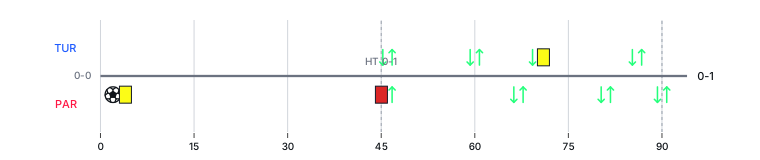
Miguel Almirón walked at 45+3' — not for a foul, but for an argument. Paraguay entered the second half with ten men against a side that had spent the first half knocking on their door with one of the heaviest possession profiles you will see.
The halftime response: Isidro Pitta, a forward, came off. Damián Bobadilla, a midfielder, came on. That is the documented fact — and the shape of the exchange is itself informative. Replacing a forward with a midfielder after a red card, before a second half at a numerical disadvantage, is a stabilizing move. Not a like-for-like swap, not a tactical adjustment designed to threaten. A forward gone; a midfielder added.
What followed in the opening phase of the second half was consistent with that reading. Between 46 and 60 minutes, Türkiye managed four shots worth 0.14 xG — a rate barely above their first-half blocked-shot stretches, despite the man advantage. Bobadilla's 45-minute contribution was functional and unglamorous: two tackles, two clearances. That is the profile of someone absorbing pressure rather than generating it. Whether the substitution caused the stabilization is more than the record can prove — a single roster move does not explain forty-five minutes of defensive organisation. But the move announced something plainly. A team that replaces a forward with a midfielder after losing a player is not pretending it can attack at the same level it was before.
One Wide, One Narrow: The Shape Türkiye Worked From
Türkiye's attacking shape was not symmetric, and that asymmetry defined the spatial puzzle they presented. Kenan Yıldız held a consistently high, wide position on the right — pushed toward the flank in the attacking third, the outermost reference point in Türkiye's attack on that side. On the left, Mert Müldür sat narrower and shallower, further from the goal line and closer to the center of the pitch.
The contrast is sharp. Yıldız was the primary width carrier on the right while the left side offered no equivalent stretch. That meant the attack's width pressure was concentrated on one flank. When Türkiye moved the ball rightward, Yıldız provided the widest outlet. The left offered something different — presence, but not the same kind of high, far-side stress.
The structural consequence of a one-sided width bias is that a compact defense can organize its coverage more economically. A block that knows the primary width is right-sided does not need to commit equal attention across both flanks simultaneously. Türkiye's shape was coherent — it had a clear wide reference point — but it did not force the kind of dual-flank problem that stretches a compact defensive unit from both sides at once. Average positions do not tell us how every individual attack unfolded, but the overall picture they reveal is a team that applied asymmetric width rather than bilateral width stress.
When the Block Finally Bent
At 76 minutes, the numbers changed. In the final phase of the match, Türkiye produced 11 shots worth 1.18 xG — more than half their total match output crammed into fifteen minutes. The block that had held for three-quarters of the game started conceding the central positions it had protected all along.
The two sharpest moments both came at 89 minutes. Deniz Gül struck left-footed from close in — a 0.4 xG chance, the single highest-quality opportunity of the match — and missed. Moments later Can Uzun found a similar central position from an assisted situation and was saved. Both arrived from inside the defensive shape that had held against corners, free kicks, and wide attempts throughout. These were not peripheral efforts. They were the central, high-quality chances the first-half volume had never produced.
What forced the deformation is not something the record can answer with certainty. There is no fatigue marker, no tracking data showing Paraguay's lines dropping. What is visible is the effect: from 76 minutes onward, Türkiye started reaching the zones the compact block had denied them. The late surge produced the genuine quality. The earlier volume — the 79% possession, the 630 passes, the first-half parade of blocked attempts — had not. The match's real danger arrived last, from a structure that finally gave ground under cumulative load.
Synthesis
Two tensions ran through this match, and neither fully resolved on the day.
The first: Türkiye's possession advantage functioned less like control and more like sustained peripheral pressure. Seventy-nine percent of the ball and 630 passes moved the game without consistently generating dangerous access. Paraguay's block — reinforced at halftime when a forward gave way to a midfielder following Almirón's dismissal — absorbed the territorial and numerical superiority for the bulk of the second half. The volume looked like winning. The shot quality, for most of the match, said otherwise.
The second: the right-side width bias that defined Türkiye's attacking shape gave the defense a solvable spatial problem. Yıldız high and wide on the right, the left sitting narrower. A compact ten-man block can organize around a single dominant flank more efficiently than around bilateral width stress. The shape had coherence; it did not have the bilateral stretch that tends to deform compact structures.
And then the final fifteen minutes arrived and changed the texture of everything. Eleven shots, 1.18 xG, Gül and Uzun both reaching central high-quality positions that had been closed all match. Türkiye's 2.1 xG for the game sits almost entirely in that late window. The contradiction the match exposed is not that possession is useless — it is that possession without central penetration is a deferral, not a guarantee. The danger eventually came. The question the result leaves open is whether the path that finally found it was always available, or whether it required the block to exhaust itself first.