
Iran's Box Protection Set the Ceiling
Iran's defensive work had a specific rhythm to it: get bodies to the ball before Belgium could set their feet for a clean finish. Fifty clearances across ninety minutes is the volume of a team that kept winning that race. Shoja Khalilzadeh was the anchor — 14 clearances, 9 duels won, 3 shots blocked. He was meeting Belgium's entries before they became shots. Hossein Kanaani contributed 8 clearances and another 2 blocks from the other side of the box. This was not passive defending. It was constant, physical work to collapse the finishing angle every time Belgium got close.
The phase windows from the first half make the ceiling visible. Between the 16th and 30th minutes Belgium produced 4 shots from just 0.22 expected goals — spread thin across four attempts. The next window, minutes 31 to 45, was 4 more shots and 0.47 xG combined — better, but still low value per attempt. Iran had zero shots in both periods. The entire first half was one team in possession trying to find the crack and one team clearing, blocking, and recovering before it opened.
The constraint was structural, not accidental. Iran kept numbers around the ball inside their own box, forced Belgium wide, and absorbed whatever came through. The clearance count is not just a defensive statistic — it is the footprint of a shape that Belgium could not consistently break down into a clean look at goal.
Belgium's Right Lane Was Their Best Answer
When the center was blocked, Belgium kept returning to the right. Leandro Trossard stayed high and wide on that side all match, close to the touchline, finding angles to play through the congestion or behind it. Maxim De Cuyper pushed even higher, behaving less like a fullback and more like a wide attacker arriving into the box. The spatial pattern was consistent: both players operating in the attacking half on the right side, layered so one could create while the other arrived.
The production numbers match that picture. Trossard finished with 6 key passes and an expected assist figure of 0.6 for the match — nearly all of it built from that advanced right-side position. De Cuyper put 4 shots on target and accumulated 0.843 expected goals across the day, a volume that reflects how often he arrived in threatening positions. He also missed one big chance outright. The right side was not Belgium's only avenue, but it was the one that kept generating the clearest looks at Beiranvand's goal.
The mechanism was straightforward: Trossard found the spaces between Iran's defensive lines and fed De Cuyper's runs into the box. Iran's compactness through the center pushed Belgium wide, and the wide route kept producing entries. The problem was not the route — it was what waited at the end of it.
The Red Card Narrowed What Belgium Could Ask For
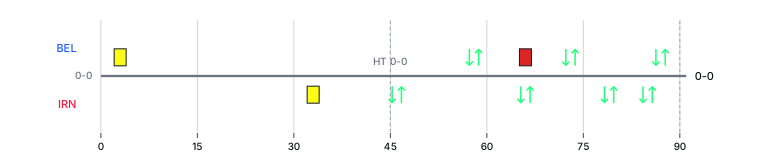
Nathan Ngoy's professional foul in the 66th minute — last man, red card — changed Belgium's arithmetic. Down to ten men with more than twenty minutes left and nothing on the board, the choice set compressed immediately. Seven minutes later, Romelu Lukaku came off for Arthur Theate. That substitution said everything about how Belgium read the situation: defensive structure first, attacking threat second.
The phase immediately following the card — minutes 61 to 75 — produced just 2 Belgium shots at a combined 0.07 expected goals. That is not a team pushing for a winner; that is a team managing exposure while reshuffling. Theate completed all 9 of his passes, won an aerial duel, made a ball recovery — he did exactly what the change asked him to do. Belgium's output did recover in the final phase, with 6 shots and 0.38 xG from minute 76 onward, but that was with a striker gone and the shape altered.
The red card did not end Belgium's attack. But it removed their primary box threat at the moment they most needed to take risk, and it forced a reshuffle that, for the critical fifteen-minute window right after, left them with almost nothing going forward. The structure got smaller precisely when it needed to get bigger.
Beiranvand Was There Every Time
Even with Iran's outfield players doing their clearing and blocking work, Belgium still put 7 shots on target. All 7 came from inside the box. Alireza Beiranvand saved every one of them.
De Cuyper tested him three times in the first half alone — at the 9th minute, then again at 44, and once more at 59 with a right-foot shot that carried roughly 0.35 expected goals, the clearest chance Belgium had all day. Beiranvand got down and stopped it. Kevin De Bruyne's assisted effort at 42 minutes, around 0.22 xG, same result. De Cuyper came back at 86 minutes in the closing stage and found Beiranvand positioned correctly again. Seven chances, seven saves, zero goals conceded.
This is what separates a goalkeeper having a good game from one who is deciding it. Beiranvand was reading the shots early — his positioning on the De Cuyper attempts at the near post, the De Bruyne effort into the center of goal — and getting set before the ball arrived. Iran's defensive shape created the clearance volume in front of him. Beiranvand was the final layer that absorbed everything that got through. Between fifty clearances and seven saves, Belgium ran out of ways to find the net.
Synthesis
The scoreline came from a chain, not a single decision. Iran compressed their penalty area and forced Belgium to find a way around the central block. Belgium found one — the right side, Trossard creating and De Cuyper arriving — and it worked well enough to generate real chances. But Iran's clearance volume, led by Khalilzadeh, kept those entries from becoming clean finishes. The structure in front of Beiranvand held its shape.
Then Ngoy's red card narrowed Belgium's options at the worst possible moment. Losing Lukaku to restore defensive balance meant Belgium's box threat shrank just when they needed to force the issue. The fifteen minutes immediately after the card were Belgium's quietest attacking period of the match.
And every time something did get through — De Cuyper from close range, De Bruyne from a good position, De Cuyper again in the final minutes — Beiranvand was there. Seven saves from inside the box. Each one the correct read at the correct moment.
This is how a structured defensive performance holds: the outfield shape limits the quality, the goalkeeper absorbs the quality that survives, and a moment of discipline breakdown on the other side removes the only remaining variable. Belgium had the route. They had the creator and the runner. What they never had was a shot that found the net — and that, precisely, is what each layer of Iran's defense was built to prevent.