
Room Was Asked Fifteen Times and Refused Each One
Curaçao kept a clean sheet because their goalkeeper made 15 saves — 10 of them from inside the penalty area — against opponents who generated enough quality to expect three goals. That is the sentence that explains the result. Everything else is context.
Eloy Room faced 27 shots, 15 of them on target. Ecuador put 21 of those attempts from inside the box. Room dealt with each one. The provider ranked him the best player on the pitch with a perfect rating, and the underlying numbers — 10 saves inside the area against a side that reached the final third 101 times — support that judgment without embellishment. The clean sheet was not a collective defensive achievement in any ordinary sense. It was a single man's work, repeated fifteen times.
The responsibility placed on a goalkeeper in this position is severe: last man, outnumbered in his own box, facing repeated service from a team that had governed possession for ninety minutes. Room accepted it. For Curaçao, that acceptance was the only reason arithmetic kept them level. Ecuador hit the woodwork once and still could not score. The route to a goal ran through Room, and Room blocked it every time.
The Midfield Governed — Which Is Not the Same as Winning
A midfield must govern, not merely commute. By that standard, Moisés Caicedo and Pedro Vite governed. Caicedo finished with 130 touches and 111 passes attempted, misplacing 12. Vite added 108 touches, 94 passes attempted with 87 accurate, and 6 key passes. Together they accounted for a substantial share of Ecuador's 646 passes — the ball moved through them; it did not bypass them.
What that volume produced was consistent access. Ecuador reached Curaçao's final third 101 times. John Yeboah, operating wider, completed 4 of 8 crosses and created 2 big chances — a genuine delivery contribution that gave Ecuador multiple routes into the area rather than one central line. Caicedo's expected assists figure of 0.6 reflects how often his passing opened the next stage of an attack. Vite's six key passes made him the primary creative engine from central positions.
The easy dismissal — that possession without a goal is only politeness — does not hold here. Ecuador's buildup was not decorative. It produced real openings. The midfield created the conditions for conversion. The team completed passes into the final third over a hundred times and manufactured six clear chances. That is not a failure of buildup. The failure came later, and it belonged to different players.
Possession Did Not Become Conversion
Ecuador generated 6 big chances and missed every one of them. That is not an unlucky evening. That is a finishing problem of a specific and avoidable kind.
Enner Valencia carried the heaviest share: 4 of the 6 misses fell to him. His shots accumulated 1.6 expected goals across 90 minutes, putting him in positions where most strikers score at least once. He put 5 attempts on target and still left the pitch without a goal. The buildup work, the midfield service, the chance creation — all of it reached Valencia in the positions a striker needs. What followed each time did not.
The team as a whole produced 3.05 expected goals. On most matchdays, that volume of quality converts into something. On this one, it converted into fifteen saves for Room and a scoreline that read zero. The finishing deficit is not a claim about Ecuador's overall attacking structure — their chance creation was real. It is a claim about execution: the clearest opportunities the buildup created were precisely the ones Ecuador declined to take.
The Late Surge Proved the Pressure — Not the Conversion
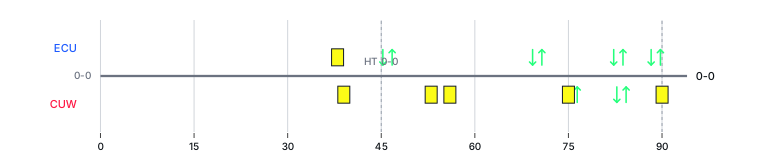
Between the 61st and 75th minutes, Ecuador produced 11 shots worth 1.5 expected goals — nearly half their match total concentrated into fifteen minutes. Curaçao managed one shot in that same window. The asymmetry was real and visible. This was Ecuador at their most insistent.
Jordy Alcivar had entered at half-time, and Pervis Estupiñán came on at the 70th minute, inside the window as it built. The timing aligns; whether those changes sharpened the attack or whether the surge would have arrived regardless, the evidence does not settle. What is clear is that this fifteen-minute spell represented the match's most concentrated Ecuador pressure — more shots, higher quality, Curaçao's one reply worth almost nothing in shot quality.
The score did not change. Room was still there. Eleven shots in fifteen minutes is a significant application of pressure against any opponent. Failing to score inside that window — having already missed six big chances across the match — confirmed rather than created the problem. The surge demonstrated that Ecuador had the means to hurt Curaçao even deep into the second half. It also demonstrated that having the means and exercising them are different responsibilities entirely.
Synthesis
The match had a clear internal logic, even if the scoreline does not obviously state it. Ecuador accepted responsibility for building, progressing, and creating — and met that responsibility. Caicedo and Vite governed the midfield. The team reached the final third over a hundred times. Six big chances arrived, the late surge produced eleven shots in fifteen minutes, and the chance quality across ninety minutes was enough to expect at least one goal.
But goalscoring responsibility does not end at the moment of creation. It ends when the ball crosses the line. Ecuador never got there. Valencia missed four clear opportunities alone. The team missed all six. Room stopped everything else that was accurate. The buildup earned a debt. The finishing refused to pay it.
The draw belongs to Room in arithmetic terms. Fifteen saves, ten inside the box, ninety minutes of individual accountability against opponents who did nearly everything else correctly. His performance did not merely contribute to the result — it was the result. Ecuador created more than enough to win this match. The question of why they did not is not complicated: one man answered every demand his goal was given, and the men at the other end answered none of theirs.