
The Spine They Built It On
The easy narrative writes itself: Spain had 67 percent of the ball, completed passes at 92 percent accuracy, and the result was settled before the half hour. Call it control, call it dominance, feel righteous about the whole thing. The better reading is more specific and, honestly, more interesting.
Spain's possession ran through two players with a precise division of labor. Rodri occupied the center of the pitch — not camped deep, not pushing high, but sitting between lines where a pivot is actually useful — and touched the ball 129 times while completing 113 of 119 passes. That is not circulation for the sake of it. That is a team breathing through one man. Pau Cubarsí, operating from a noticeably deeper position, completed 98 of 99 attempted passes across the full ninety minutes. Ninety-eight of ninety-nine. He lost the ball twice. In a full match.
Together they gave Spain a buildup structure that Saudi Arabia could not disrupt in any meaningful way. Their combined passing volume meant the ball returned to safety constantly, removing the cheap transition that is the only credible weapon for a team defending deep and outnumbered in midfield. The result was progressive, low-risk possession that created the conditions for everything that happened next. This is what a functional spine actually looks like: not romantic, not theatrical, but genuinely difficult to play against.
Thirty Minutes of Actual Football
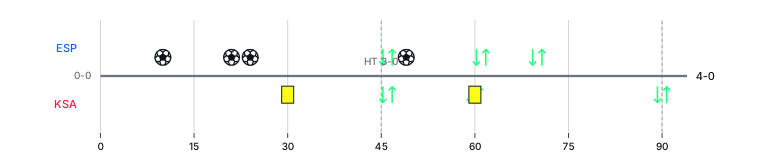
The goals arrived before the match had properly settled. Yamal converted at ten minutes with Oyarzabal supplying the assist, Oyarzabal scored himself at twenty-one with Laporte feeding him, Oyarzabal again at twenty-four from a Dani Olmo delivery. Three goals from thirteen shots in thirty minutes, and Saudi Arabia had not yet managed a single attempt.
That conversion rate is exceptional and should not be filed away as proof of an aesthetic event. What it proves is that Oyarzabal, given early final-third access and a clean ball from midfield, is very hard to contain. He played forty-five minutes. He scored twice, assisted once, put three shots on target, and created a big chance. That is a complete attacking half-hour of work compressed into one man's first-half outing. Yamal, pushing high on the left and staying there, scored and completed 29 of 32 passes with 52 touches — numbers that suggest a player operating with considerable comfort rather than scrambling against a determined press.
This was not Spain playing difficult football and prevailing through character. This was the Rodri-Cubarsí base releasing forwards who punished every opening the Saudi defensive block left. The openings were real. The finishing was decisive. Oyarzabal in particular deserves the credit directly, not laundered through language about collective brilliance. He did the specific, irreplaceable thing. The structure created the access; he made it count, which is not the same as saying the structure was inspired.
Survival Mode, Executed Without Joy
Saudi Arabia finished ninety minutes with three shots, none from inside the box, and a combined threat level across the full match that barely registered. Ali Lajami, their central defender, made twelve clearances. The team made thirty-six. That is not a team trying to play football and failing — that is a team trying to stop football and largely succeeding, just not at the scoreline.
Lajami spent the match anchored deep, the entire defensive unit sitting low while Spain's possession circulated overhead and around them. Saudi Arabia's two attempts in the closing minutes of the first half — both after the damage was already done at 3-0 — were low-quality efforts from outside the box that amounted to almost nothing in terms of threat. The remaining shot came later in the match, equally distant and equally unthreatening. Three shots total, zero from inside the box: those are the numbers of a team whose forward ambition was almost entirely extinguished by the scoreline.
The honest description is survival football, which is not a moral failing given the scoreline. When you are three goals behind before the half hour, the rational response is to stop the bleeding rather than chase a game that is already gone. They cleared the box. They absorbed. They reduced the damage to one further goal. But the clearance count — more than any other number — describes how Saudi Arabia actually spent their evening. Thirty-six clearances is not a tactical philosophy. It is the sound of a team that has accepted it is guarding ruins.
The Substitutions Said It Was Over
At halftime, with Spain three goals to the good, Yamal came off. Oyarzabal came off. Yéremy Pino and Ferran Torres came on at the restart. Both fresh, both second-choice, and the message was legible from the changes alone: the interesting part of this match was finished.
Torres played forty-five minutes, touched the ball ten times, completed three passes, and missed a big chance. Spain had four shots in the opening fifteen minutes of the second half — including the goal that made it four — then one in the following fifteen. The attacking tempo that made Oyarzabal and Yamal so dangerous in the first half was simply absent from the second, because the players who generated it were sitting on the bench watching Torres receive the ball and drift out of danger.
The output drop is observable rather than mysterious. Rotations of this kind carry a predictable cost: the chemistry, the movement, the precision that produced three goals in twenty-four minutes belongs to specific players in specific combinations, and those players were gone at the whistle. Spain retained possession, kept a clean structure, and added a goal. The second half was controlled. It was also considerably less interesting than the first — a fact the shot count makes plain without requiring any further interpretation. Controlled and interesting are not synonyms, and this Spain side did only one of them for sixty minutes.
Synthesis
Spain's central spine was genuinely worth admiring. Rodri and Cubarsí gave this side a buildup structure that was clean, low-risk, and hard to press — and Oyarzabal's first half was the kind of output that earns praise without apology. Three goals in twenty-four minutes is not fortune; it is what happens when the base is organized, the forwards are positioned well, and the finishing is sharp.
The second half was something else entirely. Spain ran the clock with Torres touching the ball ten times while the shot count dropped to one across a full fifteen-minute window. Saudi Arabia, pinned into their own half all evening, produced three shots all match — none from inside the box — and spent most of their time clearing rather than competing for territory. The final score of four goals to none is accurate but represents two separate matches stitched together: one worth a second look, one worth skipping.
The easy reading calls this a commanding performance and leaves it there. The correct reading is that Spain had a clean structural base and a first-half forward pairing that exploited it ruthlessly, then rotated to a lineup that kept possession but shed the attacking edge that made the first half worth watching. Both things are true. The first deserves the credit. The second deserves to be noticed. A team this organized produced something efficient in the first half and something administrative in the second. They won, yes. So does bad architecture: it also stands.