
The First Line Broke in Four Minutes
The comfortable reading of Japan's opening is that Tunisia simply had a bad day. The more accurate one is that Japan broke through Tunisia's first defensive line so quickly and cleanly that Tunisia never had time to establish what kind of day it was.
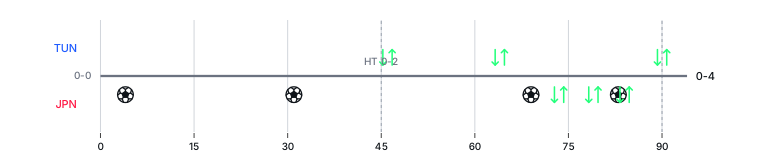
Daichi Kamada's fourth-minute goal — created by Keito Nakamura's forward pass into space — was not lucky timing. It was the product of Japan's ability to move the ball vertically before Tunisia could organize any meaningful defensive shape. In the opening fifteen minutes, Japan generated six shots worth well over a goal in quality. Tunisia produced one, barely a rounding error. When a team scores in the fourth minute from a clean assisted chance, it is tempting to say they caught the opponent cold. But six shots in fifteen minutes is not a cold-start problem. That is a structural mismatch.
Japan's wide players and deep midfielders rotated to find angles through Tunisia's press, allowing the ball to reach Nakamura and then Kamada in space the Tunisian first line had vacated. The consequence of that early compression was twofold: it set the scoreline and it told Tunisia exactly what they could not afford to give up again — which, as the next thirty minutes would show, they proceeded to give up anyway.
Ko Itakura Found the Space Tunisia Left Behind
There is a category of goal that sounds less impressive than it is. A fast-break finish from a low-difficulty position looks like opportunism on the highlights. What it actually represents is one team's defensive structure failing the moment it was tested in transition.
At the 31st minute, Ko Itakura — a centre-back, playing 89 passes with 85 accurate, operating as a genuine buildup engine — sent a deep vertical ball forward to release Ayase Ueda into open space. The chance itself was low-quality by any reasonable measure, which makes the finish more damning for Tunisia than less: Japan did not need a brilliant opening to score; they needed Tunisia to lose shape, and that was enough. Ueda ran onto the ball and converted from a wide angle with his right foot. Tunisia's defensive recovery had no clean answer.
This sequence is worth dwelling on not because it was beautiful — it was not — but because it was decisive. Going 2-0 down before half-time against a team with 62% possession and a clean defensive record effectively ends a match as a contest. Tunisia would finish with two shots. Two. The second goal did not just extend the lead; it closed the door on any realistic recovery trajectory, and it did so through a mechanism — a defender releasing a forward in transition — that Tunisia had no visible answer to.
Ueda Did More With 27 Touches Than Most Strikers Do With 70
The lazy celebration of Ayase Ueda will focus on the brace and the man-of-the-match rating. That framing is fine as far as it goes, and it does not go very far. What is actually interesting about Ueda's performance is the ratio: two goals, one assist, three shots on target — from twenty-seven touches across eighty-four minutes.
That is not a high-volume striker doing what high-volume strikers do. That is a player operating almost exclusively in the moments that matter, converting them, and declining to exist otherwise. His 69th-minute assist for Junya Ito came from a sharp central read rather than a sustained possession spell. His 83rd-minute headed goal — converting a cross in the six-yard area — was the kind of delivery-and-finish combination that requires precise movement, not just presence. Three shots on target, two goals, one big chance created. The conversion is not luck, but it is also not a general claim about some permanent ceiling — it is what this specific game asked for, and he answered with minimal waste.
The provider ranked him 9.6, highest in the match. You can dispute the precision of that number, but not its direction. Ueda gave Japan a finishing outlet that required very little feeding and returned maximum yield. Tunisia had no equivalent.
The Air Made the Box Smaller
Aerial duels are the most undertheorized dimension of how matches actually feel to play in. Winning 13 of 18 aerial contests — which Japan did — does not just produce headed goals. It degrades the opponent's ability to use long clearances as a reset mechanism. When you cannot win headers, you cannot slow games down with the ball over the top.
Takehiro Tomiyasu won three aerial duels in 79 minutes and sent eleven long balls forward with good accuracy, demonstrating that Japan's aerial presence was not confined to Ueda but distributed across multiple positions. Ueda himself won three aerial duels and converted one headed chance in the 83rd minute — a near-post finish from close range that Tunisia's defensive shape could not prevent. That goal came from a cross-and-header situation that Japan had the physical tools to execute and Tunisia lacked the aerial coverage to stop.
The important point is not that aerial dominance guarantees goals. It does not — and this article does not claim the aerial edge caused every outcome. But when one team commands the air, the other team's defensive clearances become less reliable, crosses become more viable, and set-piece situations carry more threat. Tunisia finished with five of those eighteen aerial duels. That is not just a disadvantage in specific duels — it is a structural constraint on how Tunisia could defend any ball delivered into their box.
Tunisia Brought Two Shots to a Football Match
There is a version of this where you say Tunisia were organized, kept their shape, conceded only four. That version requires you to look at the scoreline and ignore the process. Tunisia finished with 38% possession, two shots, and zero on target. Their total expected goals across the entire match amounted to 0.05 — a number so small it is more a rounding error than a threat assessment. This was not a team defending bravely under pressure; it was a team that never found a way to threaten.
Hannibal Mejbri won eight duels and was fouled seven times — numbers that suggest he was Tunisia's most contested central figure, working hard against Japan's midfield pressure. But being fouled seven times and winning eight ground duels while generating almost nothing from open play is a description of effort being spent without output. The passes he completed — 27 of 32 — did not translate into progression, big chances, or sustained spells in Japan's half. Tunisia managed 59 passes into the final third, but the total shot count tells you what those entries produced: essentially nothing.
Japan's midfield and defensive shape made Tunisia's central areas expensive to operate in. The result was identical regardless of individual application: Tunisia's most active central player spent the game absorbing contact and fouls rather than creating dangerous moments. The attack never built anything usable.
Synthesis
The easy reading of a 4-0 scoreline is that one team was very good and the other was very bad, and perhaps the best side won. That is not wrong, exactly — it is just the kind of statement that requires no football knowledge to produce.
What the match actually showed was a set of structural advantages that accumulated against an opponent who had limited answers to any of them. Japan broke Tunisia's first line in four minutes and never let them reset. When Tunisia tried to transition, a centre-back with 89 passes found Ueda behind the defensive shape at the half-hour mark. In the second half, when a team conceding three goals might look for aerial relief, Japan won the air 13-5 and converted a cross into a fourth. Tunisia's midfield survived on duels and fouls rather than progression. The sequence is not coincidence — early vertical movement created a lead; the lead created space for transition exploitation; the aerial advantage closed off Tunisia's recovery routes.
Ueda's return — two goals, one assist, 27 touches — is the kind of efficiency that makes a match look more comfortable than the mechanisms behind it. Japan did not need to be spectacular. They needed to be structured, patient in possession, and clinical when it mattered. That the football was more functional than beautiful is a genuine critique. That it was controlled and coherent is not something the scoreline alone tells you — but the shape of every mechanism in this match does.