
Uruguay's Occupation Forced the First-Half Break
The mechanism was position before combination. Uruguay kept Valverde high through the center, Olivera and Sanabria pushed wide and deep on the right side of the attacking half. With multiple runners already in the final third, Cabo Verde faced a constant choice: step out and risk the space in behind, or sit deeper and concede the ground in front of the box. Neither option was clean.
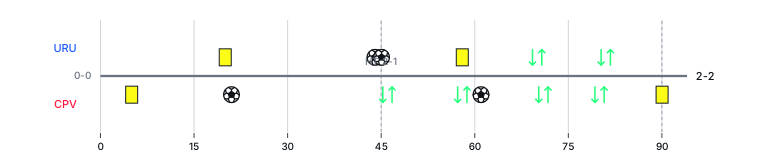
That tension paid off in a 14-minute burst from the 44th minute through stoppage time. Araújo headed in the equalizer at 44 from a position that carried close to 0.9 xG — the kind of chance you only get when a defense has already been drawn into retreat. Three minutes into stoppage time, he flipped roles: his assist sent Canobbio through for a right-foot finish worth about 0.6 xG. Two goals, six shots, over 1.5 xG in that window. Uruguay had 65 percent possession on the night and sent 74 passes into the final third across 90 minutes, but the decisive work happened right there.
What this window doesn't prove is a whole-game picture. Uruguay's advanced lines created the conditions for a scoring burst in that phase. Whether that structure held the same shape across every minute is a different question — and not one this phase can answer on its own.
Forty-Seven Clearances Isn't Defending — It's Surviving
Cabo Verde couldn't match Uruguay's occupation, so they answered a different question: how many times can you clear the ball before something goes in? For most of this match, the answer was enough. The cost was visible in the numbers — 47 clearances for the team, the bulk of which ran through the two center-backs.
Pico made 13 clearances and blocked two shots, finishing with a 7.2 rating that reflects how central he was to keeping the deficit from running away. Diney Borges added 15 of his own, winning eight ground duels and four aerial contests. Together they cleared 28 times — more than half the team total. Both operated deep and central; the ball kept coming back to them because there was nowhere else for it to go. Cabo Verde managed just 30 passes into Uruguay's final third all match, which tells you where their energy went: not into building, but into absorbing.
This kept the game at 2-1 rather than 3-1. But it is worth being clear about what it wasn't: it wasn't structure imposing itself on Uruguay, and it wasn't a low block built to protect a lead. It was two center-backs in the right place, making the right call under sustained pressure, over and over. That kind of defending buys time. It doesn't change the match — unless something on the bench does.
Varela Came On at 58. He Scored at 61.
Three minutes. That's the gap between Hélio Varela stepping off the bench and Cabo Verde drawing level. Garry Rodrigues came off at 58, Varela went on, and the picture on Cabo Verde's right side shifted. Varela stayed high and wide in the attacking half, giving the team a forward reference point out wide that hadn't been as clear before the change.
The goal itself came at 61 minutes: a right-foot finish carrying around 0.4 xG, struck from a position that required Varela to have already found the right pocket of space. That's not a chance that falls to someone still getting their bearings. The positioning was immediate; the execution matched it.
The phase framing makes it starker. Between the 61st and 75th minutes, Cabo Verde outshot Uruguay in meaningful chances — 0.46 xG to 0.03. Uruguay had spent the last half-hour of the first half writing the sequence. Now Cabo Verde were. Whether the substitution was a preplanned move or a read on the match as it developed, the evidence doesn't say. What it shows is that the cue was recognized and the execution was immediate. This is where coaching ends and player recognition begins — and Varela's three-minute turnaround is about as clean an illustration of that as the match produced.
Uruguay Chased the Win. The Space Behind Them Grew.
At 2-2, Uruguay needed a goal. The final 15 minutes reflected what chasing a winner from that position costs: Cabo Verde produced seven shots and 0.46 xG in that window. Uruguay had five shots in the same stretch for 0.39 xG — lighter, less dangerous, and aimed at a scoreline they couldn't reach. The shot volumes had flipped from the first half's picture.
The clearest expression of Uruguay's exposure came in stoppage time. Laros Duarte, on for under 20 minutes, got two attempts on target — one in the 90+4 and a free kick in the 90+7. Fernando Muslera saved both. From 15 touches, Duarte completed two key passes and put two shots on target, which is an efficiency rate that only makes sense against a defense with its weight forward and gaps behind it. The structural explanation for why Cabo Verde found that space isn't fully traceable without tracking data — but seven shots in the final phase, including two saves in stoppage time, makes the constraint legible even without it.
Muslera's two stops are why this section is about a draw rather than a Cabo Verde win. Uruguay's late pressure was real; so was the space it left.
Synthesis
Two decisive sequences and one running constraint shaped this match. The first sequence was Uruguay's: multiple runners advanced into the attacking half, a defense pushed to choose between stepping out and sitting deep, and two goals in 14 first-half minutes from positions that were already earned before the ball arrived. The occupation created the chances. Araújo and Canobbio recognized what the structure gave them.
Between that burst and the Varela equalizer sat Cabo Verde's 47 clearances — unglamorous, load-bearing, and the only reason Uruguay didn't turn 2-0 into something decisive before the hour mark. Pico and Borges didn't control the match. They kept it close enough for the bench to matter.
The second decisive sequence was three minutes long: Varela on, Varela scoring, Cabo Verde suddenly generating the better chances in the phase that followed. The substitution didn't prove a tactical plan. It proved that the right player in the right position, reading the right moment, can flip a match state faster than any structure can account for.
The late phase was Uruguay's tradeoff made visible. Push for the winner, leave space, and watch the team you were managing suddenly outshoot you. Muslera answered in stoppage time. The draw held. But the distances behind Uruguay's late pressure were real — and Cabo Verde found them seven times. The occupation was the story until it wasn't.