
Austria's Spacing Created the Break Before Argentina Asked For It
Austria's defensive players were positioned well up the pitch for most of this game. David Alaba operated deep into advanced territory, and Kevin Danso's average position hovered near the center circle — a long way from covering the space behind both of them once Argentina won the ball. The recovery distance was real, and Argentina ran right at it.
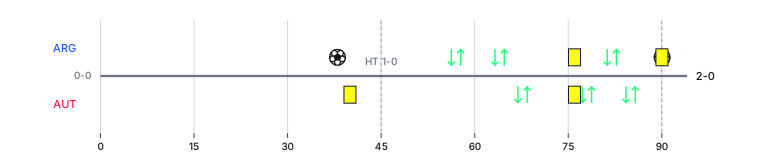
Both goals tell the same story. At 38 minutes, Facundo Medina threaded a pass to Messi on a fast break, and Messi finished from inside the box before Austria's defensive line had time to compress. In stoppage time, Argentina ran the same sequence twice in quick succession — a goal and a near-simultaneous save both generated from wide-open transition space, Austria retreating with no compact shape to defend from.
The clearest evidence came in the final phase. Argentina generated over 1.4 xG in the last 15 minutes, almost entirely from fast-break situations. Austria's advanced positioning made sense as an attacking posture — it is not a coaching indictment — but it left the same corridor open every time Argentina won the ball and ran. The cue kept appearing. Argentina kept taking it.
Messi Received the Break — and Finished It
Messi did not just benefit from the transition. He was the player Argentina kept feeding into it, operating centrally in the attacking half as both the combination option and the finisher. That dual role — drawing defensive attention by dropping into combination play, then arriving at the sharp end of the break — is hard to organize against from a back line already stretched.
The numbers hold up without decoration: two goals, four shots on target, two big chances created for teammates in 98 minutes. The ninth-minute penalty — a high-quality chance he sent wide — shows the role was established from the opening exchanges. He was the focal point before the miss and remained it all the way through the second goal deep in stoppage time.
What makes the role legible is not just the volume but the variety. Two big chances created alongside his own shot output means he was reading the picture for others as well as finishing his own. From a central attacking position, he could combine, receive, and arrive in the box. Austria could press the ball carrier or drop to cover the run forward — doing both at once against a player working from the center, already inside the transition lane, is a harder problem than it looks from the outside.
Austria Reached the Final Third and Found a Locked Door
Austria's attacking output sounds more threatening in raw volume than it was in actual danger. Fifty-five passes into the final third, 46 percent possession — that is a team that moved the ball and worked it into advanced areas consistently. What followed was almost nothing: one shot on target for the entire game, a total xG figure of 0.5, one big chance created and missed.
The pattern was consistent across phases. Between 16 and 30 minutes — Austria's best early window — they managed two shots worth barely 0.2 xG combined. The second-half stretch from 46 to 60 minutes produced another two shots worth almost nothing. When Argentina's shape held compact, Austria's progression into the final third stopped converting into anything dangerous. They found the approach, then kept finding a wall at the end of it.
This is the distinction that matters: reaching the final third and actually threatening goal are two separate problems. Austria solved the first consistently. They could not solve the second. Whether Argentina defended the central lane effectively or Austria simply could not find the combination to break the last line into a clear look, the result was the same each phase — high volume, almost no danger at the finish.
The 64th-Minute Changes Sharpened the Break
At 64 minutes, Argentina made two changes. What followed was the match's sharpest offensive window — and the same fast-break sequence that had produced the first goal reappeared with more runners to execute it.
Julián Álvarez came on and put a shot on target in his 34 minutes, accumulating close to 0.4 xG across his involvement in the late phase. Nicolás González — the other introduction — had a right-footed attempt blocked from a central position at 86 minutes, a good look from inside the box that Austria's defense just got in front of. Neither produced a decisive individual moment, but both kept the transition threat live through a phase when Austria were chasing an equalizer.
The phase numbers show what followed the changes. From 76 minutes onward, Argentina generated six shots and 1.46 xG — the strongest offensive window of the entire match. The substitutions came in at 64, and within twelve minutes the late pressure was fully in motion. Whether the changes themselves caused the surge or simply coincided with Austria pushing higher as the scoreline stayed at 1-0 is not something timing alone can prove — but the correlation is tight. The second goal came in the fifth minute of stoppage time off the same fast-break pattern that had opened the scoring in the first half.
Synthesis
The bargain at the center of this match was simple: Austria left space behind, and Argentina had the player and the system to find it repeatedly. That is not a criticism of Austrian intent — it describes what the positioning made available and how Argentina kept accepting the offer.
Messi was the thread connecting everything. He operated centrally, created for teammates, and finished the decisive break twice — at 38 minutes off Medina's pass, and again in stoppage time when the same corridor appeared and Argentina ran through it one final time. The late substitutions extended that threat into the phase when Austria were committing forward to change the result, and the 76-plus window — six shots, 1.46 xG — was the match's sharpest stretch by some distance.
Austria's parallel problem ran the other direction. They reached the final third constantly and found almost nothing at the end of it: 55 passes into that zone, one shot on target. The space they left behind to generate that forward presence was exactly what Argentina exploited. Both things were true at once — Austria attacking with real purpose, and handing over the transition lane every time they did. Argentina found the first break in the 38th minute, found it again in stoppage time, and had the right player at the center of both.