
Upamecano Accepted the Governing Role and Did Not Waste It
The responsibility for France's first phase of play fell to Dayot Upamecano, and he did not avoid it. Operating deep on the left of France's defensive structure, he completed 75 of 78 passes, distributed eight long balls with five finding their target, and accumulated 86 touches across 90 minutes. That volume and accuracy describe a defender who took command of the base of France's buildup and held it from first minute to last.
His average position stayed deep in France's defensive half — the consistent anchor that allowed France to play from a stable base rather than fighting to recover it. The consequence was visible from the opening quarter-hour: France generated six shots in those first fifteen minutes while Iraq produced none. That imbalance did not arrive by accident. It arrived because France's possession was organized from the back, with a distributor who connected the defensive block to the creative players above him without losing the ball — four possessions lost across the full ninety minutes.
The spatial record is an average position, not a movement map, so it does not prove Upamecano never ventured higher or tell us precisely what happened every time France turned the ball over. What it confirms is that his gravitational center was deep, and his output — 75 accurate passes, five long balls finding a teammate — shows he used that position to govern rather than merely occupy it. That is the distinction that mattered.
Olise and Dembélé: Every Goal Required One of Them
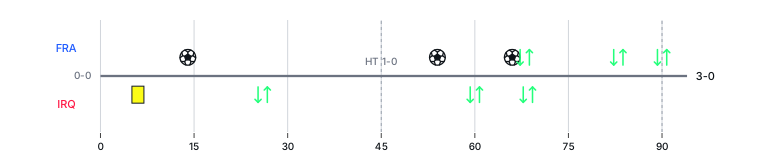
Clean distribution from depth is worth nothing if the players who receive it cannot turn it into genuine danger. France's answer to that problem was Michael Olise and Ousmane Dembélé, and between them they provided all three assists on the scoresheet. Olise: two assists, three key passes in 68 minutes. Dembélé: one goal, one assist, three key passes in the same 68 minutes. The assist chain maps the architecture of the match precisely — Olise found Mbappé at 14 minutes for 1-0, Dembélé fed Mbappé at 54 for 2-0, Olise returned to set up Dembélé's own goal at 66 for 3-0. Every French goal went through one of them.
The texture beneath the assists is equally instructive. Dembélé attempted seven dribbles, completed three, and created one big chance alongside his three key passes. Olise won six duels and was fouled once in the course of that work. Neither was a static delivery player collecting assists at the end of tidy moves — both took the ball into contact, manufactured entries from contested positions, and made decisions under pressure that the scoreline then recorded.
Iraq had no adequate answer to either. That is not hyperbole; it is the structural conclusion of a match in which France's creative pair converted Upamecano's organized distribution into three goals and six combined key passes. The supply chain ran cleanly because the two players in the middle of it accepted the creative burden and executed it.
Mbappé Converted the Chances That Counted
The honest accounting of Mbappé's night is more complicated than two goals suggests. He missed three big chances. His first goal, at 14 minutes, came from a position on the edge of the box carrying modest probability — roughly 0.04 in chance quality — and he converted it with his left foot regardless. His second, at 54 minutes, was a closer-range right-foot chance from inside the box at roughly 0.4, and he took it cleanly from Dembélé's delivery.
Two goals from 1.2 in total expected goals is a performance that met its obligation rather than transcended it. The provider ranked him highest on the night, and the finishing output supports that judgment when paired against his actual shot record — but the three missed big chances are the honest counterweight. What prevented those misses from costing France was the quality of supply: Olise and Dembélé generated enough entries that three wasted opportunities left the scoreline intact.
Mbappé was not a passive recipient waiting on the far post. He accumulated 59 touches and 39 passes, attempted four dribbles, and contributed two key passes of his own. He worked to create angles for himself and for others. The finishing role demanded he be the point where attacks ended; on the two that mattered, he was there and did his job. The missed chances are worth noting. They did not change the result, which is the other thing worth noting.
Iraq Passed the Ball. It Did Not Go Anywhere.
Iraq completed 483 passes at nearly 86 percent accuracy. The number invites a flattering reading — a team that contested the match, managed the tempo, showed technical discipline. That reading is wrong.
Zidane Iqbal and Akam Hashem were Iraq's passing anchors, combining for 134 completed passes between them. Iqbal operated through the center in an advanced zone; Hashem pushed wide right. Both passed accurately; both passed frequently. But Iraq managed only 31 passes into the final third across the full match, against France's 89. Iqbal's creative output from 71 completed passes amounted to one key pass and an expected assist value of 0.02. Hashem's expected assist contribution for the entire ninety minutes was essentially zero. The volume of circulation and the near-absence of anything productive from it tell the same story: Iraq kept the ball where it was already safe, and that is not the same as moving it somewhere dangerous.
Hashem also made nine clearances. That is the other side of the picture — Iraq's defensive workload was high precisely because their possession never relieved the pressure France applied. The ball moved, repeatedly and accurately, and it arrived nowhere that threatened to make France uncomfortable. In the final fifteen minutes, Iraq produced zero shots. The possession they accumulated in that window was the possession of a team being managed, not of a team doing the managing. Possession without progression is not control. It is patience without purpose.
Al-Hamadi Found Space That the Rest of Iraq Could Not Supply
Iraq's 26th-minute substitution changed the immediate picture. Within a minute of entering, Ali Al-Hamadi attacked a headed chance from close range — Iraq's first real threat of the match. He missed. At 75 minutes he produced Iraq's most dangerous moment, a right-foot shot from inside the box carrying roughly 0.4 in chance quality. He missed that too. Those two attempts represent essentially all of Iraq's meaningful attacking output across ninety minutes.
Al-Hamadi won six duels, was fouled three times, and accumulated 27 touches in 64 minutes — a lean but direct presence who ran at France's defenders rather than around them. His 16 total passes reflect someone operating as a focal point in transition rather than a ball-recycler contributing to Iraq's wider circulation game. The contrast with Iqbal and Hashem combining for 134 completed passes that went almost nowhere is not subtle.
The structural problem is that these two moments were isolated. The phase from 61 to 75 minutes, when Al-Hamadi produced his bigger chance, also included four France substitutions and France's third goal — meaning Iraq's best attacking window coincided with a match already decided at 3-0. The direct route was real in isolation. It was never part of a coherent structure that arrived early enough or connected deeply enough to make France genuinely uncomfortable before the game was gone.
Synthesis
France won 3-0 and the score was accurate. The chain from Upamecano's deep distribution to Olise and Dembélé's creative production to Mbappé's finishing ran without interruption through the goals that mattered. Each link accepted its obligation; none of the three collapsed under the weight of it.
Iraq's 483 passes are the figure that demands explanation rather than dismissal. The ball circulated, accurately and constantly. It did not move into France's attacking third with anything approaching the frequency required to constitute a contest — 31 final-third passes against France's 89, zero shots on target, zero goals. Possession without progression is only housekeeping. Iraq kept their own house tidy and left France's untouched.
Al-Hamadi's two transition chances show Iraq could generate real danger when the game opened up. They also show how isolated that danger remained — two shots, both missed, with nothing in Iraq's structure connecting them to each other or to a coherent attacking idea. The substitute provided a route that Iraq's possession game had not. He provided it too late, and too briefly, and France had already collected what the match owed them.
What separated these teams was not effort or technical accuracy. Iraq passed well enough. What Iraq lacked was a chain of players who understood what the match required of them in sequence — a deep organizer who structured the exit, a creative pair who turned structure into entries, a finisher who accepted the terminal responsibility. France had all three. That is why the score read the way it did.