
Attia at the Base: Egypt's Ball Before the Goals
Egypt's control of this match started with a player most of the highlights won't show — Marwan Attia, sitting deep in the center, acting as the primary recycling point for everything Egypt wanted to build. With 100 touches and 82 accurate passes, he led all players in both categories. That volume isn't incidental; it tells you where the ball kept returning and who Egypt trusted to keep the game moving forward under pressure.
The effect showed up in team-level numbers. Egypt finished with 56% possession and a 73-46 edge in final-third passes. That gap matters because final-third entries aren't just about keeping the ball — they indicate how often a team is arriving in dangerous areas with organized delivery, not scrambling for loose balls. Attia's positioning stayed low and central, giving him sight lines across the pitch and making him a consistent outlet when Egypt needed to reset and try again.
What this buildup base didn't do, on its own, is score goals. Possession share and pass volume are platform evidence, not outcome evidence. The case here is narrower: Egypt had a reliable first-line exit route and a player capable of sustaining central progression for the full match. That structure is what allowed the more dangerous combinations further up the pitch to develop off clean delivery rather than contested recovery.
Ziko Scores, Ziko Creates, Salah Finishes: How the Goals Actually Came
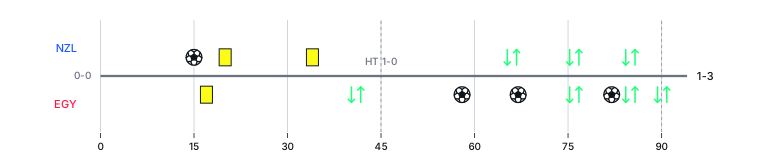
The two goals that flipped this match didn't come from the same pair, but they came from the same attacking unit finding ways to convert what the buildup layer provided. At 58 minutes, Mostafa Ziko met a Mohamed Hany delivery in the box and headed home to make it 1-1. The chance wasn't a tap-in — a header from that position, with a shot quality in the moderate range, required Ziko to arrive correctly and execute under pressure. Nine minutes later, the sequence shifted: Ziko became the provider, threading the assist that set up Mohamed Salah for a left-footed finish to put Egypt ahead at 1-2.
What links the two goals isn't that Salah and Ziko created each other's chances identically — they didn't. What links them is that Ziko was decisive in both: once as a finisher, once as the final passer. Salah, meanwhile, had been generating pressure throughout — five key passes across the full match, two dribbles completed, touches spread across 85 minutes in the final third. The goal at 67 minutes was the execution point of a longer creative workload.
Ziko's full line across 76 minutes — a goal, an assist, two big chances created, two key passes — confirms he wasn't just a passenger running in from the back post. The buildup gave both players the ball in useful positions. What they did with it is what turned Egypt's platform into a lead.
The 46-60 Window: Eight Shots, One Goal, Match Settled
Egypt entered the second half down 1-0. What happened in the first fifteen minutes after the break changed the contest entirely. Egypt produced eight shots to New Zealand's one in that phase — a 8-1 imbalance that represents a compression of attacking intent without meaningful response from the other side. The xG split was 0.8 to 0.3 across those fifteen minutes, which tells you Egypt weren't just speculating from distance; they were arriving in positions where the chances carried real weight.
Ziko's 58th-minute header came inside that surge. The equalizer arrived at the midpoint of Egypt's most concentrated attacking spell of the match. What the record shows is a team that entered the second half trailing and immediately generated far more offensive activity than the side that had the lead. The game state moved from 1-0 down to 1-1 within that window, and then Salah's finish at 67 minutes — just outside the phase boundary — completed the turnaround to 1-2.
The exact structural reason for the surge isn't recoverable from the phase data alone. What is recoverable is the output: the shot volume was unmistakable, the goal came from it, and New Zealand's single-shot response was not enough to keep the match level. When you concede while being outshot 8-1 in a fifteen-minute stretch, recovering the initiative becomes a different kind of problem.
Salah's Full Picture: Finisher and Playmaker in the Same Match
Mohamed Salah's match line — one goal, one assist, five key passes, two shots on target, two dribbles completed in 85 minutes — is the kind of output that does two jobs simultaneously. The goal at 67 minutes put Egypt ahead. The assist at 82 minutes, finding Mahmoud Trezeguet to make it 1-3, closed the result. But the five key passes are the less visible part of what made his match meaningful: those are repeated moments where Salah found teammates in positions to shoot or advance, spreading his influence across phases where Egypt needed the ball to move forward cleanly.
His two completed dribbles from three attempts show he was willing to take on his marker when the spacing opened — not just playing safe horizontally. That willingness to carry created decision problems for the players around him, and it kept Egypt's attacks from becoming predictable. A player who can both finish and create at this volume in the same game is forcing the opposition to solve two different defensive problems at once.
The provider rating of 8.6, which ranked Salah as the match's top performer, is a provider evaluation and should be read alongside the stat line rather than in place of it. Here the two align directly: a goal, an assist, five key passes, and involvement in Egypt's three decisive final-third moments. The limitation is straightforward — this is one match, not a season summary. What the game showed is Salah operating as both a finishing threat and a creator, with the scoreline requiring both functions and getting them.
Rabia at 41 Minutes: What the Record Shows and What It Doesn't
Egypt made a substitution at 41 minutes, bringing Rami Rabia on for Hamdy Fathy. That timing — just before halftime, with Egypt trailing 1-0 — raises obvious questions. The evidence doesn't answer them. Whether the change was tactical, injury-driven, or a performance response isn't visible in what's available here.
What is visible is what Rabia did after coming on. His average position stayed low and central, in the attacking half but compact rather than pushed forward. Over his 60 minutes, he won five duels, completed two tackles, cleared twice, and limited his possession losses to four. His expected assists figure was essentially zero, which means he rarely entered positions to set up chances — but that alone can't establish what role he was asked to fill. The output profile reads as a player focused on winning second balls and not overcommitting, which fits a stabilizing defensive brief. Whether that was the intended purpose or simply what emerged from his natural game in this context is a distinction the data can't make.
The bounded read is that his introduction coincided with a more controlled defensive structure for Egypt heading into the break and through the second half. That's a correlation, not a causal chain. Egypt's second-half surge ran through Attia's buildup platform and the Ziko-Salah attacking unit. Rabia looks like a supporting condition around the decisive sequence — not the trigger for it.
Synthesis
Egypt's 3-1 win had a spine, and the spine held. Marwan Attia anchored it from deep: 100 touches, 82 accurate passes, a central position that gave Egypt a permanent exit route and fed the 73-46 advantage in final-third entries. That platform didn't produce goals by itself, but it meant Egypt's attacking players received the ball in workable positions rather than fighting for loose balls in bad areas.
From there, Ziko and Salah converted what the platform provided — not as a neat mutual exchange, but as the two players who were decisive when the match needed it. Ziko headed in the equalizer at 58, set up by Mohamed Hany. Nine minutes later, Ziko threaded the assist for Salah's go-ahead finish. Salah then closed it with the assist for Trezeguet at 82. The sequence required both players to execute at moments when the game was still live and the result genuinely uncertain.
The 46-60 window is where the match stopped being uncertain. Eight shots to one, a goal inside the surge, and then Salah's finish nine minutes later. By the time Trezeguet added the third, Egypt had already done the structural work. Rabia's substitution at 41 minutes sits at the edge of all this — readable as stabilizing, unverifiable as intent.
The three mechanisms didn't operate in isolation. Attia's volume created the delivery. Ziko and Salah turned delivery into goals. The second-half surge gave both players the game state they needed to be decisive. That's the sequence. The ideas survived contact with the opponent long enough to win.