
The Ball Kept Moving — Just Not Forward
England's 79% possession sounds like dominance. Look closer and you see the shape of a buildup that was winning the ball back but not cracking the door open. Marc Guéhi finished with 129 passes and 143 touches from a central defensive position — his average positioning deep in the center tells you where England's ball circulation lived. Ezri Konsa added 118 passes, 116 of them accurate. Those numbers describe a team whose ball movement ran clean and safe through the back line rather than through it.
The combination of Guéhi's volume and his positioning tells you where England's possession machine ran: back-and-across, not through the lines. England reached the final third on 88 passes from 633 attempts — about one in seven. That ratio is the gap between tempo control and penetration. The structure kept the ball, but it kept the ball behind the problem.
This is where coaching ends and player recognition begins. The buildup gave England clean possession in their own half. It did not give forwards an easy picture. With the ball moving sideways through the center-backs, the vertical option into midfield had to be found and timed by the players — and often it wasn't there, because Ghana had already decided where they were going to stand.
Thirty-Nine Clearances Is a Defensive Idea, Not an Accident
Ghana's answer to England's circulation was simple and relentless: stay deep, stay compact, and remove the ball whenever it arrived near the box. Thirty-nine clearances across ninety minutes. That is not a team hanging on — that is a defensive structure doing exactly what it is supposed to do when the opponent has the ball three-quarters of the time.
Gideon Mensah on the left side made nine of those clearances, completed five tackles, and won eight individual duels. Jerome Opoku won six duels, added five clearances, and blocked a shot. Jonas Adjei Adjetey contributed six clearances and two more blocked shots. The pattern across all three is the same: high defensive engagement count, low pass volume, maximum proximity to their own box. Ghana's defenders weren't building anything — they were removing every ball that got close enough to matter.
The constraint this created for England was spatial. Ghana's 24 fouls also show a team willing to interrupt rather than engage high. The cue for England to go vertical into the box almost always met a body. Six England shots were blocked outright. Ghana allowed 14 shots from inside the box but kept the quality low enough to walk away clean. The idea was good. The distances — between England's circulation and Ghana's last line — were never comfortable enough to exploit.
One Fast Break, One Real Chance
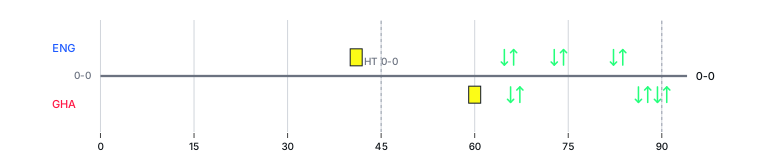
Ghana had 21% possession and two shots all match. Their one genuine attacking moment was a fast break in the 79th minute — and it was the clearest chance anyone created before the final surge.
Substitute Prince Kwabena Adu received in transition and got a left-foot shot away. The chance came in at roughly 0.24 xG — a one-in-four opportunity, which is a strong open-play look. The goalkeeper saved it. In six touches and one pass across 22 minutes on the pitch, Adu produced Ghana's only shot on target. That single sequence tells you something real about how Ghana's attacking threat was structured: not through sustained pressure, not through buildup, but by waiting for England to push high and running behind the line when the moment opened.
The mechanism here is rest-defense exposure. England's possession model kept the ball but also kept players advanced when possession turned over. Ghana didn't need to sustain anything — they needed one sequence to recognize the lane, run it, and get the shot off. They found it once. That the save held it to 0-0 rather than 0-1 is the closest thing to a decisive moment in a match otherwise shaped more by what didn't happen than what did. One transition threat from two total shots is not a whole-game identity, but it was enough to be the most dangerous thing either side produced for a long stretch.
When England Finally Pushed, the Window Opened Late
Nico O'Reilly came on at 66 minutes, and the final phase of this match looked different from everything before it. In the last fifteen minutes, England produced five shots worth 0.67 xG — their best shot-quality window of the game by some distance. That shift in the shot log coincided directly with the personnel change and the move toward more direct box presence.
O'Reilly was at the center of both late moments. At 86 minutes, his header from close range struck the post — a chance worth roughly 0.12 xG that felt bigger in real time. In stoppage time, he headed a corner attempt wide. The structure that created both chances was England overloading the box with late runners against a Ghana defense that had been clearing balls for over an hour.
The honest read is that this is correlation, not clean causation. England might have found that window regardless of who was on. But the shot log is clear about when the pressure sharpened: the best chances of the match arrived in the same fifteen-minute window as the personnel change. Ghana's defense, which had handled 90 minutes of circulation with remarkable efficiency, conceded its most dangerous spell precisely when England added direct box movement to the equation. It ended goalless — but not because England ran out of ideas. They ran out of time.
Synthesis
Put the four pieces together and you get a match whose 0-0 scoreline is almost perfectly explained by its structure. England controlled the ball through their center-backs, keeping possession clean and the tempo predictable. The problem was that controlling deep doesn't automatically mean controlling the final third — and Ghana understood exactly where to stand to make the vertical pass uncomfortable. Thirty-nine clearances later, England's 1.3 xG tells the story of a side that circulated well but rarely arrived in positions where the finish felt inevitable.
Ghana's defensive approach was coherent on its own terms. Stay compact, clear the ball, foul to interrupt — and the pattern held for most of the match. When possession did turn over in England's half, the fast break in the 79th minute showed that the transition lane was real. Adu recognized it, ran it, and only the goalkeeper kept the scoreline level. That save is the single moment the whole match turned on.
Then England's late push arrived — and for fifteen minutes the structure finally shifted. Fresh runners in the box, a header off the post, a corner header in stoppage time. It felt close. But the cue was there, the movement was there, and the execution — one post, one miss — just ran out of minutes to correct itself. Ghana defended the sequence that mattered most. England never found the one that would have broken it open.