
Possession Set the Terms — But Did Not Set the Score
Algeria completed 638 passes to Jordan's 251. They held 72% of the ball, reached Jordan's final third 88 times, and produced 17 shots against 8. By every measure of territorial control, this was Algeria's game to run. The problem, for the first forty-five minutes, was that running the game and winning it are different responsibilities entirely.
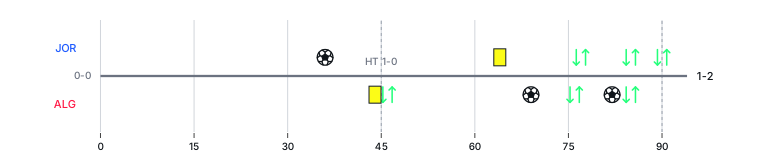
Jordan went to halftime ahead. Algeria's buildup volume — all those passes, all that occupation — had not converted into a lead. The first phase gave Jordan the better early chance volume; the second swung back toward Algeria; and neither produced a goal before the break. Possession without consequence is only politeness. Algeria spent much of the first half being very polite.
What the possession edge did establish, reliably, was a structural constraint on Jordan: 37 final-third entries against Algeria's 88, a pass-accuracy gap of nearly sixteen percentage points, and 37 clearances from a side that spent the match defending rather than building. Jordan was not beaten by the pass volume. But the pass volume made Jordan responsible for clearing the ball, absorbing pressure, and surviving a team that kept returning to its front line. That structural consequence was real and sustained across ninety minutes — even if the halftime scoreline had not yet reflected it.
Benbouali Brought a Demand Boudaoui Had Not
Algeria made two substitutions at halftime. Ramiz Zerrouki replaced Nabil Bentaleb in midfield, and Ahmed Nadhir Benbouali replaced Hicham Boudaoui in attack. The second change is the one that mattered to the scoreline.
Bentaleb had spent forty-five minutes doing exactly what a possession midfielder does: 45 passes, 39 accurate, 53 touches. He circulated the ball. He did not hide from it, which already placed him above several players in similar positions. But Algeria had been carrying possession without threatening the box with any directness, and Benbouali was the answer to that particular problem. He arrived as a target, a header, a physical demand in the area. Within twenty-three minutes of coming on, he had scored. The goal was a header from a corner, assisted by Mahrez — low quality on the shot map, yet converted. Six aerial duels in 45 minutes, two shots on target, one goal. For a player brought on to accept the responsibility of finishing half a match's worth of buildup, that is about as direct an account of duty accepted as football offers.
The sequence does not prove the substitution caused everything that followed. What it does show is that the change altered the attacking demand placed on Jordan — from absorbing circulation to defending aerial delivery and box presence — and Jordan did not solve that adjustment before conceding.
The Left Side Stayed Wide
Mahrez and Aït-Nouri occupied separate wide corridors for most of the match — Mahrez anchored to the left flank, Aït-Nouri pushed out to the right. Neither clustered through the center. Their average positions across the ninety minutes were separated by nearly two-thirds of the pitch's width, which meant Jordan's defensive cover was being asked to account for the full lateral span of Algeria's shape simultaneously.
Mahrez, across 76 minutes, put in seven crosses, completed 30 of 31 passes, created three key chances, and registered the assist on Benbouali's equalizer. His chance-creation numbers reflect a player who kept accepting the responsibility of the ball under pressure, kept finding teammates, and kept producing deliveries into dangerous areas. He missed one big chance and was fouled twice — the record of someone actively involved rather than someone drifting through proceedings.
The honest limit here is that average positions are cumulative. They describe where Mahrez and Aït-Nouri tended to operate across the whole match; they do not tell us that Algeria locked into a fixed wide shape or held those positions at every moment. What they do confirm is that both players consistently appeared in separate wide zones, pulling Jordan's coverage in different directions at the same time. Whether that was a deliberate instruction or simply the shape of how this Algeria team plays, the positional record does not settle.
Corners Finished the Game
Jordan's defensive record through much of the match is not embarrassing. Six saves, 37 clearances, a back line that spent ninety minutes absorbing pressure and largely held. Algeria had three big chances and missed two of them. The block was compact enough, for long enough, to carry a lead into the interval.
But Algeria earned ten corners across the match, and Jordan's responsibility at set pieces did not hold. Benbouali's equalizer at 69 minutes was a headed goal direct from a corner — low probability on the shot map, executed cleanly. Amine Gouiri's winner at 82 minutes was a right-foot finish, also from a corner. Two corners, two goals, both decisive.
The late phase data is pointed. From 76 minutes to the final whistle, Algeria produced five shots worth a combined 0.7 expected goals. Jordan produced zero shots and zero expected goals in the same window. That is not a team still fighting to restore parity — that is a team that had exhausted its attacking options and was left to hope the set-piece problem would not strike again. It struck again. The evidence does not confirm why Jordan's marking failed on those specific deliveries, and the rendered record does not support a broader collapse of their defensive system. What it confirms is that the route Algeria found — corners, aerial delivery, box presence — was the route Jordan could not close when it mattered.
Synthesis
Algeria did not win this match because possession automatically produces wins. They went to halftime losing despite every territorial advantage the statistics describe. The possession dominance established a constraint — Jordan spent the match clearing, absorbing, and surviving — but it did not establish a lead. That required a decision.
Benbouali's introduction changed what Algeria was demanding of Jordan's defense. Where the first half asked Jordan to manage the ball against a team circulating through midfield, the second half asked them to defend aerial delivery and box presence from a forward built for exactly that purpose. Mahrez and Aït-Nouri had already been pulling Jordan's cover wide in both directions; Benbouali added a vertical demand that had not been present before halftime. When corners arrived in volume — ten in total — Jordan had no answer for the combination of delivery and aerial threat that Algeria brought to bear.
The question this match poses is one of responsibility accepted and deferred. Algeria accepted the responsibility of possession, adjusted their attacking profile at halftime, and then executed — twice — from a delivery route Jordan had left unresolved. Jordan accepted the responsibility of defending, did so with real discipline for much of the match, and then found that organization in open stretches offers no protection from corners once the personnel on the delivery end have changed. That is not a collapse of legs. It is a collapse of responsibility — and in football, that always has a final score attached.