
Haaland Was the Mechanism Norway's Routes Required
Norway's margin in this match was narrower than three goals suggest — Senegal created real chances, moved the ball better, and pushed hard in the final quarter. What closed that gap was Haaland: two goals from shots whose combined value sat at around 0.84, three of his shots on target, operating inside a genuinely contested physical match where he won four aerial duels and still created one big chance of his own.
That output matters for what it reveals about how Norway converted. Haaland's shots were not gifted positions — he lost seven duels over ninety minutes, misplaced five of eleven passes, and missed a big chance too. The efficiency was real, not the product of space Senegal simply handed over.
One match doesn't establish a finishing rate. But the mechanism for this game is clean: Norway's routes to goal were limited and deliberately direct, and Haaland was at the end of both that cost Senegal. When the direct line opened, he was there. That is the article's starting point — not a verdict on what he does every match, but a precise description of what he did in this one.
The 48th Minute Showed What the Direct Route Actually Cost
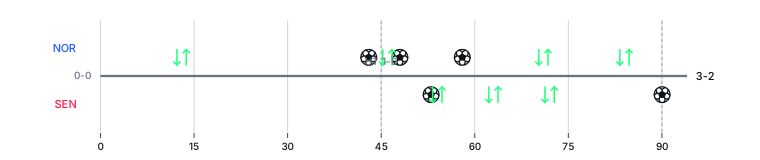
Norway's second goal, at 48 minutes, shows how the direct route worked in practice. Haaland received Martin Ødegaard's pass in transition and finished left-footed — a fast-break sequence short enough that it was over before Senegal could reorganize. The shot quality was modest, around 0.16, but the chance was created and converted in one clean movement.
The structure underneath that goal is the telling detail: Norway did not need sustained possession or territorial control to manufacture a goal-scoring opportunity. One transition window, one ball from Ødegaard into Haaland's run, was sufficient. That constraint — not dominance but efficiency within brief openings — is what the 2-0 scoreline actually reflects.
This is a local claim, not a full-match one. Senegal held the ball regularly and reached Norway's final third throughout. The 48th minute doesn't prove Norway spent the whole game countering. It proves something narrower: that when the transition window opened, the direct connection from Ødegaard to Haaland was the kind that ends up in the net. Norway needed it to happen a small number of times. It happened. That asymmetry — not dominance — is what made those two minutes the turning point.
The Left Flank Was Live Before the Interval — Pedersen Used It Once
Norway's opening goal came from the left flank. Marcus Pedersen had been there since the 13th minute, brought on when Julian Ryerson came off. What the record shows is that Pedersen spent the first half operating deep on the left side, his average position sitting well inside Norway's own half throughout — not the profile of someone tasked with overloading a channel, but a player holding a compact position with the capacity to threaten from depth.
His goal at 43 minutes was a right-foot finish from low probability — around 0.05 — struck from a position that had been available on that flank for the better part of half an hour. The left lane was not a strategic centerpiece of Norway's build-up; it was a route that was live, and on this occasion, used. Pedersen's goal is evidence the lane was open, not a blueprint for how Norway constructed every attack.
The sequence is specific: a left-side entry thirty minutes before the interval coincided with a direct goal from that flank just as the half closed. One goal, low quality on paper, right time. Norway did not build an attack consistently down that side — they used it once, and once was enough to take the lead into the break.
Berg Arrived at Halftime and the Decisive Goal Came Within Twelve Minutes
Patrick Berg entered at 46 minutes. Two minutes later Haaland scored Norway's second — but it was Ødegaard's pass that threaded it, not Berg's. The correction matters: Berg was on the pitch, Norway's midfield had just changed shape, and the goal followed immediately, but Ødegaard was the assist. Berg's direct contribution came twelve minutes later, when he found Haaland at 58 minutes for the goal that made it 3-1.
One assist. Thirteen passes from thirteen attempts. One big chance created across 45 minutes of football. That player line describes someone who arrived without friction, located the right connections quickly, and helped settle the contest before Senegal's late pressure could reopen it. The gap between what Berg provided in the second half and what Norway's first-half midfield had generated in terms of sharp ball-to-Haaland connections is not something the stats can fully account for — but the second half is a matter of record.
The substitution doesn't prove premeditation or that Berg alone restructured Norway's possession. What it confirms is that within twelve minutes of his entry, he provided the assist that made Norway's lead decisive. That connection — Berg to Haaland at 58 minutes, 3-1 — is the clearest version of why the midfield change mattered in this match.
Senegal's Possession Became Pressure — After the Scoreline Was Already Set
Senegal's control of this match was genuine: 58% possession, 489 passes at 88% accuracy, 64 entries into Norway's final third. Those numbers describe a team that moved the ball with coherent purpose and reached threatening areas regularly — not a side that was outplayed or passive for ninety minutes.
The problem was timing. Senegal had four big chances across the match and missed two of them. Their sixteen shots produced only four on target. The 0.91 xG they generated in the final fifteen minutes — six shots, sustained pressure — arrived after Norway led 3-1. Ismaïla Sarr's goal at 90+3, set up by Nicolas Jackson from a position worth around 0.25, confirmed Senegal could finish when the geometry aligned. It also confirmed this was a closing statement, not a recovery.
The structural tension is familiar: possession that doesn't convert when the scoreline is still open becomes pressure that arrives too late. Senegal made 64 entries into Norway's final third and ended with one goal. Norway used fewer, shorter routes earlier and more decisively. That gap in timing — not in quality or intent — is the match's real summary. Possession that does not produce goals before a 3-1 deficit is established is a different thing from possession that does.
Synthesis
Norway's win was assembled from specific moments rather than continuous control. Pedersen's goal gave them a lead from a low-probability position just before the interval. Ødegaard found Haaland in transition at 48 minutes to make it two. Berg, barely twelve minutes into his appearance, provided the assist that made it three. None of these required Norway to dominate Senegal — they required the routes to open and the right players to be present when they did.
The contradiction the match surfaced is worth naming precisely: Senegal's structural advantage — more of the ball, more entries into the final third, a genuine late-pressure phase — did not convert at the moments it could have changed the scoreboard. Norway's advantage was narrower and local. Haaland at the end of a transition window. A low-probability shot from the left that landed. A substitute midfielder connecting cleanly to a striker within twelve minutes of arriving.
Senegal's late surge was real — 0.91 xG in the final fifteen minutes, a genuine goal in stoppage time. But 3-2 after 90+3 is not a revival; it is the scoreline catching up to what Senegal were capable of once the game was already decided. Norway's directness won not because it was superior in volume but because it concentrated at the right moments. The match did not create that asymmetry. It exposed it.