
The Match Lived and Died in Fifteen Minutes
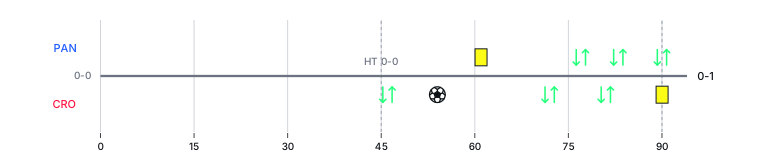
Two substitutions at halftime. Both immediate. Croatia brought on Budimir and Gvardiol at the interval and then, in the fifteen minutes that followed, produced the only sequence in the match that could genuinely be called dangerous. Three shots, close to 1.8 combined expected goals, and a winning goal at 54 minutes. Josip Stanišić delivered the assist; Budimir did what strikers are supposed to do with good service. Panama's response in that same window was a single effort worth barely 0.2 expected goals. The arithmetic of that quarter-hour is not subtle.
Whether the changes were reactive or planned is unknowable from what happened on the pitch. What is clear is that they coincided with the only genuine attacking spell Croatia managed all match. Before the break, they were building without penetrating. After the 60th minute, they stopped building at all. The Vatreni found their moment, scored, and then decided that was enough football for one afternoon — which, strategically speaking, it was.
The entire match pivoted on a single window. Croatia opened it, stepped through it, and then locked it from the other side. That is a coherent approach to winning an away game. Whether it is a coherent approach to playing football is a question the scoreline will answer for everyone who does not care about the distinction.
Six Shots, 1.6 Expected Goals, and the Limits of Calling That Good
Six shots. The number sounds modest until you attach the expected goals figure: 1.63 across the full match, with four of those attempts from inside the box. Croatia did not batter Panama. They simply positioned themselves to shoot from places that matter, and then mostly stopped shooting.
At 57 minutes, Marco Pašalić had two efforts in quick succession from fast-break situations — one missed, one saved, each carrying roughly half a goal's worth of danger on its own. That pair of attempts represents a team moving quickly into the box when the chance appears, not circling the perimeter hoping for the ball to fall kindly. When Croatia shot, they shot from situations worth shooting from. Two big chances went begging; one was converted. The efficiency ratio is real.
The critique writes itself: 58 percent possession and six shots across 90 minutes is not an expression of ambition. It is the profile of a team that concentrated its risk into a narrow window rather than sustained pressure, then used the ball to avoid conceding rather than to create. Efficient is a word. So is conservative. Calling one of them a virtue is more a matter of taste than evidence — and the taste on display here was for security over spectacle, for the single good chance over the ten mediocre ones. Whether that is courage or caution depends entirely on what you think football is for.
Budimir: Forty-Five Minutes, One Goal, Ten Duels Won
Ante Budimir scored in his 45 minutes on the pitch, won 10 duels, six of them aerial, and accumulated 0.8 expected goals from a single shot. A provider rating of 7.7 is a round, sensible number for a forward who did his job with an economy that borders on surgical.
The aerial dimension is worth noting specifically. Budimir didn't just finish — he competed. He won the kind of physical contests in the box that change where defenders have to stand, which changes where spaces open. Ten duels won in half a match is not a figure that implies a quiet evening. It implies a striker constantly asking questions in the areas where goals live. The goal itself arrived through exactly that mechanism: sustained pressure in the right zones, a decisive delivery, a clinical finish.
The obvious limitation is that 45 minutes is one data point, and reading too much into a single impact appearance is how bad analysis happens. But within the scope of this match, his entry was the clearest individual pivot available. He came on, he scored, he kept defenders occupied, he left. The narrative is almost offensively tidy — which is probably why people will call it inspired rather than merely well-timed. Budimir is the kind of player who makes a small argument very efficiently: give me the ball in the right place and I will make you look clever for putting me on.
Panama Pressed. Croatia Cleared. Nothing Threatened.
Once Croatia led, the match changed character entirely — and Croatia accepted that change without any visible resistance. Panama generated six shots across the final thirty minutes, which sounds like pressure until you examine what those shots were worth. A right-foot effort at 68 minutes carried 0.03 expected goals and was saved. A header from a corner in the same minute was worth 0.10 and missed. A left-foot attempt at 78 minutes came in at 0.06 and also missed. These are not the numbers of a team penetrating a defensive structure; they are the attempts of a team hitting walls from inconvenient angles.
Marin Pongračić made 11 clearances across 90 minutes. Not all of them were elegant, which is fine, because none of them needed to be. They needed to be decisive, and they were. The clearance volume is the most honest summary of what Croatia's defensive second half actually looked like: a team willing to deal with the ball aggressively and repeatedly, keeping Panama's entries away from the areas where genuine danger lives.
The sustained low expected-goals values on Panama's late attempts suggest Croatia did more than merely survive pressure — they managed the shape of what they were conceding. Panama had the ball in advanced areas, which the scoreline will record as pressure. What the shot locations record is something closer to frustration: presence without penetration, volume without quality. Croatia's defensive performance in the second half wasn't beautiful. It was, however, sufficient — and they understood the difference.
Synthesis
Croatia's win over Panama was built in one quarter-hour and defended for thirty. That is not a criticism wrapped in diplomatic neutrality — it is the structural description of what the match actually contained. The halftime substitutions opened a window; Budimir scored through it; the window closed; Croatia then spent the remainder ensuring Panama could not find another one.
Budimir was the hinge. Not a creative force, not a player who made the game interesting, but a striker who did precisely what the situation required: win aerial duels, demand the ball in dangerous spaces, and score when the chance arrived. Pongračić was the weight on the other side of the lever — 11 clearances, constant, unglamorous, and necessary in exactly the way unglamorous things sometimes are.
The result was legitimate. The construction was coherent. The football was, by almost any aesthetic standard, thin. Croatia with 58 percent possession and six shots is a team that knows how to avoid losing more than it knows how to win. They had 1.6 expected goals and converted just enough of it. Panama had late territory and converted none of it. The scoreline reflects that precisely.
The easy reading — Croatia were clinical, smart, professional — is not wrong. It is simply incomplete. Clinical and interesting are not synonyms, and calling something smart does not require pretending it was also brave. Croatia won. So does bad architecture: it also stands.