
The Flanks Set the First Demand
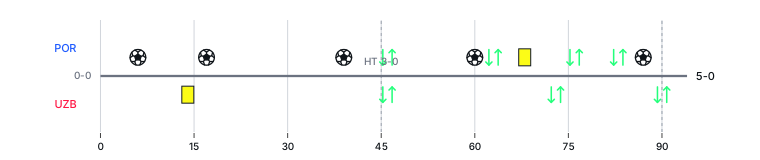
Portugal's opening approach put a specific demand on Uzbekistan's shape: defend the width or concede the depth. João Cancelo stayed high on the left throughout the first half — five crosses, two key chances created, and the assist that put Ronaldo through at six minutes. Nuno Mendes held the opposite flank with even more authority: 98 touches across 90 minutes, three key passes, and a goal of his own at 17 minutes. Two full-backs operating as genuine attacking outlets meant Uzbekistan's midfield was perpetually being pulled sideways, with no clean answer available.
The goals followed the pressure. Cancelo's assist for Ronaldo's opener was the first consequence of a defense that could not cover both flanks and maintain central shape simultaneously. Mendes's goal eleven minutes later was the second. Neither chance was accidental. Both arrived because Portugal had accepted the responsibility of the wide positions and acted on it immediately, before Uzbekistan had settled into any organizing rhythm.
What the positions of both players confirm is that Portugal did not hold their full-backs conservatively and invite the opposition forward. They committed to attacking width from the opening minutes, stretched the defensive shape, and required Uzbekistan to make uncomfortable choices. Uzbekistan made those choices poorly. The match was 2-0 before the first quarter-hour was complete, and the structure that produced that scoreline was already fully established before the second goal arrived.
The Center Did the Governing
If the flanks created the width, Vitinha provided the logic that held everything else together. In 83 minutes he completed 95 of 98 passes — a figure that reflects not luck but a player who demanded the ball, found the space to receive it, and moved it quickly enough to stay out of trouble. Four possessions lost across the entire match. He was the axis around which Portugal's circulation turned, a midfielder who governed the center rather than merely commuted through it.
Bruno Fernandes operated higher — 94 touches, two big chances created, and the assist for Ronaldo's third goal at 39 minutes. His position between the midfield and the attacking line meant Portugal always had a live route through the center into the final third. Fernandes found Ronaldo, and Uzbekistan had no answer. The ball moved centrally, the connection was made, and the goal arrived. That is as much as the sequence allows us to say with certainty about the defensive side of it — but the outcome itself was unambiguous.
Vitinha circulated, Fernandes connected, Ronaldo finished. A midfield that governs does not require the opponent to be poor — it requires its own players to accept the responsibility of central territory and carry it for ninety minutes. Vitinha lost possession four times across the whole match. That kind of economy is not a stat to admire in isolation; it is what central government looks like when a player actually understands the demands of the position.
Uzbekistan's Forward Had Nowhere to Go
Uzbekistan held 34% of the ball. That figure alone tells you this was not a match with two competing plans. It was a match where one side set the agenda and the other spent 90 minutes responding to it. Seven shots, two on target, zero big chances created, and 30 clearances. These are the figures of a team overwhelmed structurally, not merely outrun.
Eldor Shomurodov completed 21 of 28 passes and touched the ball 45 times across the full match. He stationed himself centrally, which is where a forward ought to be when building a counterattack, but the service behind him was too thin and too slow to make that position threatening. Uzbekistan managed only 31 passes into Portugal's final third across the entire game. A forward who wins nine duels but receives the ball so sparingly is not a danger — he is being tolerated by the opposing structure as an acceptable risk.
Shomurodov worked. That much is clear from his duel count and his positioning. The problem was that the ball rarely arrived in conditions that allowed him to do anything consequential with it. His touch profile — 45 touches, 28 pass attempts, no big chances — describes a forward starved of support rather than a forward who failed. Uzbekistan could not connect its defending units to its attacking outlet, and Shomurodov paid the price for a collective disconnection his individual effort could not repair.
The Rotation Closed the Match on the Same Terms It Opened
João Cancelo came off at halftime. So did Francisco Conceição. The score was 3-0. Nélson Semedo replaced Cancelo, Pedro Neto came on for Conceição. Fresh wide players on a lead already comfortable — and the match continued in the same attacking shape it had maintained through the first half.
The first fifteen minutes of the second half produced five Portugal shots and a goal. Semedo completed 38 of 42 passes across his 45 minutes — steady, positionally sound, a stable presence on the flank rather than a creative upgrade. Uzbekistan's two shots in that same window were of negligible quality. The match had not become contested. It had simply continued.
At 83 minutes Vitinha came off and Rafael Leão entered. Four minutes later Leão scored. Whether the change directly caused the goal is not a conclusion the evidence supports — thirteen minutes of football and one shot on target is too thin a thread for that claim. What it does show is that Portugal's rotation produced no collapse in attacking output. Five shots and a goal in the opening second-half window, a further goal in the final phase. Leão's finish at 87 minutes was not stoppage-time sentiment. It was a fifth goal scored by a side that had run this match on its own terms from the first whistle and found no reason to stop.
Synthesis
Portugal imposed the terms of this match in its first 17 minutes and never renegotiated them. The flank occupation that produced two early goals was a structural demand on Uzbekistan that the visitors could not answer: cover the width and leave the center available, or hold the center and surrender the flanks. They had no third option. The central axis of Vitinha and Fernandes then converted that pressure into controlled movement — 95 accurate passes from one, two big chances created from the other, and a third goal before halftime.
What separates this performance from a routine result over weaker opposition is the consistency of the responsibility accepted. Cancelo and Mendes committed to the wide positions from the first minute and acted on them immediately. Vitinha governed the center with the economy of a player who understood what the position required — four possessions lost in 83 minutes is not a stat; it is a standard of care. Fernandes operated higher and found Ronaldo when the space opened. Each of them understood what the match demanded and did not hide from it.
Uzbekistan were not passive. Shomurodov competed, the defense cleared thirty balls, and the midfield ran. But 34% possession and zero big chances describe a team that could never set its own terms, and one forward working in isolation could not alter that arithmetic regardless of his effort. The question this match posed — who will accept responsibility for what happens on the pitch — had one serious answer. Portugal gave it early and sustained it for ninety minutes without apology.