
Alajbegović Stayed High and Wide, and the Opener Came From Exactly There
Kerim Alajbegović spent the match pinned high on the right flank, well inside Qatar's half. Sultan Al-Brake, the defender across from him, averaged a position equally advanced — and his numbers told the story of a player who spent the afternoon chasing: one duel won to three lost, 11 possessions given away, a 5.2 rating. Two players, same corridor, very different outputs.
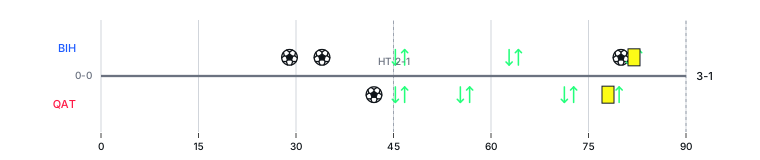
Alajbegović's stat line shows what the space allowed: six dribbles completed from eight attempts, four fouls drawn, ten duels won. Two key passes, one big chance created. At the 29th minute, Bašić picked him out wide right, he took it right-footed, and the ball went in from a low-probability position — around 0.04 expected goals from out toward the flank. That is a difficult finish, and he made it clean.
Al-Brake's advanced positioning left a corridor that Alajbegović kept returning to across the first half. The opener came directly from that channel. The evidence shows the position and the outcome; it does not map every touch or establish a pre-game plan. What it does show is that Bosnia's clearest flank threat ran through the right, and the first goal followed from exactly there.
Bašić Gave Bosnia a Passing Route They Could Always Find
The right-side threat only arrives if the ball can get there. Ivan Bašić was the reason it could.
Playing centrally in the attacking half the entire game, Bašić completed 66 of 69 passes — a rate that points to availability more than to safe recycling. Six of his seven long balls found their target. He registered 87 touches across 90 minutes and lost possession only six times. When Bosnia needed to shift play toward the right, or simply keep the ball moving forward, Bašić was the address they came back to. The assist on the opener was the most visible evidence of that: he picked out Alajbegović with the pass that led directly to the 29th-minute goal.
What made the volume add up was where he held his position. Staying central in the attacking half meant Bosnia always had a receiver between their defensive line and the front. The passing didn't disappear when Qatar pushed higher; Bašić stayed in the areas the game asked him to occupy and kept the ball moving. Sixty-six accurate passes in a 90-minute game, six long balls that landed — that is a midfielder who was genuinely difficult to bypass rather than one who simply recycled possession sideways.
The data supports central orchestration in this game. It doesn't map every phase of Bosnia's buildup or prove a fixed role in other matches. But in this one, Bašić was the hub the structure ran through.
Qatar Created More, and Did Not Convert
Qatar's chance profile should have made this a closer result. They finished with 0.77 expected goals to Bosnia's 0.64, three big chances created to Bosnia's one, five shots inside the box to Bosnia's four. The shot map pointed toward a side that was reaching better positions.
The clearest moment came in first-half stoppage time. Pedro Miguel had two attempts in quick succession: the first, a low-probability shot, missed wide. The second — a genuinely dangerous chance worth around 0.17 expected goals — hit the post. At that point, the score was already 2-0, the second goal having arrived at 34 minutes via an own goal. Two moments in stoppage time where the ball reached the frame and came back out; a different outcome there and the entire second half looks different.
Bosnian numbers tell the other side of the ledger: 14 shots, 10 of them from outside the box, one big chance across the whole game, and a 0.64 expected goals total that is genuinely modest for a team that won by two. The margin came from converting a low-probability opener, the own goal, and a late substitute finish — not from overwhelming Qatar with chance quality. Qatar had the better individual opportunities. They just could not take them, and the data does not isolate exactly why. What it shows is the gap between what they created and what appeared on the scoreboard.
Two Substitutes, Seventeen Minutes, One Goal, Done
The substitution sequence is almost embarrassingly direct. Dennis Hadžikadunic came on at 63 minutes; Ermin Mahmić followed at 64. At 80 minutes, Hadžikadunic assisted and Mahmić scored. Seventeen minutes on the pitch, one goal, match sealed at 3-1.
The game was not already over when they came on. Qatar had pulled one back before this point, and 2-1 with half an hour left is a live scoreline. What the two players produced was short and decisive. Mahmić touched the ball eight times in 26 minutes, lost possession once, and converted his only shot — a corner-situation attempt from low probability, around 0.05 expected goals, right-footed. Hadžikadunic, across 27 minutes, landed nine of eleven passes, won two tackles, made three clearances, and delivered the assist that set Mahmić up.
The causal chain is exactly as short as it looks. Bosnia made the changes, the two players combined, and the ball went in the net. The evidence supports the direct sequence — substitution timestamps and the assist-goal record are both explicit. It does not prove what prompted the changes or how much the substitutes shifted the broader shape of the game. What it does prove is that when the moment arrived, Mahmić saw it quickly enough to finish it. That is where coaching ends and execution takes over.
Synthesis
Bosnia did not need to dominate this game. They needed three separate things to work at the right time, and all three did.
Alajbegović stretched Qatar's left side across the first half, produced the opener from a wide right position, and kept that corridor occupied. Bašić moved the ball through the center with enough precision and volume that Bosnia had a forward route on almost every possession — 66 completed passes, six long balls that landed, the assist on the goal. When Qatar's better individual chances came — genuinely dangerous in first-half stoppage time — they hit the post and missed. The score held at 2-0.
That Qatar xG gap is the most uncomfortable number in this match. They had the sharper looks at goal and still lost by two. A post, two big chances missed out of three: that is not misfortune spread evenly across a game. It is a specific failure at the moments that mattered most.
And then the bench closed it anyway. Mahmić's finish at 80 minutes, from a corner position that carried maybe a 5% conversion probability, removed whatever doubt remained. The structure gave him the moment — Hadžikadunic's assist, a corner that dropped to the right spot, a scoreline that needed one more. He took it. That is the match: three mechanisms, each working once, at the times the game asked them to.