
The Game Colombia Chose to Run
Possession without consequence is only politeness. Colombia's was not polite — it was suffocating. With 64% of the ball and 540 passes at nearly 88% accuracy, they did not allow DR Congo to develop any rhythm worth calling attack. The Congolese side managed eight shots across ninety minutes, one on target, and registered exactly zero big chances. The match had an organizing principle, and it belonged entirely to Colombia.
The phase-by-phase shape tells the same story without variation. In the first fifteen minutes, Colombia produced five shots to DR Congo's one. Between sixteen and thirty, they put four more attempts on goal while DR Congo created nothing. The final stretch of the first half brought five more Colombian shots and another irrelevant Congolese effort. That is fourteen first-half shots for one side and two for the other, with a half-time score of nil-nil. Colombia governed the game; they simply could not yet close it.
There is a distinction worth drawing. DR Congo's 298 passes at 75% accuracy describes a team that was not attempting to play through Colombia — they were managing their own defensive shape, recycling without ambition. Colombia's 63 entries into the final third versus DR Congo's 38 is a cleaner picture of where the contest actually lived. One side accepted the responsibility of trying to win a football match. The other accepted a different, less demanding brief.
Quintero Arrived and the Attack Acquired a Purpose
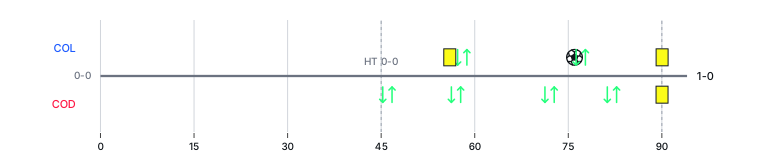
The problem was not Colombia's control. It was that their control had no finishing edge. Fourteen first-half shots, the woodwork struck, chances missed — possession accumulated without the thread that separates pressure from decision. That changed in the 58th minute, when Juan Fernando Quintero replaced James Rodríguez.
In 32 minutes on the pitch, Quintero completed 7 of 10 long balls, registered two key passes, and provided the assist that settled the match. At 76 minutes, he delivered the ball into the area for Daniel Muñoz to convert. The finish itself was a low-probability left-foot effort from an acute angle — not a generous chance — but the delivery that created it was precise, and that precision came from Quintero's willingness to take the ball in a decisive position and do something sharp with it. He had 33 touches in little over half an hour. That is not decoration; that is engagement.
The honest reading is that Quintero did not transform a match Colombia already held. What he provided was the specific quality the first half lacked: a player who wanted the ball in consequential situations and understood what to do with it. His expected assists figure of 0.14 in those 32 minutes reflects the directness of his involvement. The substitution came at 58 minutes; the goal arrived at 76. Within that window, Quintero produced the delivery that mattered. The evidence does not reconstruct every touch in between, but it does show the sequence had an author — and that author had just come off the bench.
The Defender Who Did Not Stay Back
Daniel Muñoz scored the winning goal. That alone would earn him mention. What makes his performance worth more careful attention is that the goal was not an isolated act of opportunism — it was the natural consequence of how he had played for seventy-six minutes before it.
In the fourth minute, Muñoz struck the post. That is a right-back in the attacking third inside four minutes of a Group K match, connecting cleanly enough to find the frame. His average position across ninety minutes sat near the midfield line — notably high for a player nominally tasked with defending a flank. He finished with 69 touches and 51 passes at 92% accuracy. Two shots, one goal, one post. That is not a defensive performance interrupted by a lucky finish. That is an attacking contribution sustained from first whistle to last.
The responsibility question is worth asking plainly. Muñoz accepted a set of demands that most defenders avoid: he pushed into territory where mistakes are visible, where quality is tested, where the difference between a poor touch and a good one costs a goal at one end or wins one at the other. He did not hide in his own half behind the comfort of defensive work. His provider rating of 7.8 and man-of-the-match recognition reflect what was observable — a defender who understood the full dimensions of what this match required and delivered them. That is rarer than it sounds.
Synthesis
Colombia did not win this match through inspiration. They won it through a structure that accepted three connected responsibilities: hold the ball, find the quality to sharpen the attack when possession alone cannot break through, and get bodies into advanced positions willing to carry the consequence.
The first responsibility was met for most of ninety minutes — 64% possession, 540 passes, the Congolese side restricted to one shot on target across the full game. The second arrived eighteen minutes from time in the form of Quintero, who provided two key passes and the decisive assist from a demanding delivery. The third was carried throughout by Muñoz — a defender who occupied the forward half of the pitch, struck the post in the fourth minute, and scored the winner in the seventy-sixth.
DR Congo's eight saves and 19 clearances tell you everything about what their ninety minutes looked like. They survived for a long time, but surviving is not a plan — it is a delay. The moment Colombia found the sharp pass and the willing finisher in the same sequence, the result was settled.
The match punished no catastrophic error and rewarded no piece of individual genius. What it rewarded was willingness to take the ball into situations that matter, and the technical discipline to do something useful once there. Muñoz understood that from the opening minutes. Quintero demonstrated it briefly and decisively after the hour. Colombia, as a team, earned a 1-0 result that the overall shape of the contest had long suggested they deserved.