
Hakimi as the Load-Bearing Outlet
Morocco's attacking structure had a clear spine, and it ran through Achraf Hakimi pushing high on the left. With 104 touches and 8 key passes across the full ninety minutes, he wasn't just a presence on that side — he was the primary channel through which Morocco moved the ball into dangerous territory. Haiti's defensive block couldn't ignore him; to shade toward Hakimi meant leaving space elsewhere, and Morocco's shape was built to exploit exactly that choice.
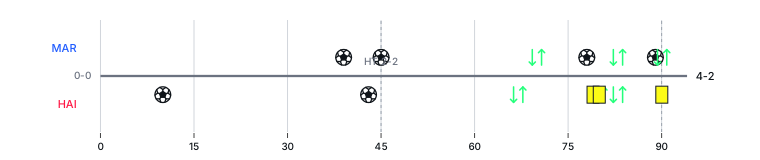
The goals confirmed what the volume of involvement already suggested. Hakimi scored the equalizer at 39 minutes to make it 1-1, then turned provider in first-half stoppage time — his assist sending Ismael Saibari through to level again at 2-2. Both equalizing sequences ran through the same left-sided corridor he occupied all game. That kind of double involvement in the chaotic final ten minutes of the first half isn't coincidental; it reflects what happens when a single player becomes the structural hinge for progression.
The evidence shows advanced occupation and sustained production, not a written tactical mandate. What it does show is that Hakimi's role on that side was load-bearing enough that when Morocco needed a goal, the sequence kept arriving from the same source. That's not proof of instruction — but it is proof of structural dependence. The match did not create Hakimi's left-lane authority; it exposed how central it already was.
Width Came from Both Directions
The left-side story is real, but it only makes sense alongside what was happening on the right. Bilal El Khannouss held a high advanced position on the opposite flank throughout the match — mirroring Hakimi's occupation on the other side. Morocco didn't stretch Haiti's defense from one direction; they stretched it from two simultaneously.
El Khannouss finished with 99 touches, 3 key passes, and a 5-from-7 dribble success rate. The provider evaluation gave him the top individual rating on the pitch at 8.9, and while those rankings carry their own limits, the underlying numbers support the picture: he was a sustained threat down his side, drew defensive attention, and created chances that consistently pulled Haiti's shape. The bilateral occupation meant that shifting to contain Hakimi opened the right channel, and defending El Khannouss meant conceding the left. Neither player could be neutralized without gifting the other one.
This is the structural logic Morocco's attack actually ran on. The width wasn't a stylistic preference — it was the mechanism that made possession threatening rather than just voluminous. With Haiti sitting deep and compact, registering 26 clearances and 8 saves across the match, the only way to generate quality chances was to force defensive decisions across the full width. Hakimi and El Khannouss together achieved that, even as Haiti stayed compact long enough to threaten on the counter.
Haiti's Transitions Changed the Cost of Control
Morocco's width and Hakimi's high occupation came with a cost, and Haiti made them pay it twice before halftime. Haiti finished with just 0.66 expected goals across the entire match — nine shots, two on target — and yet they scored twice. The first goal came inside the opening phase when Haiti converted from their only meaningful early chance. The second, Wilson Isidor at 43 minutes from a low-quality chance assisted by Jean-Kévin Duverne, turned a 1-1 draw into a 1-2 deficit heading into the final minutes of the first half.
This is the contradiction at the heart of the first half: Morocco had more of everything — more shots, more territory, more chances — but Haiti's efficiency in transitional moments meant the scoreline didn't reflect the pattern of play. In the 31-to-45-minute window, Morocco produced six shots worth about 1.4 combined chance quality; Haiti produced two shots worth barely 0.07 and still scored once. That gap between chance quality and goals is not a pattern that holds indefinitely, but in a first half already swinging between lead changes, it imposed a real and visible constraint on how aggressively Morocco could commit forward.
Haiti's 31 percent possession and compact shape meant Morocco could not break through cleanly, and every time the ball turned over in dangerous areas there was transition exposure to manage. The structure held long enough for those two moments to land. Structural superiority and a first-half deficit at the same time — that's the contradiction those ninety minutes had to resolve.
The 70th-Minute Changes Turned Pressure into Separation
Morocco entered the second half level at 2-2, and the match stayed locked until the 70th minute, when two substitutions arrived simultaneously: Soufiane Rahimi on for Saibari, Gessime Yassine on for the striker he replaced.
What followed was direct. Rahimi scored at 78 minutes, assisted by Chadi Riad, to make it 3-2. Eleven minutes later, Yassine finished at 89 minutes — Rahimi turning provider — to close it at 4-2. Two goals, two different scorers, with the two substitutes combining for both. In the window between the 76th and 90th minutes, Morocco generated six shots worth about 1.0 combined chance quality, with both goals converting inside that stretch. Rahimi produced a goal and an assist across his twenty minutes; Yassine needed just ten touches to finish his.
The easy read is fresher legs breaking tired ones, but the evidence does not support that framing specifically. What it shows is two players entering a live match and converting where their predecessors had not. The two substitutes combined for every goal that separated the teams. Morocco's attacking structure had been pointing toward a breakthrough; these were the players who found it. The personnel change mattered — the scoreline proves that much, even if the mechanism behind it stays bounded by what visibly happened rather than what was privately planned.
Synthesis
The result looks clean — 4-2, Morocco comfortable — but the match underneath it was a chain of structural problems that didn't resolve in a straight line. Hakimi's left-side dominance was real, and it drove Morocco's best attacking sequences. El Khannouss mirroring him on the right meant Haiti faced a genuine two-sided problem, not a one-dimensional overload they could simply shade against.
But that same aggressive width left Morocco exposed in transition, and Haiti converted that exposure twice in the first half with a finishing efficiency that had no business corresponding to the shot quality they generated. For forty-five minutes, Morocco controlled everything except the score. Structural superiority and a deficit at the same time — that's the contradiction the first half exposed, and it's the part the scoreline buries.
The substitutions resolved the tension. Rahimi and Yassine delivered what the structure had been unable to close — a direct goal and an assist inside twenty minutes, with the second substitute providing the finish that sealed it. The margin grew. The scoreline eventually caught up with the pattern of play.
What this match actually demonstrates is that Morocco's attacking system is coherent and productive — bilateral width, a load-bearing left outlet, sustained chance creation against a disciplined block. But coherence isn't the same as security. Haiti found the gap twice, and in a tighter match those moments could have defined everything. The 4-2 reads as control. What it was, more precisely, is a well-structured team that absorbed a real first-half threat and then finished what its shape had been building toward — through the players who came on to do it.