
Vinícius Did Not Need Many Invitations
The easy compliment for Vinícius Júnior is that he is dangerous. The accurate one is more specific: he finds high-value positions and finishes from them, which is considerably rarer than simply being threatening.
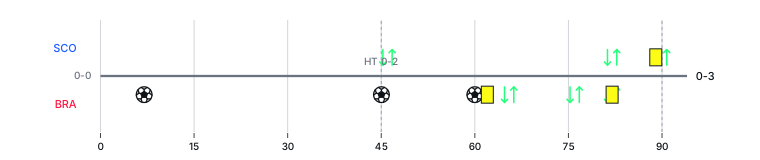
In the seventh minute, Rayan delivered, Vinícius met the ball with his right foot, and the shot — struck from close range, centrally — gave the goalkeeper almost nothing to work with. That was not luck or reaction; the position was already won before the ball arrived. At the stroke of half-time he added a header, again from a delivery that put him exactly where goalkeepers cannot reach. Two goals, both from situations already tilted heavily in the scorer's favor before he pulled the trigger. Five shots on target across the ninety. Total shot value above three. That is a player selecting correctly and finishing to match.
What the record does not tell us is precisely how he moved to find those positions — the off-ball pattern is beyond what is visible here. What it does confirm is the output: two goals, both from chances that were already high-quality by any measure. Vinícius did not manufacture his way out of trouble and improvise a finish. He arrived in the right place and did the thing that is supposed to happen there. Scotland conceded that standard twice. Brazil needed nothing more.
Bruno Guimarães: The Creator Who Did Not Need to Announce Himself
There is a type of midfielder who gets praised relentlessly while a team is winning and blamed the moment it stops. Bruno Guimarães is not that type, which is precisely why he is interesting. He does not demand to be noticed. He simply makes good decisions at a rate that forces you to notice him anyway.
Two assists. Three key passes. Two big chances created. Nine ball recoveries. Those numbers describe a player who was functional in both phases — not someone who created by standing still and waiting for things to happen around him. The third goal, at sixty minutes with the score already settled, came from his supply: Matheus Cunha finishing, Guimarães providing the delivery. That is not a cameo contribution. That is a player who kept looking for the right pass when the match was already won, because the right pass is the habit, not the score-state response.
The honest limit here is that the record shows what he produced, not the exact route he used to produce it. We know the passes arrived in dangerous positions. We know two of them became assists and two more opened genuine big chances. What we cannot reconstruct from this is the precise moment Scotland's shape opened and the exact delivery window Guimarães identified. The output is visible and substantial. The mechanics of how he found the space each time are not fully legible from what is recorded. That combination — decisive production, understated method — is the thing most expensive midfielders promise and fewer than you would expect actually deliver.
Scotland Had Shots. Scotland Did Not Have Goals. These Are Different Problems.
Fourteen shots, ten inside the box, seven corners, 499 passes completed near ninety percent accuracy. On paper, that is a team that was involved. On the scoreboard, it is a team that lost three-nil. The gap between those two descriptions is the whole story of Scotland's evening.
The actual chance quality behind those fourteen shots was 1.13 — not a gift, but not the kind of number that automatically explains a heavy defeat. The two biggest chances went to Scott McTominay: a left-foot effort at seventy-two minutes that missed, and a corner-situation shot deep in stoppage time that was saved. Both were real opportunities, the kind that change scorelines when they go in. Neither did. Two big chances, two misses: a clean, symmetrical failure to convert the moments that actually mattered.
What should not follow from this is any claim about why the misses happened. The record describes the conversion gap, not its cause. Scotland were not victims of some diagnosable breakdown — they had genuine opportunities and did not score from them. The dangerous interpretation, the one worth resisting, is that shot volume and box entries are automatically meaningful. They are the currency of looking like you are competing. They are not the same as competing effectively. Scotland crossed into the box ten times and left with nothing. That is not a moral verdict. It is a finishing record.
Ferguson Was Brilliant. It Did Not Save Anyone.
Sometimes the most illuminating thing about a loss is who performed best for the losing side. Lewis Ferguson completed 86 of 91 passes, accumulated 113 touches, and spent the match anchored through the center of Scotland's midfield — the player the team kept returning to when it needed the ball kept moving. His rating of 8.1 was higher than most of the players on the winning team. That is not a small irony.
Ferguson operated deep in the defensive center, functioning as Scotland's recycling point: the pass that arrived when the build-up stalled, the body that kept possession ticking when the shape was under pressure. A 94.5 percent pass completion from 91 attempts is not a quiet game. That is a player who touched the ball constantly and did not give it away. He also won six duels, made four tackles, and recovered three balls. For a midfielder anchoring a side that conceded three, that is a substantial physical contribution alongside the technical one.
The thing Ferguson could not do — and nothing here suggests this was his failure specifically — was convert that central retention into the kind of final-third danger that changes scorelines. One key pass. One shot on target. Expected assists under 0.1. He held the midfield together and gave Scotland the platform to build from. The platform went unused. That separation — between keeping possession and turning it into something threatening — is the structural problem the whole match exposed. Ferguson was genuinely excellent at his job. His job was not the job Scotland needed most.
Synthesis
The comfortable reading of this result is that Brazil are simply better — more talented, more clinical, inevitable — and Scotland competed respectably in a match they were always going to lose. That reading is not wrong. It is just not useful, because it mistakes the outcome for the explanation.
What actually happened was a match defined by a very specific quality gap at the moments that cost goals. Vinícius scored twice from chances already tilted in his favor before he touched the ball. Guimarães produced two assists and two big chances created, then recovered nine balls in the same ninety minutes — someone who was active and dangerous in both directions, not a creator who hid when his team had the lead. Scotland generated fourteen shots and left with 1.13 chance value converted to nothing. McTominay's two clearest opportunities, at seventy-two minutes and deep in stoppage time, were missed and saved respectively.
Ferguson recycled 86 passes through the center of the pitch in a 3–0 defeat and earned an 8.1 rating for it. That is the most honest encapsulation of Scotland's evening: the structure was competent, the retention was genuine, and none of it reached the register where matches are decided. Brazil's three goals came from two players doing very specific things well. Scotland's zero came from fourteen shots that never found the same register.
Tidy possession and a high pass map are aesthetically satisfying metrics that can accompany a three-nil defeat without contradiction. They did here. The match separated building something from building the right thing — which, irritatingly, turns out to matter more than the building looks.