
How the Right Side Opened the Match
Switzerland did not win this match through balanced possession. They concentrated weight on the right flank — Rubén Vargas operating high in that channel, Ricardo Rodríguez pushing forward from deeper on the same side — and that structural lean shaped the context for the opening goal.
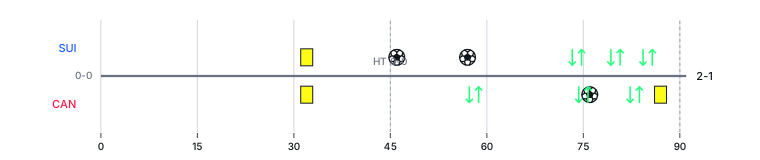
Vargas spent the game in an advanced right position, and Rodríguez, nominally a defender, held an unusually high average station on the same flank. Two players, one corridor, both tilted toward attack. The consequence is visible in the goal itself: Vargas scored in the 46th minute, assisted by Johan Manzambi, to make it 1-0. The finishing and the buildup were consistent with where Switzerland had been investing their energy across the match.
The honest limit here is that where players spend time is not the same as where they were sent. This was a spatial lean, not a confirmed tactical instruction. And Switzerland were not exclusively right-sided — the concentration does not mean the left was abandoned. But the pattern held well enough across the match to shape the context that mattered most: the opening goal came through the flank Switzerland had been loading all game.
What Kobel Actually Absorbed
The cleaner story of Switzerland's win is the right-flank goal. The honest story is that they needed their goalkeeper to hold something together across the full ninety minutes.
Gregor Kobel finished with six saves — all six inside the box. That is not a number that describes a goalkeeper who faced comfortable, routine work from distance. Canada managed seven shots on target across the game, with twelve of their thirteen total attempts coming from inside the box, and Kobel dealt with the serious threats when they reached him. His rating of 8.7 was the highest on the pitch and backed by the match record: the provider ranked him the game's top performer, and the stat line explains why.
The late phase tells the more compressed version of the same story. From the 76th minute through stoppage time, Canada generated five shots while Switzerland produced none. The lead held at 2-1, but not through defensive comfort. It held because Kobel kept dealing with chances that Switzerland's outfield players could not prevent from reaching him. That is a different kind of winning margin than the scoreline suggests — not control, but sustained intervention under accumulating pressure. The gap between what Canada created and what they converted is, in large part, one man's work.
Promise David and the Problem He Created
Canada's substitution in the 75th minute was not a cosmetic change. Promise David came on for Tajon Buchanan and within sixty seconds had scored — a right-footed finish assisted by Nathan-Dylan Saliba that cut the deficit to 2-1. The sequence was almost instantaneous: substitution at 75, goal at 76.
What David added was a focal point in the box. His 15-minute stat line — one goal, three shots on target, two ball recoveries, one aerial duel won — reads like someone who arrived with a specific physical role and discharged it immediately. His two most dangerous attempts carried a combined xG around 0.5, which given the late stage and the margin involved, made Switzerland's lead feel genuinely conditional rather than secure. His headed effort deep in stoppage time — saved by Kobel — was the last serious moment of the contest.
The structural consequence is straightforward: Canada before David was 2-0 down and generating pressure without a clear threat in the box. Canada after David was 2-1 down with a live scorer making runs into dangerous positions. That shift in the choice set for Switzerland's center-backs — suddenly required to account for an aerial presence and a willing runner — is what turned the final fifteen minutes from management into survival. The substitution did not manufacture pressure from nothing; it sharpened pressure that already existed into something Switzerland genuinely had to answer.
Synthesis
Three mechanisms shaped this result, and none of them is reducible to the others. Switzerland's right-flank concentration created the conditions for the opening goal — a spatial lean that Vargas and Rodríguez maintained high enough and long enough to produce a real finishing moment at the start of the second half. That was the foundation.
But foundations do not close matches. Kobel closed this one. The six inside-box saves across ninety minutes represent the actual mechanism of the 2-1 margin holding. Switzerland were not in control of the match's final shape; they were protected inside it. Canada hit twelve of their thirteen shots from inside the box and still walked away with one goal. That conversion gap is the Kobel story, and it matters more than the scoreline implies.
What Promise David's cameo exposes is the distance between scoreline and process. His arrival at 75 minutes did not create Canada's pressure from scratch — but it sharpened it immediately and dramatically. One minute after he entered, the score changed. The final fifteen minutes became a test of margin rather than outcome only because David forced it to be one, converting a chase into a live threat and leaving Kobel to answer his headed effort in stoppage time.
The match did not expose a Switzerland system under stress from the first whistle. It exposed what happens when a narrow lead, a goalkeeper carrying real load, and a sharp substitution from the trailing side all converge in the same quarter-hour window. The contradiction at the heart of this result is structural: Switzerland built through one flank, won through one man between the posts, and survived through the narrowest of margins once the right substitution arrived.