
Possession With Consequence
Côte d'Ivoire did not simply accumulate the ball. They used it to deny Curaçao any sustained period in which to settle, build, or threaten. The away side finished with 63% possession and 623 passes completed at nearly 90% accuracy — numbers that describe not just volume but the kind of clean, unhurried circulation that compresses an opponent's decision time without the possessor needing to do anything spectacular.
The distinction matters. Possession without consequence is only politeness. What Côte d'Ivoire produced was something more purposeful: a passing rhythm that kept the pitch tilted, forced Curaçao to defend rather than organize, and created the conditions for the two moments that settled the match. Seven total shots, two goals, three big chances created. The structure mattered more than the counting.
Curaçao's position by contrast pointed toward a team spending most of the evening answering rather than asking. They were reactive from the opening minutes and never found the sequence or the territory to change that situation before two goals had already been conceded. At that point the game's fundamental question had been answered: Côte d'Ivoire had an idea that survived pressure. Curaçao had not yet found one of equivalent quality.
Sangaré Governed Where Others Only Ran
Ibrahim Sangaré was the player who made the structure legible on the pitch. His 110 touches and 98 passes placed him at the center of everything Côte d'Ivoire did in circulation. He stayed close to the middle of the pitch, acting as the relay point through which the away side's rhythm was maintained and the game's tempo was set. A midfield must govern, not merely commute — and Sangaré governed.
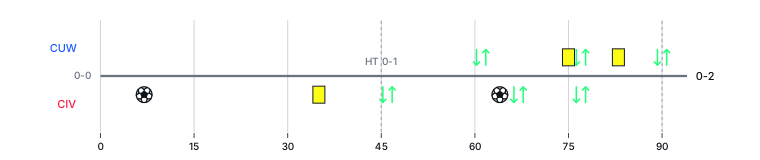
The assist for the second goal at 64 minutes — threading the ball to Péпé to make it 0-2 — was the sharpest illustration of what that midfield authority produced: not just safe possession, but progression that ended in a goal. Sangaré also won eight duels and recovered the ball five times across ninety minutes. He was not a player who hid in comfortable space and moved the ball sideways to stay clean. He accepted the ball under pressure, which already placed him above several others on the pitch.
The governing midfielder in a functional side does two things simultaneously: he keeps his team comfortable when it has the ball, and he makes the opponent's attempts to disrupt that comfort costly. By the time Sangaré's assist arrived, Curaçao had spent the better part of an hour failing to solve either problem.
Two Shots, Two Goals, No Excess
Nicolas Péпé was on the pitch for 67 minutes and required only two shots on target to settle the match. The first came inside the seventh minute — an assisted finish from a central position carrying a genuine chance value near 0.43, the kind of opportunity that a clinical forward is expected to take. He took it. The second arrived at 64 minutes from a tighter angle, the chance value closer to 0.13. Péпé converted that one as well.
That is the kind of finishing that makes a structural plan look inevitable. Côte d'Ivoire created three big chances across the game and missed one; Péпé was responsible for both that counted. The harder opportunity — the one that required technique under the kind of pressure that separates finishers from players who score only when conditions cooperate — was taken cleanly and without ceremony.
He left the pitch shortly after that second goal. The job was done. Whether this particular conversion rate holds over a larger sample is a separate question; on this evidence alone, Péпé accepted the responsibility that fell to him. He did not hide from the ball, and when the ball found him in positions that mattered, he did not hide from the moment either.
The Backline That Kept the Pitch Permanently Open
The circulation and the goals did not appear without a spatial condition that made them possible. Côte d'Ivoire's defenders spent this match well advanced of where defenders typically operate — Christopher Operi and Guéla Doué averaged positions clearly in the attacking half, and they were not alone. Four defenders in total averaged positions on the attacking side of the pitch, maintaining a compressed territorial shape that pushed Curaçao back without requiring explicit pressing, simply by occupying depth and width simultaneously.
Of the sixteen Côte d'Ivoire players with recorded average positions, nine fell on the attacking side of the pitch, and eight of those concentrated in the central lane. That density explains why Sangaré had space to receive, distribute, and move. The midfield did not have to fight for position because the spatial structure had already claimed it.
What this created for Curaçao was a continuous problem without a comfortable answer. A compact defensive block handles one of those spatial questions reasonably well. An opponent who is advanced, center-heavy, and maintaining clean circulation puts every part of that block under pressure at once. Curaçao spent the game choosing which fire to put out rather than choosing where to attack.
Curaçao's Late Burst: Volume Without Quality
Trailing by two, Curaçao brought on Jurien Gaari and Deveron Fonville at the 77th minute, and the final quarter-hour produced their most active attacking spell of the game. Five shots in 15 minutes — which on the surface looks like a response. The combined chance value on those five efforts was just under 0.30. That is volume without genuine threat. For comparison, Péпé's seventh-minute opener alone carried more expected value than all five of those late attempts combined.
The double substitution coincided with the burst, though whether the changes caused it or whether a two-goal deficit simply forced Curaçao to take risks they had not been willing to accept earlier is not something shot counts alone can answer. What is clear is that the activity did not translate. No goal, and the chances created in that late window did not suggest one was particularly close to arriving.
A trailing side that attacks in the closing minutes produces numbers. That is not the same as producing a real argument. Côte d'Ivoire had already completed the structural work that made those late numbers largely irrelevant — the match's real decisions had been made at the seventh minute and sealed at the sixty-fourth.
Synthesis
The match had one coherent reading, and it ran from the first minute to the last. Côte d'Ivoire came with an idea — advance the backline, concentrate in the center, give the midfield hub space to govern — and the idea survived for ninety minutes. Curaçao produced their most coherent spell only once the game had already been decided, and even then produced shots rather than goals.
Sangaré's passing line and Péпé's finishing are where the eye naturally goes. But neither would have been possible without the spatial discipline behind them. Defenders pushing high enough to compress the pitch created room in the center; room in the center allowed Sangaré to receive and circulate cleanly; clean circulation delivered the ball into positions where Péпé could finish. The structure was not decorative. Each element depended on the others.
Curaçao were not passive. They created chances of their own, and their late five-shot burst was genuine effort under pressure. The problem was the same one that ran through the whole game: effort disconnected from the kind of structural authority that makes effort productive. When the ball was theirs, they rarely found the sequences to punish what Côte d'Ivoire left exposed. When the ball was not, they spent most of ninety minutes being told where to stand.
Côte d'Ivoire accepted responsibility for the game. They took command of the circulation, trusted the structure, and converted the moments it delivered. Curaçao, for most of those ninety minutes, only participated. The scoreline was not a surprise. It was a settlement.