
The Wide Players Who Did the Actual Work
Mexico did not beat Czechia by being better everywhere. They beat them by being significantly better in two specific places — the wide advanced channels — and those two places supplied the most dangerous chances of the game. Collapsing that into generic attacking superiority does the match a disservice.
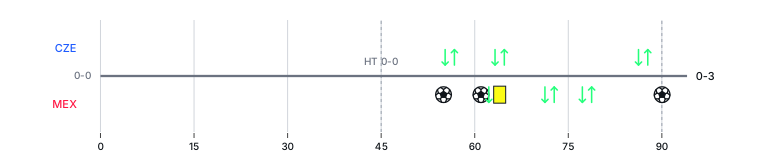
Mateo Chávez spent the afternoon high on the right, and at 55 minutes he arrived in the area to finish left-footed — a shot carrying genuine value, not a poacher's luck. Jorge Sánchez held the opposite flank with even more creative output: an assist, three key passes, two big chances created across 90 minutes. Between them, these two wide players did not merely contribute to Mexico's attack — they constituted the cleanest part of it. Chávez stayed advanced, he stretched what space was available, and a well-constructed chance followed. Sánchez was the most productive creator on the pitch.
Mexico's defenders will note they had only 11 shots and never dominated the ball. Fine. Neither point damages the argument. Wide positioning generated high-quality access, and high-quality access converted at the rate that matters. You do not need 20 shots when two players in advanced wide positions are supplying the right deliveries into the right areas. This was not beautiful football. It was efficient football from a specific structural pattern — which is almost worse, because it will be praised as though it were the same thing.
Czechia Had the Ball and Almost Nothing Else
The flattering version of Czechia's performance is that they controlled 52% of possession and outshopped Mexico 13 to 11. The honest version is that they generated 0.47 expected goals from those 13 attempts, put exactly one shot on target across the entire match, and manufactured zero big chances. That is not a possession side. That is a possession silhouette with nothing inside it.
In the first 15 minutes, Czechia fired four shots and troubled nobody — three misses, nothing testing the keeper, 0.15 in combined value. Lukáš Červ's 46th-minute effort was the lone attempt that forced a save all game. Seven of their 13 shots came from outside the box. Four were blocked. The geometry of their attempts was the problem: Czechia circulated the ball, reached the final third 44 times, and consistently asked questions that were too easy to answer.
This is not a comprehensive indictment of Czech football as a concept. It is a game-specific observation about what their possession produced in this contest: perimeter work that never stressed Mexico's shape from dangerous angles. The ball moved. The threat did not. There is a version of that which gets called patient buildup. In this match, the more accurate word is harmless.
Pushing Forward Cost Them the Second Goal in Six Minutes
Trailing after Chávez's 55th-minute goal, Czechia pushed forward. The consequence arrived at 61 minutes: Jorge Sánchez fed Julián Quiñones on a fast-break, and Quiñones scored from close range on a chance worth 0.76 — the highest-quality opportunity of the match by a considerable margin. Two goals down, game functionally over.
The phase window tells the story in numbers. Between the 61st and 75th minutes, Czechia managed two shots worth 0.04 combined. Mexico had one shot — that one — worth 0.76. The difference between those figures is not a rounding error. It is the precise cost of defensive exposure following a forward commitment that produced nothing.
Quiñones finished with the composure the situation demanded: a right-foot effort delivered crisply inside the area. His numbers across the full match — one goal, 47 touches, four recoveries — suggest a player who was available throughout but needed the right moment. The fast-break gave him that moment, and Czechia's advanced shape gave Mexico the space. The sequence was not a Mexico tactical masterstroke. It was a Czechia structural consequence, which in practical terms amounts to the same thing.
Fidalgo Came Off the Bench and Finished With His First Touch of Consequence
Álvaro Fidalgo entered at 72 minutes with Mexico already two goals up and the contest decided. What he did in 18 minutes was neither irrelevant nor transformative — it was competent in the most precise sense, which in this context was exactly sufficient. Thirteen of his 14 passes found their target. He scored the third goal in stoppage time from a Roberto Alvarado assist, a right-footed finish from inside the area worth around 0.2 — a decent chance, taken cleanly.
The late phase between 76 minutes and full time showed Mexico sustaining meaningful attacking output despite the match being long won: three shots, 0.37 in value, one goal. Czechia managed three shots and 0.05 in the same window. Fidalgo's contribution was not the result of some orchestrated closing strategy. He came on, kept the ball moving, and finished when the opportunity appeared. A provider evaluation placed him second among Mexico's performers on the night — useful texture, but the stat that actually matters is 13 from 14 with a goal in under 20 minutes.
This is what a squad with real depth produces when a match opens up. Not a player who changes the game — the game was already changed — but a player who arrives and does exactly what the moment requires without needing the moment to be smaller than it is. Fidalgo did not make Mexico's result better. He made it complete.
Synthesis
Mexico won this match three ways, and only one of them will appear in the highlights reel. Chávez and Sánchez worked wide advanced positions and produced the cleanest chances of the game — the opening goal at genuine value, the assist for the second, two big chances created from one flank alone. That was the structural core, and it was enough to make the rest almost administrative.
Czechia's possession went nowhere that hurt Mexico: 13 shots, one on target, 0.47 in expected value across 90 minutes. Volume without access is not attacking play. It is statistics arranged to look like attacking play. The ball circulated beautifully and accomplished almost nothing.
The fast-break at 61 minutes converted a competitive match into an embarrassing scoreline. Pushing forward to recover a deficit, Czechia left space behind. Mexico ran into it. Quiñones converted the highest-quality chance of the entire game — 0.76 — and the contest ended there in any meaningful sense. Fidalgo's composed stoppage-time finish was administrative.
What this match actually reveals is simpler and less flattering to both sides than the scoreline implies. Mexico found a structural pattern — width, advanced positioning, transition readiness — that Czechia's ball-moving approach had no answer for once it mattered. Czechia had more of the game and less of what the game required. Mexico won badly enough to make it look routine, which is almost always the most dangerous kind of win: the kind people mistake for quality.