
Sixty-One Percent of Nothing
The comfortable reading of this match is that Germany had the ball and were unlucky. They were not unlucky. They were strangled in the center and left wandering the margins, and calling that bad fortune is the kind of thing people say when they have confused possession with ideas.
Pedro Vite and Moisés Caicedo made central progression genuinely costly for the entire ninety minutes. Vite finished with nine tackles and nine ball recoveries — the sort of numbers that do not accumulate by accident, but by consistently placing yourself between Germany's passers and the spaces that matter. Caicedo added four tackles, six recoveries, and one interception alongside that, keeping constant pressure on whoever tried to receive and turn centrally. Together, they did not simply defend; they made the area through the middle feel smaller than it was, forcing Germany's ball circulation into a loop that never threatened.
The result was damning. Germany completed 592 passes at 87% accuracy and reached the final third 78 times, but generated only 0.65 expected goals across the full ninety minutes — less than half of Ecuador's 1.51 despite playing with a fraction of the possession. That is not a sample-size curiosity. That is a team with the ball and no route to the destination. Ecuador made central buildup costly enough that Germany's numbers never converted into danger, which is the only metric that actually matters.
Raum Was Not a Plan. He Was a Confession.
When you close the center, the other team goes wide. That is defensible. What is less defensible is going wide eleven times from the same player and the same flank without adjusting when it fails, then still calling what you are doing an attacking structure.
David Raum operated persistently down Germany's right channel, finishing the match with eleven crossing attempts. Three of them were accurate. He was stationed deep in that corridor for the entire game — a left back essentially reassigned to supply crosses that Ecuador's defenders were waiting to clear. Ecuador managed twenty-nine clearances across ninety minutes, which tells you how well they read what was coming and how reliable Raum's contribution was as a supply route. Ecuador's center-backs were not caught scrambling; they were positioned.
This is what predictability costs. Raum's crossing volume was not a sign of Germany's width ambition — it was a sign that the middle was blocked and the wide-right corridor had become the path of least resistance, then the path of only resistance. A 3-from-11 crossing return from your most active delivery option is not a wide overload. It is a team running out of answers and running them in the same direction. Ecuador did not need to solve a complicated problem. They needed to hold shape, defend the air, and let Germany keep sending the same message to no reply.
The Substitute Who Ended the Argument
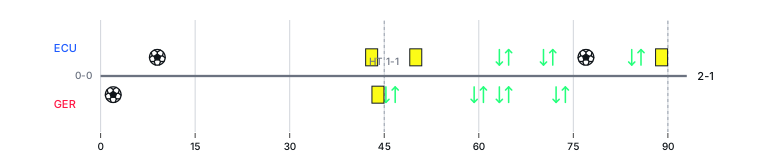
Ecuador brought Kevin Rodríguez on in the sixty-fourth minute, replacing Enner Valencia. Thirteen minutes later, Gonzalo Plata scored the winner and Rodríguez had the assist. That is the sequence — clean, short, decisive.
What makes it worth examining beyond the scoreline is the quality embedded in that thirteen-minute window. Rodríguez entered with Ecuador level at one goal apiece and left his mark on a shot that carried an expected goals value of around 0.83 — a high-quality opportunity, not a scramble from the edge. His expected assist value for those twenty-six minutes was 0.535, created from just fifteen touches and nine passes. That is an efficiency rate that most players do not approach in a full ninety. The position he operated from — advanced, central, close to the box — matched exactly where Ecuador needed a new presence to break the match open.
It would be wrong to say the substitution alone won the match. Ecuador's midfield had been doing the structural work all game. But the winning goal sequence ran directly through the substitute, and without Rodríguez's delivery, Plata's finish does not happen. What the bench gave Ecuador in the final phase is what Germany's starting eleven could not manufacture at all: a moment of genuine attacking invention with the game still alive. Sometimes the difference between intelligent football and expensive football is exactly that — one team knows when to change the problem; the other keeps restating it.
Synthesis
Ecuador did not beat Germany by accident, and they did not beat them through effort and heart and the other things people invoke when they cannot explain football. They beat them through a coherent sequence of structural decisions that Germany never found an answer to.
The midfield screen was the foundation — Vite and Caicedo making central lanes uncomfortable enough to redirect Germany's entire possession structure. The wide-right corridor became Germany's solution by default, and Raum's eleven crosses were less a tactical choice than an admission that everything else was unavailable. Three accurate deliveries from eleven attempts is not pressure — it is repetition without consequence, which is the most boring kind of courage.
Then Ecuador changed the final act. A substitution, a thirteen-minute window, an assist, a goal. Rodríguez did not rescue Ecuador; Ecuador had already done the defensive work. He resolved it.
Germany had 61% of the ball and built nothing worth having. Ecuador had 39% and scored twice from the chances they manufactured. People will say Ecuador were fortunate, or that Germany will sharpen up. Maybe. But the possession numbers in this match were not cruelly misleading — they were accurate. Germany showed you what having the ball without a plan looks like in ninety compressed minutes. Ecuador showed you what having a plan with less ball looks like. The result was not a surprise. It was a verdict.