
The Passing Platform Japan Built
Japan did not produce a spectacular midfield performance. What they produced was a reliable one — and in this match, reliability was responsibility enough. With 52% possession and nearly 85% pass completion across the full ninety minutes, they moved the ball with a composure that gave their attack a genuine base to work from.
The load fell primarily on Ao Tanaka and Daichi Kamada, the two central players who effectively governed Japan's rhythm. Tanaka completed 68 of 76 passes and touched the ball 93 times — numbers that speak to someone who wanted it, not someone who moved sideways to avoid pressure. Kamada's 77 passes and 11 ball recoveries added both volume and defensive literacy. Between them, they gave Japan's structure its spine.
Possession without consequence is only politeness, but that charge cannot fairly be leveled here. The midfield base created a stable enough platform that Japan could afford to be deliberate about where and when they attacked. This was not dominance in any theatrical sense — Sweden were not overrun — but Japan understood the demands of maintaining the ball under pressure, and Tanaka and Kamada met those demands consistently. The question the platform raised was whether Japan could convert its composure into something decisive. On the right side, they found the answer.
Doan to Maeda: A Sequence Worth Understanding
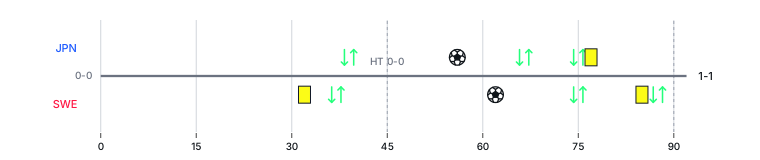
The opener arrived in the 56th minute, and it was neither lucky nor inexplicable. Ritsu Doan, positioned on Japan's right and carrying an expected-assist figure of 0.28 for the match, found Daizen Maeda with the decisive pass. Maeda's average position — consistently advanced and occupying the right channel — placed him exactly where Sweden's defense had to produce an answer.
The finish itself was high quality: a shot worth around 0.6 in chance value, struck with the right foot from close range. Maeda's tally of four clearances and five duels won across the ninety minutes also tells you this was a player who contributed before the ball reached him in that position — he earned his geography. Doan, meanwhile, created the match's one big chance and provided the assist; his 24 accurate passes in 67 minutes gave Japan's right side both the width and the penetration they needed.
What this sequence illustrates is not a rehearsed move but a pattern of occupation. Both Doan and Maeda spent the match in advanced right-channel positions. When the combination clicked in the 56th minute, it did not come from nowhere — it came from Japan repeatedly making the same demand of Sweden's defensive organization until the opening arrived. That is how a structured build-up becomes a goal.
Elanga's Answer Was Sharp, and Also Narrow
Six minutes after Japan scored, Sweden equalized. The goal belonged to Anthony Elanga, and it deserves honest accounting: he took a chance worth barely 0.02 in expected goals and converted it cleanly with his left foot. That is not a fluke in the dismissive sense — finishing a low-probability chance requires composure and technique — but it is also not evidence of a team imposing its will on an opponent.
Elanga's match numbers are worth examining in context. He won six duels, was fouled five times, and completed one dribble from three attempts. He was active, physical, and dangerous in isolated moments. The provider's top rating among Sweden's players — 7.7 — reflects the decisive contribution accurately. But 25 total passes in a full ninety minutes tells you something about how isolated his involvement was from the broader Swedish structure. Sweden's equalizer was not the product of a team building pressure through connected play and arriving at a deserved goal. It was the product of one player doing something precise and difficult with very little.
That distinction matters. Elanga took responsibility in the moment — which is more than can be said for several of his teammates across the ninety minutes — but his goal flattered a Swedish process that had not earned the same standing as Japan's.
Card Pressure, Substitution, and a Narrowed Match
Before Elanga scored, Sweden had already been forced into a significant structural change. Isak Hien picked up a yellow card for a foul in the 32nd minute, and five minutes later he was withdrawn — replaced by Lucas Bergvall. The substitution came too quickly after the card to be read as anything except a direct response to it.
Hien had averaged a deep, central position. Bergvall settled into a more advanced midfield area. The positional contrast between the two players signals a shape alteration whether or not the precise details can be confirmed: a central defender replaced by a midfielder is a structural change regardless of how it was communicated internally. Sweden produced no shots and no expected goals in the five minutes immediately following the change, and only 0.12 xG across the next fifteen — though timing alone cannot establish full causality here.
What it does show is that Sweden spent the remainder of the first half managing a constraint rather than acting on their own terms. A yellow card on a central defender, followed within minutes by his removal, leaves a team governing from necessity. Their structural choices from the 37th minute onward were shaped by the imperative of keeping eleven men on the pitch. That kind of reactive governing rarely produces the same clarity of thought as a match played without that pressure.
Eight Corners and a Narrow Late Threat
Sweden's late pressure was real in the sense that corners and dead balls kept Japan's defense occupied. It was limited in the sense that open-play creation through the second half was thin. Sweden won eight corners across the match and converted that volume into four corner shots worth 0.37 in expected goals combined — more than half of their total chance value from the whole game.
The clearest corner opportunity came in the 79th minute: Victor Lindelöf met a delivery with his head from close range but missed the target. The chance carried close to 0.19 in expected goals — the highest individual shot value among Sweden's late efforts, and a genuine threat. It illustrates what Sweden's late game actually looked like: aerial delivery, set-piece organization, and occasional quality from dead balls. Their shot profile confirms it — four corner shots, two other set-piece attempts, and only five efforts classified as open-play situations across the full ninety minutes.
There is nothing wrong with winning through dead balls. But when corners and free kicks account for more than half your attacking value, you are not controlling the game — you are accessing it periodically from specific conditions. Sweden's late push kept Japan honest. It did not suggest the match's underlying balance had shifted.
Synthesis
A 1-1 scoreline tends to imply equivalence. This match did not produce it.
Japan earned their goal through a repeatable process: a stable passing base governed through the middle by Tanaka and Kamada, and a right-side combination between Doan and Maeda that was patiently constructed until it became decisive. The opener was not accidental — it was what happens when a team understands the demands of the match and meets them with something more than activity.
Sweden's reply, and Sweden's evening as a whole, was built on different materials. Elanga converted a chance that had no business going in by the numbers and kept them in the match through individual quality their collective structure had not earned. The card-forced substitution in the 37th minute narrowed their choices before the second half began. And when the final push came, it arrived primarily through corners — not through the kind of connected open-play pressure that forces a genuine defensive reckoning.
The point Sweden took was not undeserved. Results belong to whoever scores more goals, and they scored as many as Japan. But the responsibility for governing the match sat clearly on one side of the pitch for most of the ninety minutes. Japan ran the game with more thought. Sweden survived it with more fortune.