
The Defenders Who Weren't There When It Mattered
South Korea's two center backs spent the match stationed in South Africa's half. That is not a coaching accusation — it is a description of where possession-forward structures tend to push nominal defenders when the team controls the ball for long stretches. The problem is not where they were during South Korea's attacking phases. It is where they were not when possession was lost.
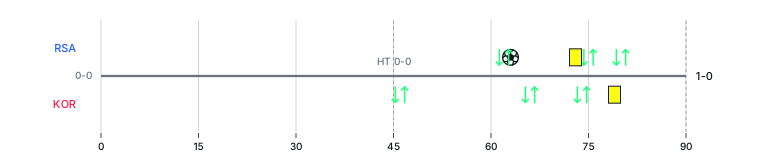
South Africa generated fast-break chances from exactly that vacancy. The most dangerous came in the 30th minute — a left-foot attempt from inside the box that carried genuine quality, well above the threshold for a high-probability chance. It was saved, but the architecture was already visible: South Korea's center backs operating deep in attacking territory, recovery distances too large to cover when the transition flipped. The 63rd-minute fast break that produced the only goal ran through the same corridor, the same structural gap.
The contradiction the match exposed was not recklessness in any individual moment. It was the inherent cost of committing players forward against a side built to absorb and release. South Korea's shape protected their ability to build and circulate. What it conceded was the space behind the defensive line the instant the ball changed hands — which, against a compact counter-oriented opponent, it kept doing. Neither fast-break opportunity was accidental. Both came from the same open channel.
Forty-Two Clearances and What They Actually Mean
South Africa cleared the ball 42 times. South Korea completed 720 passes. Those two numbers sit in deliberate tension: the first describes a team that gave up territory and defended continuously; the second describes a team that held the ball at will and still could not force a decisive advantage from it.
The compact shape South Africa maintained forced South Korea into approaches that generated volume without depth. Kang-in Lee attempted 13 crosses and completed one. That is not poor execution in isolation — it is what happens when a deep defensive block seals the central lane and the only available delivery route becomes wide and aerial. Mbekezeli Mbokazi alone contributed 13 clearances from a deep central position, absorbing ball after ball. Aubrey Modiba held his line wide on the right, remaining in the defensive half throughout, maintaining width in the block and denying the half-space entries that can destabilize this kind of shape.
What South Africa's structure protected was the area in front of goal and the routes into it. What it conceded deliberately was possession and territory — crossing zones, wide channels, corners. South Korea had six corners, eight shots, three on target, and an expected goals total of around 1.0. That is not a complete shutout. It is a team whose possession machinery produced chances at the low end of what the volume would suggest. The block kept the conversion rate down, and one fast break was enough.
One Player Carrying the Weight of a Passing System
Gi-Hyuk Lee finished the match with 119 touches and 106 attempted passes — 91 of them accurate — while operating high on the right side of the attacking half. Those numbers would stand out in any midfield. The buildup flowed through him, which created something coherent and something fragile at the same time.
What it created was a reliable progression route. Lee's volume and positioning gave South Korea a consistent outlet to recycle possession and push the ball into South Africa's half. Against a compact low block ceding territory, having a high-volume distributor who maintains position and keeps things moving has real practical value. The touch total suggests he was the primary circulation hub — the player the team could find when the first line of options was covered.
What it left unresolved was a narrowing of the attack's problem for South Africa's defenders. A team that keeps returning to one channel makes the defensive task more legible. Lee's 11 long-ball attempts produced four successful completions — a ceiling that hints at what happened when South Africa organized around the right-side emphasis. The buildup became a lane rather than a threat. Whether that concentration came from system design or simply where Lee found space naturally is beyond what the match record shows. The pattern was real and consistent, and it ran into a defensive shape that had answers for it.
One Minute, One Assist, One Goal
Tshepang Moremi entered the pitch at the 62nd minute. At the 63rd, he had an assist. The sequence does not require embellishment: a substitution followed within sixty seconds by the decisive fast-break goal, with Moremi providing the final pass to Thapelo Maseko.
Maseko's finish came from a left-foot strike on a fast break — a low-probability chance by any shot-quality measure, and a goal nonetheless. He played 75 minutes, won six of 15 ground duels, drew four fouls, and produced the only shot on target that counted. His goal was the product of South Africa's entire structural approach finding one moment to convert: compact defense absorbing sustained pressure, transition space exploited, the substitute directly involved in the decisive sequence.
Moremi played 28 minutes, completed one dribble, won three duels, and registered that single key pass. His broader influence across the final half hour is not the claim here. The claim is narrower: within sixty seconds of entering, he was the direct creator of the only goal. That is South Africa's counter-attacking structure doing exactly what it was built for — hold shape, absorb, and release at speed the moment the defensive line is caught high. South Korea's advanced defenders, their buildup concentration, their possession commitment — all of it set the conditions. Moremi and Maseko supplied the execution at the one moment that mattered.
Synthesis
The easy reading of this result is upset: South Korea dominated possession, South Africa barely touched the ball, and somehow it ended 1-0 to the team that completed 339 passes. But the result was not chaos finding a winner. It was two structural choices meeting in the same match and one of them resolving first.
South Korea's possession architecture pushed defenders into the attacking half and concentrated buildup through a single player on the right. That created rhythm and circulation but narrowed the progression and left the space behind the defensive line open every time the ball was turned over quickly. South Africa's compact resistance protected the center, conceded territory, and absorbed volume — 42 clearances, a crossing strategy forced on Korea by the very compactness it could not penetrate, an expected goals total of roughly 1.0 from 720 passes.
South Africa generated around 1.1 expected goals from 339 passes. The fast-break efficiency was not an accident — it was the coherent output of a shape that understood its defensive task and converted the one transition that mattered. Moremi's arrival sharpened that transition precisely. The substitution did not invent the mechanism; it accelerated a sequence the whole match had been building toward: Korea's defenders caught high, the gap exposed, one pass and one finish. The match did not create the contradiction South Korea carried. It simply made them pay for it once.