
A Control Profile That Held for 90 Minutes
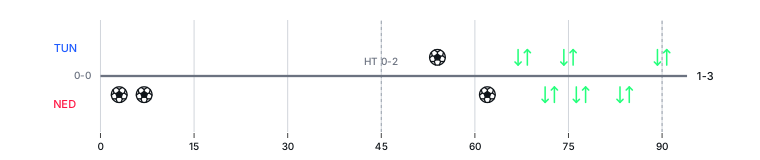
The 3-1 scoreline tells you who won. The underlying numbers tell you how comprehensively. The Netherlands finished with 72% possession, 20 shots, and 1.68 xG; Tunisia managed 28% of the ball, 10 shots, and 0.43 xG. That is not a lead that fluctuates and equalizes — it is a structural gap that held from first whistle to last.
What made it real was the buildup behind it. The Dutch completed 649 passes at over 92% accuracy and found the final third 112 times. That kind of pass volume is not random circulation; it is a team that keeps recycling possession until the right forward picture opens, rather than releasing the ball under pressure and surrendering territory. Tunisia, with 257 passes completed at under 78%, had no comparable engine. Their buildup generated almost no forward momentum, and each Dutch recovery just started the cycle again.
The result profile reinforces the story: the Dutch held the xG advantage, the shot-volume advantage, and converted three times. No signals suggest the scoreline was inflated. The process and the result matched.
Where the Danger Lived: Inside the Box, Every Time
Possession volume is one thing. Where that possession generates shots is what determines whether a goalkeeper and back line can actually manage the pressure. The Netherlands put 16 of their 20 shots from inside the penalty area — an 80% box-shot share that is the Dutch buildup translated into geography.
For Tunisia, that concentration created a specific defensive problem. A block that concedes mainly from distance can lean on the percentages; one that faces attempts repeatedly from inside the box cannot absorb the same volume without giving up goals. The Dutch also generated three corner shots and knocked the woodwork once, adding a set-piece dimension to the open-play threat. Their attack had width, depth, and a consistent end-destination — the zone where goals happen.
The shot profile adds texture: 1.68 xG across 21 attempts, with two big chances generated and one of those missed. That is a team creating high-value looks, not just peppering the keeper from distance. The gap between Dutch and Tunisian xG — 1.68 to 0.43 — reflects exactly that. Volume plus location is a combination a defensive block at 28% possession has almost no answer for across a full 90 minutes.
The Block That Held Shape But Had No Exit
When you're conceding 72% of the ball, you stop building and start absorbing. Tunisia's shape reflected that reality: twelve of their sixteen players averaged positions in their own defensive half, concentrated heavily through the center. The block was deep and compact — keeping the Dutch in front rather than letting them in behind. For long stretches, that discipline held.
The problem with that posture is structural. It does not generate attacks; it manages them. Tunisia managed only 39 passes into the Dutch final third across the entire match. Their transition outlets were narrow and their exits were rare. Which is why the two moments they did find the net or nearly find it are worth pausing on: Hazem Mastouri's 54th-minute header from a corner, a low-xG chance that he attacked and converted, and his late 90th-minute right-foot attempt on a fast break that missed — a roughly 0.01 xG look, a hope shot, not a genuine chance.
Thirty-five clearances versus twelve for the Dutch. That number is the whole story of the defensive burden. A deep block can grind out results, but against buildup that kept regenerating pressure at pace, Tunisia's exit routes stayed narrow all night. The corner goal was exactly what a team in that situation is playing for — one set-piece cue recognized, one chance taken. The rest was survival.
Van Hecke: Distribution, Defense, and End Product in One Line
Jan Paul van Hecke is where the Dutch team profile becomes a person. He completed 129 of 133 passes — a central defender who is not just playing sideways but finding live targets and sustaining the buildup cycle that kept Tunisia pinned. His 145 touches across 90 minutes place him at the center of Dutch possession, not the edge of it.
The 62nd-minute goal came from a corner: Tijjani Reijnders delivered, van Hecke read the delivery, attacked the ball, and headed it home. The xG on that attempt sits around 0.04 — a low-probability header from that position — but reading the delivery early and finishing it is player recognition doing its job. The structure created the cue; van Hecke executed it.
What makes the performance complete is the defensive ledger running alongside it: 5 clearances, 1 blocked shot, 7 ball recoveries, 2 tackles. He was not a distributor who got lucky with a set piece. He was managing defensive pressure at one end and initiating the progression that kept Tunisia in their own half at the other. The provider gave him man of the match — and while a provider rating is evaluation context rather than proof, the underlying numbers support it fully. One key pass, one goal, 129 accurate passes, 7 recoveries, 5 clearances: that is an all-phase performance. When a central defender works that way, he is not just reflecting the structure — he is sustaining it.
Synthesis
These two teams came into the match playing completely different games — and for 90 minutes, those games never really intersected on equal terms. The Netherlands built from deep, circulated possession with precision, and kept arriving inside the penalty area often enough that Tunisia's defensive block simply ran out of answers. Sixteen box shots is what you get when buildup keeps finding the final third 112 times and refuses to release the ball cheaply.
Tunisia played the match you play when the ball is not yours: deep, central, compact, and waiting for the rare moment to bite. For most of the night, the structure held its shape. But a block that can only transition through set pieces and isolated fast breaks has a narrow exit, and the math of 0.43 xG across 90 minutes reflects that ceiling. One corner header went in. One fast-break hope at the death missed. Thirty-five clearances later, the result was 3-1 regardless, because Dutch pressure kept regenerating from closer and closer range.
Van Hecke is the individual thread that ties the Dutch side of it together. The sequence on the 62nd-minute corner — delivery read, ball attacked, finish converted — is a miniature of what the Netherlands did all night: structure creates the cue, player recognition finishes the action. He did that while also playing 129 passes and recovering seven balls defensively. The gap between what the Dutch sustained and what Tunisia could answer was never really in doubt. Van Hecke just made it visible in one person.