
France's Fastest Route Was Also Its Most Honest One
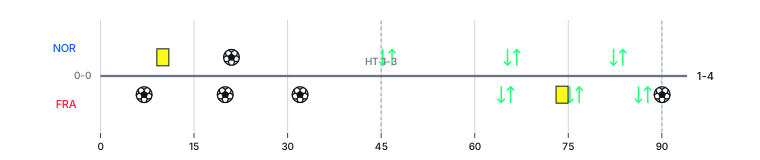
Within twenty seconds of kickoff, Kylian Mbappé was already running at Norway's exposed back line. The chance was saved. It did not matter. What mattered was the pattern it announced: France's clearest path to goal was not through possession or patient buildup but through the vertical space Norway left when the ball turned over. Three fast-break shots in the opening twenty minutes, generated from Norwegian turnovers and France's willingness to commit men forward at pace, made Norway's rest defense answer questions it was not fully prepared to answer.
Mbappé tested the goalkeeper again from a fast-break position at the seventeen-minute mark, a chance worth more than the first. Norway survived that one too. But the third fast-break attempt, Ousmane Dembélé arriving at twenty minutes, did not end with a save. France had found the lane, used it repeatedly, and eventually collected the goal it had been pressing toward. One goal from three fast-break opportunities with a combined chance value around 0.27 — that conversion rate sounds modest, but it understates the pressure those sequences placed on Norway's shape each time France turned defense into attack.
None of this proves France arrived with a premeditated counter-attacking scheme. Fast-break tags describe the moment of transition, not the team's philosophical intention. What they do confirm is that France accepted the demands of the open game — committed runners, direct progression, willingness to play before the opposition reset — and Norway did not defend those moments reliably enough. The lane was open when it needed to be closed. France noticed. That is responsibility taken at the right moment.
Norway Had the Chances. They Did Not Have the Finisher.
Here is what the scoreline does not tell you: Norway generated more expected goals than France. Their 1.69 against France's 1.31 reflects a team that found high-probability scoring positions — six shots inside the box, four big chances — and then declined to convert any of it into the goals the underlying quality demanded. Three of those four big chances were missed. The fourth was saved.
The saved penalty at fifty minutes is the detail that concentrates everything. Jørgen Strand Larsen stepped up with Norway still in the match, carrying a personal expected goals tally across his afternoon of over one expected goal — the sort of number that belongs to a striker who has genuinely threatened the frame. The goalkeeper saved it. Strand Larsen finished the match with two big chances missed, one shot on target, and a rating that fairly reflected the gap between his situation-quality and his output. That is not a mentality verdict; it is a finishing one. The conversion rate on Norway's chances was ten percent. France's was over twenty-two percent from a smaller shot volume.
Possession without consequence is only politeness, and Norway were polite in the worst possible moments. Their forty-three percent possession and eighty-two percent pass accuracy produced enough final-third access to give any neutral observer the impression of a competitive side. The result profile confirms they were one — more shots, better accumulated chance value, a goalkeeper who had to make five saves. What it also confirms is that the scoreline gap exceeded the underlying process gap by a distance. Norway's problem was not ideas. It was the inability, at four separate big-chance moments, to attach thought to execution.
Three Goals, Three Shots on Target, Sixty-Five Minutes: Dembélé Made the Margin Look Simple
Ousmane Dembélé's cumulative expected goals for the afternoon came to 0.29. He scored three. That arithmetic should be stated plainly and without decoration, because it describes the single largest difference between what the match's underlying data suggested and what the scoreboard recorded. France's four-goal total against 1.31 expected goals was not a team-wide act of overperformance. It was, in substantial part, the work of one forward converting chances that the probability model assessed as decidedly uncomfortable.
In sixty-five minutes, Dembélé took three shots. All three were on target. All three became goals. He contributed two key passes alongside that, completed five of seven long balls, and left the pitch having touched the ball fifty-one times with a rating the provider placed at the maximum available score. That last figure is an evaluation signal, not an objective truth about his authority over the entire match — but paired with the statistical line, it does not need defending. Three goals from three on-target efforts in sixty-five minutes is a performance that earns its superlatives without borrowing any.
What Dembélé did to the match state was simple and severe: he removed Norway's ability to compete through gradual accumulation. Every goal he scored widened the gap that Norway's genuine chance quality needed to close. By the time Norway had accumulated the xG to deserve a level match, they were already chasing a scoreline that their conversion failures had made unreachable. That is not luck dressed up as finishing. That is the decisive edge in a game where one side took its chances and the other did not.
Synthesis
The honest reading of this match requires holding two things at once, because the scoreline flatters one and buries the other. France won 4-1 on an expected goals margin of 0.38 — barely wider than the gap between a single good chance and a mediocre one. Norway had more shots, better accumulated chance value, and a striker who was in the right positions all afternoon. The result says France were dominant. The process says the match was closer than that.
But closer does not mean even, and the two threads that ran through this game explain exactly where it was decided. France created danger in transition — not constantly, not through overwhelming territorial control, but precisely when Norway's defensive shape was disorganized enough to be punished. They converted one of three fast-break chances directly and used the pressure of the other two to keep Norway's defensive attention divided. Norway, meanwhile, accumulated chance quality without the finishing to use it. Four big chances, three missed, one saved penalty. A conversion rate of ten percent when the situations demanded more.
Dembélé connects both threads. His three goals from 0.29 expected goals widened the scoreline beyond what Norway's own failures could explain on their own. He was the multiplier — the reason France's efficiency story became a four-goal story rather than a two-goal one. Take him away and Norway's missed chances become a near-miss rather than a wasted afternoon. Add him back and the 4-1 resolves into something that is simultaneously improbable and entirely earned. France turned their best moments into goals. Norway turned their best moments into statistics. The match was decided in that difference, not in the overall balance of play.