
Australia Set the First-Layer Terms
Possession edges in international friendlies are easy to wave away. This one had structural content. Australia finished with 56% of the ball and 536 passes to Paraguay's 427 — not a marginal gap, but a difference that held across the full ninety minutes and shaped what both teams were doing with and without the ball.
The numbers aren't the mechanism; they're the output of one. Australia kept the ball in ways that made Paraguay track and recover rather than build. Paraguay's 24 clearances against Australia's 10 is one visible cost: a side that spends significant time defending deep tends to clear a lot. Their pass accuracy sat at 77%, below Australia's 82% — not because they can't pass, but because winning the ball under pressure and immediately recycling it is harder than controlling from the front.
What possession at this level does not guarantee is penetration. Australia's 12 shots carried around 0.6 expected goals — low per-shot quality, spread across inside and outside the box. Paraguay, with fewer shots and only 0.25 xG total, were not creating high-value chances either. What Australia held was the first layer: ball time, passing volume, territory. What neither team solved was the layer underneath it — how to actually break the defensive line.
Souttar and Circati Carried the Weight
The possession edge had a specific address: Australia's center-backs. Harry Souttar and Alessandro Circati together logged 196 touches and 159 completed passes across the ninety minutes. For context, that is a full midfield's worth of ball involvement distributed through the back two. That load tells you something about where Australia's buildup actually lived.
Souttar operated centrally and played the higher-volume passing role — 94 passes total, 86 accurate — functioning less as a defensive anchor and more as the first pivot in Australia's circulation. Circati contributed 73 passes and showed the wider carry tendency, positioning himself on the left side of the buildup where he could push the structure forward. Neither center-back was content to simply receive and recycle square; their involvement went upfield.
The consequence for Paraguay was that pressing high became costly. If you can't win the ball before the Australian center-backs have combined twenty-plus times, you are conceding ground and chasing the game. Paraguay's response was to sit and absorb rather than press aggressively — which preserved their shape but handed Australia the first-layer control described above. The center-back involvement didn't produce many box entries directly. But it maintained the conditions that forced Paraguay to defend, which kept Australia's transition risk low and their attack organized, even when the final product was missing.
Bos Found the Lane, Not the Finish
When Australia needed to move the ball forward and create something that looked like danger, the left side was where they looked. Jordan Bos logged 88 touches and won 16 duels — more duel activity than any reading of a peripheral winger would suggest. He was a live threat, constantly in contact, repeatedly the player Australia went to when they wanted to test Paraguay's right-sided shape.
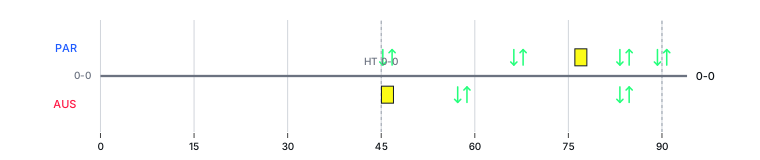
The three key passes tell the sharper story. Bos wasn't just receiving and recycling; he was finding pass angles that created shots and forward moments for teammates. He attempted seven dribbles and completed four, which means he was regularly trying to beat defenders rather than playing the ball back to safety. Two shots on target — at the 36th minute and the 83rd — plus a final-minute miss in stoppage time made him Australia's most persistent individual attacking presence.
The limitation is real but telling: none of those shots were high-probability chances. The 36-minute effort, the 83-minute attempt, the 90th-minute miss — all were low-to-mid expected-goals range, saved or wayward. What the left lane gave Australia was volume and pressure. What it didn't give them was a clean line to goal. Paraguay packed the defensive box effectively enough that Bos's angles stayed uncomfortable rather than dangerous. He was the release valve. He was not the solution. That gap — between finding the outlet and converting the opportunity — is exactly what made the scoreline logical.
Paraguay Found a Different Route at Halftime
At the break, Paraguay made one change: Maidana off, Mauricio on. What followed was a different competitive texture. In the fifteen minutes after the substitution, Paraguay registered three shots — more than they had managed cleanly in many stretches of the first half. Mauricio was directly involved in two of them, both on target.
The 50th-minute shot came from a fast-break situation — Paraguay running at Australia's structure rather than trying to build through it. That is a meaningful change in method. Australia's center-back-heavy buildup created exposure at the back when transition happened quickly; Paraguay's route in the second half looked to exploit exactly that space. The stoppage-time shot — Mauricio again, assisted, on target at the death — showed the same pattern persisting to the final whistle.
It would be overreading the evidence to treat the substitution as a coaching masterstroke or suggest Mauricio alone reshaped the game. Paraguay's overall xG for the match remained modest at 0.25, and their total of seven shots doesn't describe a side that cracked Australia open. What the substitution window shows is that Paraguay's competitive approach shifted: less absorption, more direct. Mauricio became the outlet through which that directness expressed itself. The scoreline survived — Australia's defensive shape held — but Paraguay had found a lane. That the match ended goalless despite both threats says something about the defensive competence on display, and about how evenly matched the two teams' failure to finish actually was.
Synthesis
The easy reading of a 0-0 is that nothing happened. The more useful reading is that two distinct competitive approaches ran into each other and neither could finish.
Australia's control was real — built through their center-backs, channeled through the left side, sustained across ninety minutes. The problem was the final conversion: possession that didn't generate high-quality chances, a left-lane outlet that found pressure resistance rather than space, and a defensive opponent that survived by ceding territory while protecting the goal. That is a coherent system with a coherent ceiling.
Paraguay's response after halftime was not a retreat or a collapse — it was an adjustment. A more direct outlet, a player who could carry the transition threat, a period of genuine pressure on Australia's shape. The fact that those shots were saved or missed doesn't diminish the logic of the approach. It just means Paraguay's execution ran into the same finishing problem Australia did.
What this match actually describes is two teams whose defensive organization outran their attacking invention. The structural tension — Australia's buildup dominance against Paraguay's transition counter — stayed unresolved until the whistle. That is not a failure of drama. It is the match's honest result.