
The Shape Iraq Couldn't Escape
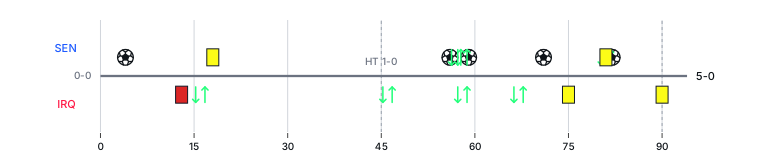
The game changed shape before most tactical adjustments even register. At 13 minutes, Rebin Sulaka received a red card for a professional foul — last man, no debate — and the structural problem that followed set the terms for everything after it.
What made the consequence lasting wasn't the numerical deficit in isolation. Three minutes later, Iraq made the first of their compelled adjustments: a substitute came on and a defender came off. Down to ten men, they removed defensive cover to reshape — a move that reads less like a plan and more like a scramble to redistribute the burden across an already thinned block. The structure that remained had to absorb Senegal's pressure without the midfield cover to filter it. That gap only widened as the match wore on.
Iraq's team numbers confirm how little attacking presence they managed from that point forward. Six shots total, just one on target, five launched from outside the box — distance substituting for access. Thirty-five clearances across 90 minutes tell the real shape of the afternoon: a defensive line constantly recycling pressure rather than dissipating it. The constraint created at the 13th minute didn't simply tilt the match. It built the conditions that made everything Senegal converted in the second half structurally available from much earlier.
Camara's Fifty-Seven Minutes
Before Senegal cashed in on that structural advantage, someone had to keep the creative pressure coherent — for 57 minutes, against a ten-man defensive block with nothing to do but sit deep and absorb. That role fell to Lamine Camara.
The numbers are direct: five key passes, one assist, 45 passes attempted with 36 completed, one big chance created — all before he came off. Camara wasn't simply keeping the ball moving; he was the release valve each time Senegal needed a line-breaking option against a compressed shape. Seven ball recoveries add a second layer to the picture. This wasn't a pure creator sheltering from defensive responsibility — it was a player carrying the creative burden while still doing the unglamorous work underneath it, functioning simultaneously as engine and outlet.
The structural context sharpens what those numbers mean. A 10-man Iraq sat deep by necessity, which meant Senegal's creative options required threading through a packed block rather than exploiting open ground. Five key passes in that environment isn't routine midfield circulation; it's someone consistently finding the angles a compressed defensive shape is designed to deny. When Camara came off at the 57th minute, Senegal didn't lose their creative capacity — but the architecture of it changed, which is precisely what the second act required. His exit was both a recognition of what he'd already built and a signal that the match was entering a different phase entirely.
Three Changes, Three Goals, Twenty-Five Minutes
Three substitutions at the same minute is unusual enough to register, and the timing mattered immediately. At the 57th minute, Senegal made a triple change — three players off, three on — and within two minutes the scoreboard moved again.
Pape Gueye scored at 59 minutes, assisted by Ismaïla Sarr, to make it 3-0. Gueye added a second at 71 minutes, this time from an Iliman Ndiaye assist, for 4-0. Ndiaye completed the sequence at 82 minutes — scoring from a Gueye lay-off — to close out 5-0. Three goals in 25 minutes, each involving the players who came on or had just come on moments before the changes. The scoreline went from two goals to five inside the final third of the match.
The post-substitution output window confirms the pattern in concentrated form: one goal in the first five minutes after the change, two within fifteen. An Iraq defensive block that had already made 35 clearances across the whole match — and had been operating a man short since the 13th minute — was being asked to absorb fresh energy and new combinations simultaneously. The timing cannot prove these goals were caused by the substitutions in any clean mechanical sense. What it shows clearly is that the structural conditions were fully in place when the fresh personnel arrived: a numerically depleted, clearance-heavy defensive unit meeting a burst of new angles all at once. That combination produced an immediate, concentrated scoring cluster — not a gradual accumulation, but a rush.
Synthesis
A 5-0 result invites simple explanations. The red card. The bench. The squad disparity. Each of those is part of the story, but none tells it on its own — and more importantly, treating them as separate events misses what made this match's shape coherent.
Sulaka's 13th-minute dismissal didn't just reduce Iraq to ten men; it forced a defensive reshuffle three minutes later that stripped structural cover from a block already facing Senegal at full strength. Iraq spent the next 77 minutes managing a burden that compounded with each phase — 35 clearances is not organisation, it is attrition. The space for a creator like Camara to generate five key passes and an assist against that block wasn't luck; it was the direct consequence of Iraq's structural thinning arriving early and staying in place.
The 57th-minute triple change then worked with that accumulated condition rather than needing to create it. Senegal's bench didn't manufacture a vulnerability — they inherited one. What the incoming players provided was fresh decision-making against a defensive unit that had been absorbing pressure without relief for over an hour. Three goals in 25 minutes is what happens when a concentrated personnel shift meets a structurally exhausted opponent: not a coaching masterstroke, but a conversion of advantage that had been accumulating since the opening quarter-hour. The match was constructed from the 13th minute onward. The bench simply closed the building.