
Berhalter Was the USA's Whole Right Side
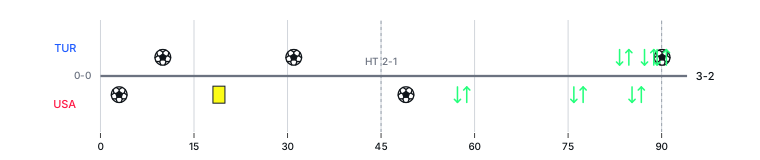
Sebastian Berhalter did not just play well — he was the mechanism the USA ran their attack through. Eight crosses, five key passes, two big chances created, a goal, and an assist across ninety minutes. That is not a winger having a good night; that is a team routing its final-third access through one player's delivery.
The goal itself showed the shape. Berhalter's assist put Auston Trusty on the ball in the third minute, and Trusty converted — the USA up inside three minutes, the game immediately tilted by a wide supply line that kept working even after the lead changed. Berhalter stayed involved through both halves, drawing fouls, completing crosses at 50 percent, and creating openings that the rest of the team had to finish.
Where it gets interesting is the limitation baked into that model. Berhalter carrying five key passes in one game is a signal of real involvement, but it also tells you the USA were leaning on that channel heavily. The crosses came, the corners came, and the question became whether volume would become goals — or whether one thread was enough to hold a lead against a side that still had changes to make.
Nine Corners, One Goal, and a Gap That Stayed Open
The corners kept coming because the delivery kept forcing them. Nine in total, six of which generated shots. That is a real pattern — the USA were not just winning set pieces; they were converting corner situations into actual attempts on goal with enough regularity that Türkiye had to keep defending them.
The first payoff arrived inside three minutes when Trusty turned a corner situation into the opening goal, a left-foot finish from close range. But the pattern after that was mixed. Trusty got his head on another corner just before half-time — a decent chance, xG around 0.12 — and missed wide. McKennie met one in the 66th minute and sent it off target. The six corner shots together were worth roughly 0.44 in expected goals. That is not a dominant set-piece threat, but it is not noise either; it is persistent pressure that forced Türkiye to stay organized at the back well into the second half.
The problem the USA could not solve was conversion, not volume. The cue was there — the corner, the delivery, the runner — but the recognition at the end of the sequence kept breaking down. A header off-target, a ball that did not sit right. You can generate the structure all you want. The player still has to execute when the chance arrives. By the time Türkiye made their late move, the USA had squeezed nine corners out of the game and had one goal to show for all of it.
Two Minutes on the Pitch, One Shot That Settled It
Kaan Ayhan came on in the 88th minute. Two minutes of regulation left, score level at 2-2, and Türkiye introduce a player who — inside five minutes of his appearance — puts the ball in the net to win the match 3-2 in the eighth minute of stoppage time.
The shot itself was not a scramble. Ayhan's finish carried an xG of 0.94 — a right-foot strike from inside the six-yard area that was almost certain to go in the moment it was struck. Türkiye produced two shots and over a goal's worth of expected goals in that five-minute window after the substitution. Whether that sequence was designed or whether Ayhan simply arrived at the right moment with the right body position is not something the record can tell you. What it can tell you is that the window between the substitution and the winner was brief, the chance was high-quality, and Ayhan was directly involved in both the shot and the goal.
This is the sequence the whole match compressed into: a team spent ninety minutes building pressure from wide areas, generated corners, created chances, and held leads that kept slipping away. The other side waited, made one change in the dying minutes, and the substitute scored with the first opportunity that really mattered. The cue was the late introduction. The execution was a finish that left no room for doubt.
Synthesis
Two threads ran through this match, and neither one cancels the other out.
The USA built something real. Berhalter's output — the assist in minute three, the five key passes, the eight crosses, nine corners generated — was a genuine supply line into the final third. The corner cluster alone produced six shots and one goal; the structure was there, the delivery was there, and the pressure was sustained across ninety minutes. That is not a lucky team. That is a team that found a working channel and kept using it.
But Türkiye's answer did not need ninety minutes. It needed one substitution and one clear look at goal. Ayhan's finish in the eighth minute of stoppage time — 0.94 xG, right foot, inside the area — was the kind of chance that does not miss. The post-substitution window lasted barely five minutes and produced more expected goals than the USA's entire corner sequence. That asymmetry is the match.
The scoreline reads 3-2 to Türkiye and that is accurate, but it hides the dynamic underneath: a team that built pressure consistently and a team that resolved the match in a single late sequence. The USA's model required corners to keep converting; it required the defensive line to hold while chasing goals. When both conditions failed at once in stoppage time, there was nothing left to absorb the blow. Berhalter's supply line was real. Ayhan's recognition was faster.