
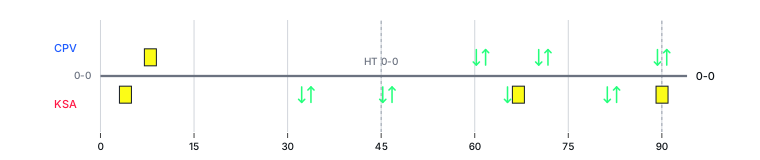
A 0-0 That Tells You Almost Nothing Useful
A 0-0 result describes the score. It does not describe the contest. Cabo Verde produced 16 shots to Saudi Arabia's seven, with an expected-goals margin of more than a full goal in the home side's favor — over 1.1 in their advantage by the final whistle. That gap is not statistical noise. It is the clearest measure of which team accepted the burden of building genuine threat and which team spent the evening trying to prevent it.
The home side held 51 percent of the ball, completed 85 percent of their passes, and reached the final third 60 times. Saudi Arabia, across their seven attempts, accumulated 0.4 in expected goals. The visiting side had less of everything that produces chances — and the result they needed. That is not an accident, and it is not a verdict against the quality of Cabo Verde's work. It is, instead, the shape of a specific match: one team governing the ball and the attack, another governing the space in front of their goal.
The 0-0 flattered Saudi Arabia. A side that concedes a margin of 1.1 in expected goals in a single fixture has survived rather than competed as an equal. Cabo Verde's own conversion failures contributed to the blank board — eight outright misses across 16 attempts is a real statistic — but the process advantage was clear enough that calling this a balanced match would be wrong.
After Halftime, the Weight Shifted and Did Not Return
Cabo Verde's first half offered little to suggest what was building. Their expected-goals total across the opening 45 minutes sat below 0.2 — enough to hold possession, enough to probe, but not enough to threaten seriously. Saudi Arabia defended a quiet first period without being tested in any way that mattered.
What changed after the break was cumulative and then sudden. Between the 46th and 60th minutes, Cabo Verde produced four shots worth 0.28 in expected goals. Useful pressure, but still manageable for a disciplined defensive shape. Then the 61-to-75 window: two shots, 0.77 in combined expected goals. That is more dangerous output from two attempts than the entire first half had generated. The match's center of gravity had moved, and it did not move back.
The final phase — 76 to 90 — added five more shots worth 0.34, sustaining the late siege without matching that concentrated peak. But the second half as a whole produced roughly 1.4 in expected goals against less than 0.2 before the break. A team under that kind of accumulating pressure, across 45 minutes of progressive threat, should eventually concede. Saudi Arabia, to their credit, did not. That refusal is one half of the story. The other half is that Cabo Verde's second-half process, judged honestly, deserved more than a point.
Duarte Entered and Found the Match's Sharpest Moment
Laros Duarte came on at 71 minutes and in four minutes made the clearest individual case for what Cabo Verde had been building. His fast-break attempt at 75 minutes was the match's single most dangerous shot, carrying 0.63 in expected goals. It found the goalkeeper. The board did not change.
In 19 minutes on the pitch, Duarte completed seven of eight passes, registered three key passes, completed his one dribble, and produced that shot on target. Those numbers, concentrated in less than a third of a match, established him as the most direct individual contributor from the bench — not by reputation but by output. The fast-break situation itself was significant: Saudi Arabia's compact shape had restricted central access throughout the evening, but a quick transition gave Duarte the space and the angle that the earlier, more patient buildup had not found. That is what a properly directed substitution can do — not change the shape of the game but find the seam the shape had been hiding.
A 0.63 chance is not a formality. It is close to one. That Cabo Verde could not convert their best opening — their clearest separation from the defensive wall in front of them — captures the particular frustration this result leaves behind. The save was good. The chance was better. The point stands alone.
Saudi Arabia Made the Central Lane Expensive
Saudi Arabia did not need to threaten much offensively because their defensive work set the terms for everything else. Five of Cabo Verde's 16 shots were blocked before they could test the goalkeeper — not saved, blocked at the point of release. Add eight outright misses, and the pattern takes shape: the home side found room to attempt 16 shots but regularly arrived at the moment of decision with the central lanes narrowed and bodies in the way.
Abdulelah Al-Amri was the standout individual in that structure. He completed 44 of 52 passes, won five ball recoveries, and contributed clearances and blocks across 90 minutes. The provider's highest-rated performer for Saudi Arabia, at 7.8, Al-Amri's work was distinguished less by drama than by spatial understanding — he knew where the next danger would appear before it arrived, which is the only kind of defending worth praising. Ali Lajami, entering as a substitute and playing 57 minutes, added five clearances and two blocked shots, absorbing a portion of the late second-half surge without disruption.
Saudi Arabia also won 29 tackles and made 10 interceptions across the match. The collective effect was a defensive shape that gave Cabo Verde volume without value — the Duarte fast-break was the one moment the structure could not account for, and even that was saved. A side that blocks five shots and wins 29 tackles has done its job. Saudi Arabia did its job.
Synthesis
The 0-0 was an honest result only in the most technical sense. A draw requires parity; this match did not produce parity in any meaningful attacking measure. Cabo Verde built the better case — more shots, better shots, a second half that accumulated roughly 1.4 in expected goals while Saudi Arabia managed under 0.3 across the same period. That is not a marginal edge. That is a clear statement about who accepted the responsibility of attacking and who declined it.
What Saudi Arabia brought was discipline without ambition, and that is not a small thing. A visiting side that defends with collective understanding and keeps the match blank against a team generating 1.5 in expected goals has done something difficult and real. Al-Amri's composure over 90 minutes and the blocked shots that kept Cabo Verde at arm's length represent genuine competitive work — the kind of unglamorous output that earns results rather than headlines.
The gap between what Cabo Verde produced and what they converted is a question of finishing, of structure, and of one Saudi goalkeeper performing when it counted. The late chance Duarte put directly at the keeper was the match in miniature: real quality, real threat, and ultimately not enough to break what Saudi Arabia had constructed. Cabo Verde understood the demands of the game more completely, governed the ball, and built the better second half. They leave with the same point as the side that spent 90 minutes refusing to let them score. That is the particular cruelty of a result that tells you almost nothing about the football.