
Colombia Created the Problem Without Solving It
Twenty-four shots, 1.6 xG, fifteen attempts from inside the box — and nothing on the board. The problem Colombia had against Portugal was not one of access. They found their way into shooting positions often enough. The problem was what they did when they got there.
Both of Colombia's recorded big chances went unconverted. The broader shot profile tells a similar story: xG per attempt sat at roughly 0.07, which means most of the volume arrived in low-probability positions rather than from genuine openings close to goal. Seventeen of the 24 shots came from assisted moves, suggesting the delivery into those positions was functioning — but the quality of each individual chance was limited, and Colombia's finishers could not make up the difference.
Seven shots were blocked before Diogo Costa even had to act. That detail matters. It says something about how clearly Portugal's defenders read the attack's patterns — the threat was visible early enough to be cut off. Fifty-five percent possession and 53 passes into the final third gave Colombia territorial dominance, but territorial dominance is not the same as authority. A team that generates volume without converting its best chances, and whose cleanest opportunities get blocked or missed without so much as testing the goalkeeper, has created the appearance of control rather than the substance of it. Portugal absorbed that appearance for 90 minutes and left with a point.
Portugal's Defensive Labor Carried the Result
A defense that finishes a match with 22 clearances, 11 interceptions, and seven blocked shots has not had a quiet evening. Portugal spent most of this game doing the unglamorous work of staying between Colombia and the goal, and the numbers show how consistently that work was demanded of them.
Renato Veiga and Rúben Dias each contributed seven clearances. Veiga added four blocked shots — the highest individual block count in the match — and three interceptions. Dias won three of four aerial duels and made two interceptions of his own. Neither player's contribution reads like scrambling. That volume of clearances and blocks, distributed and repeated across 90 minutes, reflects a defensive unit that recognized threats early and dealt with them on its own terms rather than reacting in panic after being beaten.
Diogo Costa's role was more direct. Six saves across the match, two of them from inside the box, meant that when Colombia's sequences did cut through Portugal's structure and find angles on goal, Costa was responsible for the final line. The saves from inside the box are the ones that deserve attention — those are chances where Colombia had already solved the first defensive problem and were asking a harder question. Costa answered it both times. Portugal did not concede 24 shots by accident or by defensive failure. They conceded them because Colombia kept arriving, and Portugal kept meeting them with someone who accepted responsibility for the problem.
James Rodríguez Governed the Ball
The central question with James Rodríguez is always whether he does the one thing most of his teammates cannot: take the ball in central positions under pressure, play the pass that requires judgment rather than just execution, and elevate Colombia's attack above what its collective quality would otherwise produce. Against Portugal, in 76 minutes, he did that consistently — even if the match ended scoreless.
Seventy-two passes, 65 accurate. Five key passes. An expected-assists figure of 0.57 — the highest of any player on the pitch. He recorded 85 touches, more than any Colombia outfield player in the time he was on, and his average position placed him centrally and slightly advanced: not a deep organizer distributing from distance, but a player operating in the zones where the real passes are either made or refused. James made them. He completed both of his dribble attempts and recovered three balls defensively, which corrects the impression that his workload was purely creative and passive.
His influence across creator, distributor, and ball-carrier roles was not a function of standing still and receiving simple balls. He was the route through which Colombia's most purposeful attacking sequences ran. The honest limitation is this: five key passes produced no assists, and the shots those passes generated were not converted. That is not a verdict on his performance — it is a verdict on the match. He supplied the authority. Colombia did not finish the argument.
The Minute-60 Changes Sharpened What Colombia Already Wanted to Do
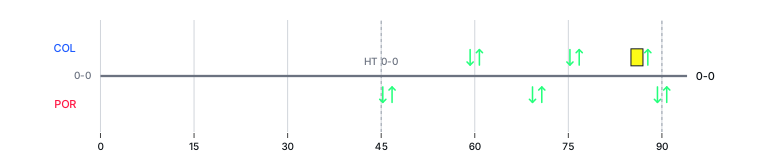
At the hour mark, Colombia brought on Richard Ríos for Jefferson Lerma and Luis Javier Suárez for Jhon Córdoba. What followed was the most concentrated attacking spell of the afternoon: seven shots worth 0.46 xG between the 61st and 75th minutes. Portugal, in that same fifteen-minute window, produced zero attempts.
Three of those seven shots arrived within five minutes of the substitutions. The incoming players were directly involved in five shots across the full post-change window. The record does not tell us whether the changes caused the surge or arrived at the moment Colombia's pressure was already building toward something — the timing is a coincidence the evidence can observe but not adjudicate. What is clear is that nothing comparable had appeared in the preceding second-half phase, when Colombia's attack had been relatively quiet.
The spell did not change the score. Seven shots at 0.46 xG without conversion meant Portugal's defensive line held through its most difficult sustained test of the second half. But the window itself matters as a description of what Colombia's attack looked like when it arrived in its sharpest form: compressed, direct, and consistently directed at goal. The fact that it lasted only fifteen minutes before the match leveled off again is perhaps the most precise summary of Colombia's day — the capacity was real, the finishing was not.
Synthesis
This 0-0 was not a match without a story. It had a clear shape: one team generated the volume and the creative route, the other found enough bodies and enough concentration to ensure that volume never became a goal.
Colombia's problem was not that they failed to reach Portugal's third. They arrived there 24 times. Their problem was that the individual quality of each chance stayed low, both of their best opportunities went unmissed, and seven shots were blocked before Costa needed to intervene. James Rodríguez supplied what Colombia needed in the midfield — the central presence that organized buildup, freed wider threats, and created the five key-pass opportunities that should, in other circumstances, have led somewhere. He was not the reason the match ended goalless. He was the reason Colombia kept constructing the question.
Portugal's answer was physical and consistent. Veiga and Dias combined for 14 clearances and five blocked shots between them. Costa made six saves. Twenty-two clearances as a team total is not a sign of a defense under siege through poor organization — it is a sign of a defense that understood where the next danger would appear and sent someone to meet it before it became worse. Portugal absorbed the afternoon with discipline rather than luck.
The substitution surge after the hour showed that Colombia still had something left — a sharper, more direct attacking spell than anything they had managed in the previous thirty minutes. That it produced seven shots and no goals says less about what changed after minute 60 than it does about the match as a whole. Colombia kept arriving. Portugal kept answering. On the day, answering was enough.